
India has highlighted 13 key outcomes from the recent Shanghai Cooperation Organisation (SCO) summit, focusing on enhanced cooperation in security, counter-terrorism, and addressing transnational threats. These outcomes include the establishment of a Universal Centre for Countering Challenges and Threats to Security, a strong stance against state-sponsored terrorism, and agreements on narcotics control, climate change, and artificial intelligence, reinforcing India's engagement in the Eurasian region.

Prime Minister Narendra Modi, addressing the SCO summit in Bishkek, called for a united front against terrorism and its financing, rejecting double standards. He emphasised resolving conflicts through dialogue and diplomacy, not battlefields. Modi also highlighted that connectivity projects must respect national sovereignty and territorial integrity, a veiled reference to China's Belt and Road Initiative. India's vision for SCO rests on security, connectivity, and opportunity.

National Security Advisor Ajit Doval on Wednesday said that the Shanghai Cooperation Organisation members should respect the sovereignty and territorial integrity and seek no unilateral military superiority in adjacent areas.
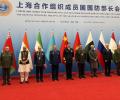
In his address, Singh said there should be "no double standards" in combating terrorism and urged the SCO member nations to condemn the menace with unity.
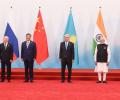
The Shanghai Cooperation Organisation (SCO) strongly condemned the Pahalgam terror attack and concurred with India's position that 'double standards' in the fight against terrorism are unacceptable.

Prime Minister Narendra Modi on Monday presented India's strong stance against terrorism, calling out the 'some countries' for their open support of terrorism and reaffirming that such 'double standards' are not acceptable.
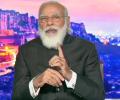
The remarks by Modi at a virtual SCO summit came in the backdrop of the Sino-India border row.

The declaration said the SCO leaders reaffirmed their commitment to peaceful settlement of disagreements and disputes between countries through dialogue and consultations.

In his address, the PM also hit out at those making repeated attempts to "unnecessarily" bring bilateral issues to the SCO in violation of the grouping's foundational principles, in an oblique reference to Pakistan.

Government sources said the Pakistani action was "blatant violation" of the SCO charter and against all its established norms of safeguarding the sovereignty and territorial integrity of SCO member states.

At least 3,000 soldiers from China, Russia, Kazakhstan, Tajikistan, Kyrgyzstan, India and Pakistan participated in the drill.

Earlier in the day, the ministry of external affairs "strongly advised" Indians to avoid travel to Iran until further notice, amid rising tensions and protests in the Islamic Republic.
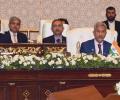
Delivering a thinly veiled message to Pakistan from its soil, External Affairs Minister S Jaishankar on Wednesday said activities across borders characterised by the 'three evils' of terrorism, extremism and separatism are unlikely to encourage trade, energy flows and connectivity.

Pakistan foreign minister Bilawal Bhutto Zardari arrived in Goa on Thursday to attend a conclave of the Shanghai Cooperation Organisation (SCO), in the first such high-level visit to India from the neighbouring country since 2011.

Prime Minister Narendra Modi condemned the violation of Qatar's sovereignty following Israeli air strikes on Doha, targeting Hamas leaders. He conveyed India's deep concern to the Emir of Qatar and reiterated support for peace and stability in the region.

Except for Pakistan, the defence ministers of all other member countries attended the meeting in person. It is learnt that the Pakistani representative joined the deliberations virtually.

'Lingering border disputes and fierce geostrategic competition in South Asia between China and India are likely to temper any cooperation Beijing might hope to achieve with New Delhi in the SCO,' says P K Vasudeva.

It would be the highest level visit to India by any Pakistani leader in recent years and a possible opportunity to break the ice between the two nations.

In his opening remarks at the virtual summit of the Shanghai Cooperation Organisation (SCO), Modi also said that some countries use cross-border terrorism as an instrument of their policy and the grouping must not hesitate to criticise them.
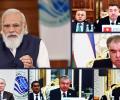
The Shanghai Cooperation Organisation (SCO) will hold its first in-person summit in Samarkand in Uzbekistan on Thursday after two years, shaking off Covid fears and providing a rare opportunity for all its eight heads of state to meet on the sidelines of the event to have face-to-face talks on pressing global and regional issues of common concern.

He said countries should work for promoting open and inclusive cooperation for win-win outcomes.
In an address at the Council of Heads of Government meeting of the eight-member SCO, Vice President Venkaiah Naidu said the most important challenge faced by the region is terrorism, particularly cross-border terrorism, and that India remained concerned about threats emerging from ungoverned spaces as well.

'The future of BRICS is under stress as Chinese attempts to expand the platform are being resisted by India and Brazil.' 'Beijing is focused on a quick expansion with the aim of giving the platform a distinctly anti-Western orientation, which New Delhi and Brasilia seem to have no interest in,' notes Harsh V Pant.
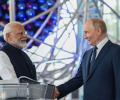
Prime Minister Narendra Modi on Tuesday told Russian President Vladimir Putin that a solution to the Ukraine conflict is not possible on the battlefield and peace efforts do not succeed in the midst of bombs and bullets even as he flagged concerns over a missile strike on a children's hospital in Kyiv.
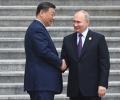
"The two sides note that the relationship between Russia and China has progressed to a more advanced interstate cooperation compared to the military-political unions of the Cold War era as it is not bloc or confrontational in nature, nor does it target any third countries," Russia's new agency Tass quoted the document as saying.

The G20's Bali Declaration Wednesday acknowledged differences among members on the Russia-Ukraine war but said it was essential to adhere to international law, including protection of civilians caught in conflicts.
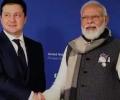
Prime Minister Narendra Modi spoke with Ukrainian President Volodymyr Zelenskyy on Tuesday and asserted that there can be no military solution to the Ukraine conflict, while also underlining that endangerment of nuclear facilities could have catastrophic consequences.

India as the G20 host has a 'unique role' to play in bringing about an end to the war in Ukraine due to its 'longstanding historical' ties to Russia, the United States has said, expressing hope to work closely with New Delhi to find a way to stop the conflict.
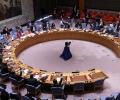
India has abstained on a draft resolution tabled in the United Nations Security Council which condemned Russia's 'illegal referenda' and annexation of four Ukrainian territories and called for an immediate cessation of violence while underlining the need to find pathways for a return to the negotiating table.
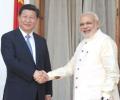
The summit is being seen as an effort by India and China to rebuild trust and improve ties that were hit by the 73-day-long Doklam standoff last year.

Ahead of his crucial talks with Russian President Vladimir Putin in Moscow, Chinese President Xi Jinping said on Monday that his peace plan to end the raging Ukraine war takes into account the 'legitimate' concerns of all parties and reflects the broadest common understanding of the international community.

Modi, who met Putin last week on the sidelines of the 22nd meeting of the Shanghai Cooperation Organization in Uzbekistan's Samarkand, had told the Russian leader that "today's era is not of war".

Shringla said that diplomacy is looking at a very changed scenario in terms of how statecraft and relations between countries work in the wake of the pandemic.

In his address to RIC Foreign Ministers, Wang said the three countries should 'correctly handle and properly deal with sensitive factors in bilateral relations and safeguard the overall interests of mutual relation', without directly referring to the current round of India-China military tensions along the Line of Actual Control, (LAC).

His remarks without naming any country came against the backdrop of tension between India and Pakistan after New Delhi revoked Jammu and Kashmir's special status.
'India needs to closely monitor the discussions at the UNSC and make counter-measures as this touches its core interests', points out Srikanth Kondapalli.
