
Dr Reddy's was the top gainer in the Sensex pack, rising over 3 per cent, followed by PowerGrid, TCS, HCL Tech, Infosys and Reliance Industries. On the other hand, L&T, IndusInd Bank, Bajaj Finserv and Bharti Airtel were among the laggards.

The government has promised to keep the deficit at 4.1%

Infosys slipped nearly 9% after the company cut full year revenue outlook for FY17.

Omkeshwar Singh, Head, Rank MF, a mutual fund investment platform, answers your queries.

If you have a short-term horizon, it might be better to wait for a while, say analysts.
The recent rally has seen investors' preference shift to high-beta and policy reform-driven sectors like capital goods, banking, power, infrastructure and oil and gas.
December is packed with key economic and political events, both at the domestic and the global level, which will decide how foreign institutional investors (FIIs) fine tune their investment strategies
The liquidity-driven market rally since September, which has seen about $2 billion of inflows into the Indian equity markets, has propelled the benchmark the S&P BSE Sensex to a new high after about six years.
The air of expectancy around the election outcome has kept things heated.
With Satya Nadella set to become Microsoft CEO, more India-trained professionals are taking top positions in the world.
Capital goods and banking stocks catapulted the indices.

The year-to-date returns are 13.33 per cent for Indian funds, compared to 11.66 per cent for emerging market funds overall.

Technical fault was the reason behind it.

Ricoh India, the largest gainer among these pack, has rallied 192 per cent from Rs 294 to Rs 859 on the BSE so far in the current calendar year.

The current up move, according to analysts, closely resembles the rally post the global financial crisis in 2008-09, not just in quantum and speed, but also the way small-and mid-cap indices outperformed large-cap peers.

With global markets pushing ahead, enthused by strengthening US jobs market, and also due to prospects of European rate hike, Indian markets also continued the march ahead.

Lawyers say compensation may be an uphill task for investors because of a lack of judicial precedent and broader institutional difficulties.

IMD expects day temperatures to remain above-normal in select regions across the country between March and May 2021.

Here's how to get high returns from equities...
The 30-share BSE Sensex closed at 20,822 down 72 points after touching a high of 21142.85 while the broader 50-share Nifty index closed at 6,187 levels down 27 points; the index touched a high of 6,289 today.
Key indices ended weak for a third consecutive session after a stellar rally.
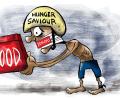
Given that there has been no negative news flow around Zomato, analysts believe it's time to lap up the shares at lower levels.
RBI Deputy Governor K C Chakrabarty said the central bank will come out in June with its next financial stability report, which showcases the country's financial strength, and
It feels govt may find it challenging to meet the revenue projections.

True sustainable growth can come only through an increase in productivity, and such increases can happen only through innovations, technical and organisational, in all sectors of the economy - industry, services and agriculture, writes Ajit Balakrishnan.

Shares of RIL ended 2.4% higher as it pips TCS to become most valued firm
Markets ended way off their record highs as investors booked profits ahead of NDA's new cabinet and its key policy measures.

The Sensex has slid 18.5 per cent from its January 2015 peak.
Standard & Poor's, which has threatened to downgrade the country's sovereign rating to junk, sees economic growth improving.
Standard & Poor's, which has threatened to downgrade the country's sovereign rating to junk, sees economic growth improving.
In the male-dominated corporate world, these women have proved their mettle and turned out to be inspiring and successful role models.
When it comes to financial markets, fear and greed play a large component in determining market prices.

The government said in a court filing it was seeking civil money penalties from S&P and McGraw Hill.

Global rating agency Standard & Poor's said the government's decision to increase domestic gas prices is likely to benefit two major gas producers Oil and Natural Gas Corp (ONGC) and Reliance Industries Ltd (RIL).

The S&P BSE Sensex has dipped five per cent, thus far, in CY15.
SBI, Tata Motors, Bharti Airtel, ICICI Bank and Reliance Industries among top gainers.

Investing in the US market provides Indian investors a hedge against the rupee's long-term tendency to depreciate against the dollar.

Thus far in FY21, BSE, NSE have rallied 70 per cent and 71 per cent, respectively.

Acquisitions may have played a role in much of the increase.

Analysts attribute this withdrawal trend to the nervousness ahead of US presidential elections and the fact that the markets raced ahead even as the economic recovery remained fragile back home.
