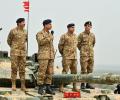
'Munir hopes to solidify his hold on power.'
'Pakistan's army has got a streak of democracy. It is more democratic than the country.'
India had better be prepared. Munir could be back at our throats soon, even within the next 12 months, warns Shekhar Gupta.

'Pakistan's only concern has been while they were on the FATF watch list was to distance their State institutions and organs from any direct connection with the actual execution of militancy inside Kashmir.'

As he settled down to his job as army chief, General Qamar Javed Bajwa -- who died last week; his passing did not merit even an obituary in major print or electronic media in Pakistan! -- developed a vision of reducing his country's and his institution, the army's traditional hostility toward India, points out Rana Banerji, who headed the Pakistan desk at RA&W.

'Pakistan has found itself in a favourable position after Operation Sindoor by appreciating the mediation as claimed by Trump and recommending him for the Nobel Peace Prize.'

If General Asim Munir, Pakistan's new army chief, wants to help defuse the current polarised atmosphere and shepherd civilian politicians towards negotiations on an acceptable date for elections, he may need to distance himself from any perception of needless hostility to Imran Khan, explains Rana Banerji, who headed the Pakistan desk at RA&W, India's external intelligence agency.

Pakistan Prime Minister Shehbaz Sharif on Thursday chose Lt Gen Asim Munir as the new Army chief to replace incumbent General Qamar Javed Bajwa.
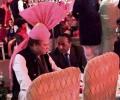
"Wearing the gifted turban of Modi itself shows that Sharif's sincere intention towards the neighbouring country. Besides, it also demonstrates that Sharif values the gift of Modi," a source added.

Lt Gen Abbas -- commissioned in 1987 by Pakistan Military Academy (PMA) in the 41 Baloch Regiment -- has formerly served as the personal secretary to the chief of former army chief Gen Raheel Sharif.

'All Pakistan army chiefs follow a consistent line as far as India is concerned.'

The military establishment is in no mood to forgive or forget Imran's anti-military utterances, observes Rana Banerji, who headed the Pakistan desk at RAW, India's external intelligence agency.

'Many senior officers are unhappy with him, but many lower level officers are still supportive.' 'This is also not something that has happened for a long time. So this is certainly a milestone.'
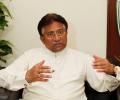
Learning perhaps from the Kargil debacle, Musharraf tried hard to evolve as a statesman in his dealings with India, recalls Rana Banerji, who headed the Pakistan desk at RA&W.

'A close look at the time-lines tells you that exactly as the back-channel negotiations were in their most crucial stage, "somebody" was planning the 26/11 attacks in Mumbai,' says Shekhar Gupta questioning Khurshid Mahmud Kasuri's account of a peace deal with India.
