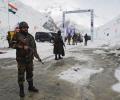
Indian and Chinese militaries on Monday moved back their frontline troops to the rear locations from the face-off site of Patrolling Point 15 in the Gogra-Hotsprings area in eastern Ladakh and dismantled temporary infrastructure there as part of a five-day disengagement process.
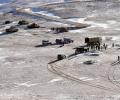
The development comes after after reaching a consensus in the 16th round of military talks, the two sides said in a joint statement this evening.
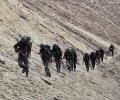
The government needs to answer the critical question of whether it has accepted any restrictions on its infrastructure creation activities, asserts Ajai Shukla.

'The Chinese are retaining geostrategic pressure on India by keeping troops there and building infrastructure continually.'
The MEA said the two sides agreed to continue discussions through diplomatic and military channels to resolve the remaining issues "at the earliest" so as to create conditions for the restoration of normalcy in the bilateral relations.

The summit is also being attended by Pakistan Prime Minister Shehbaz Sharif, Iranian President Ebrahim Raisi and leaders of several central Asian countries.

India and China will complete the disengagement process in the Gogra-Hotsprings area in eastern Ladakh by September 12, the External Affairs Ministry said on Friday.

The Chinese military on Friday confirmed that the troops of China and India have begun the process of disengagement from the Patrolling Point 15 in the Gogra-Hotsprings area of eastern Ladakh in a 'coordinated and planned way'.

Gen Naravane said that the Indian Army did not hide casualties during Galwan clash in eastern Ladakh as the Chinse have done.

The Army said Gen Pande witnessed Parvat Prahar exercise besides interacting with officers and troops deployed in the region. The exercise featured a display of operational capabilities by artillery guns and other key weapon systems.
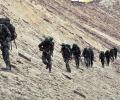
"Some steps are required for full normalcy, we have not reached there," Bagchi said.

It took India and the Indian Army to show to the world that enough is enough and to challenge the neighbourhood bully, he said.

India's engagement with China is "complex" and Chinese attempts to unilaterally alter the status quo along the Line of Actual Control (LAC) in eastern Ladakh starting from April-May 2020 seriously disturbed the peace and tranquillity in border areas, the ministry of external affairs (MEA) said in a report on Monday.
The actions on the ground would be confirmed and are expected to be followed up soon.

"After the Major General-level talks on Wednesday, the talks are expected to be held over the next few days in Chushul at multiple levels to find solutions to the dispute in specific areas," sources said.
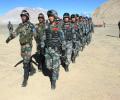
Sources said that after the June 6 talks between Military commanders followed by other rounds of talks, there has not been any considerable build-up activity by both sides and Chinese aggressive behaviour has also been toned down, they said.

'We can expect heightened belligerence from China.'

The Shanghai Cooperation Organisation (SCO) will hold its first in-person summit in Samarkand in Uzbekistan on Thursday after two years, shaking off Covid fears and providing a rare opportunity for all its eight heads of state to meet on the sidelines of the event to have face-to-face talks on pressing global and regional issues of common concern.

Jaishankar said the last few years have been a "period of serious challenge", both for the relationship and for the prospects of Asia, noting that continuation of the current impasse will not benefit either India or China.

The Indian side is expected to seek disengagement as soon as possible in the remaining friction points besides pressing for resolution of issues in Depsang Bulge and Demchok.
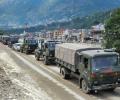
Indian Army planners find themselves contemplating the possibility of more Chinese intrusions along the contested 3,488-km border. That could lead to the army having to man a 'hardened LAC' round the year, like the LoC with Pakistan, reports Ajai Shukla.
The CSG is one of the topmost bodies in the government which provides directions to the military and diplomats on the stand to be taken during talks with the Chinese and also take a stand on the points and demands raised by the Chinese side.
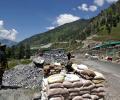
The Indian troops deployed there are mentally prepared for tackling the weather and terrain. In contrast, the Chinese troops deployed along the Line of Actual Control (LAC) are not used to these conditions as they have been brought from mainland China and are not accustomed to high altitude extreme cold weather conditions.
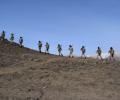
'The Indian Army is fully prepared for a long and permanent deployment if the PLA does not retreat.'

A total of around 100 troops took part in the operations from the Indian side while the Chinese had over 350 people on the location.

Indian Army chief General Manoj Mukund Naravane on Tuesday said that as far as the western front was concerned, there is an increase in the concentration of terrorists in various launch pads and there have been repeated attempts of infiltration across the Line of Control.
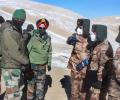
"The meeting thus did not result in resolution of the remaining areas," the Army said in a statement.
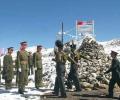
Since China began this buildup, the Indian side says Chinese troops will have to start the de-escalation. Only then will Indian troops go back. The June 6 meeting agreed to this roadmap.

'The Chinese staying put in Pangong Tso, and creating a buffer zone on Indian territory in other areas,' a senior serving general tells Ajai Shukla.
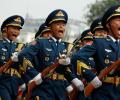
Since the June 15 clash, the PLA has inducted large numbers of troops, armoured vehicles and artillery along the LAC, from Depsang and Galwan in northern Ladakh to Hot Springs, Pangong Tso, and Chushul in central Ladakh, to Demchok and Chumar in southern Ladakh.

'India has to prepare for future warfare where kinetic use of force at the border will be limited. War will take place in the realms beyond the border.'

'China is unwilling to restore the status quo ante of April 2020.' 'India will have to weigh its options based on this premise.'

Senior officers recounted extreme Chinese brutality to the Indian prisoners, with some of them being pushed over cliffs and soldiers' bodies being recovered from the Galwan River.
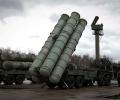
RInstead of disengagement, the Indian and Chinese armies have deployed an estimated 35,000 to 40,000 soldiers each along the LAC. The PLA has deployed S-400 air defence missiles to neutralise the IAF's advantage in air power

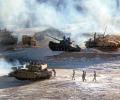
Official sources said withdrawal of tanks and other armoured elements from certain friction points is nearing completion while pulling back of troops from the North bank areas is being undertaken.
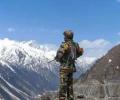
'China has forcibly occupied territory it had never occupied before, blocked Indian patrols' access to areas they had patrolled for decades and, most provocatively, killed 20 Indian soldiers.' 'Most countries would regard these as acts of war.' 'New Delhi has apparently taken off the table the option of evicting the PLA with force,' observes Ajai Shukla.
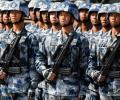
With the Indian Army having blocked the PLA several kilometres inside India, hundreds of soldiers from both sides remain in a tense face-off.
