
Mehbooba Mufti, PDP chief, urged Kashmiri Pandits to move beyond past grievances and invest in a shared future in the Kashmir Valley. Speaking at the Kheer Bhawani mela, she highlighted the warmth between communities and called for government support for Pandits, while also appealing to them to isolate those who seek to use them for political agendas.

'Our leaders, including Mallikarjun Kharge and Rahul Gandhi, are in touch with all Opposition parties, including the DMK and the AAP.'
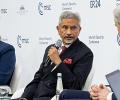
India's External Affairs Minister S Jaishankar countered a US senator's claim that democracy does not put food on the table, citing India's PMGKAY program which provides food to 800 million people. Jaishankar argued that different parts of the world have different experiences with democracy and that the model of globalization has contributed to issues with democracy in some regions. He emphasized that India's democratic system effectively delivers food security, highlighting the PMGKAY program as an example.
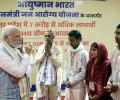
According to a parliamentary response by the Union health ministry in 2023, around 654,000 families in Delhi are eligible to enrol under the scheme.

The government has extended the PMGKAY scheme to provide 5 kg free foodgrains per month to around 80 crore poor people for another five years. A decision in this regard was taken in the meeting of the Cabinet, chaired by Prime Minister Narendra Modi, on Tuesday. Giving details on Wednesday, Information and Broadcasting Minister Anurag Thakur said the Pradhan Mantri Garib Kalyan Anna Yojana (PMGKAY) has been extended for another five years from January 1, 2024.

The government has extended the Pradhan Mantri Garib Kalyan Anna Yojana (PMGKAY) scheme to provide 5 kilogrammes of free foodgrains per month to around 80 crore poor people for another five years.

'The decision to supply free food grains is not an economically sound decision because the government will find it very difficult in future to charge anything for food grains.'
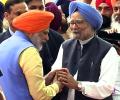
Whether it was the MGNREGS or the NFSA or the Aadhaar-based DBT scheme for cash transfer, the Modi government has built on the basic architecture created by the Singh government. Policy makers in the Modi government, instead of discarding them as products of the previous political regime, worked on them, expanded their scope and reach, and used new tools to improve their performance, explains A K Bhattacharya.
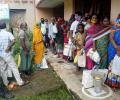
A bench of Justices MR Shah and Hima Kohli directed the Centre to submit a fresh chart with the number of migrant and unorganised sector workers registered on eShram portal.
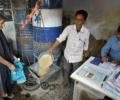
The Pradhan Mantri Garib Kalyan Anna Yojana (PMGKAY) was launched in March 2020 to provide free 5 kg foodgrains per person per month to about 80 crore beneficiaries covered under the National Food Security Act (NFSA) to reduce their hardship during the lockdown period. This was over and above the general allocation under the NFSA.
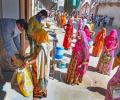
The government's food subsidy in the ongoing fiscal year is expected to be a little less than Rs 4 trillion.
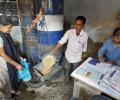
The free food scheme is driven by electoral considerations, but its long-term fiscal risks outweigh the short-term gains, cautions A K Bhattacharya.

The Delhi high court on Thursday set aside the AAP government's doorstep ration delivery scheme -- Mukhymantri Ghar Ghar Ration Yojna.
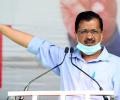
The central government on Friday stopped the doorstep delivery of ration scheme MMGGRY (Mukhya Mantri Ghar Ghar Ration Yojana) of the Delhi government, scheduled to be launched on March 25.
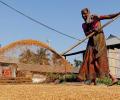
Stating that the food subsidy bill is becoming "unmanageably large", the Economic Survey 2021 on Friday suggested the government to increase the selling price of foodgrains provided through ration shops to over 80 crore beneficiaries. Foodgrains via ration shops are supplied at highly subsidised rates of Rs 3 per kg for rice, Rs 2 per kg for wheat and Rs 1 per kg for coarse grains through Public Distribution System (PDS) as per the National Food Security Act (NFSA). "While it is difficult to reduce the economic cost of food management in view of rising commitment towards food security, there is a need to consider the revision of central issue price (CIP) to reduce the bulging food subsidy bill," the survey said.
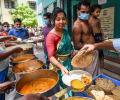
A decision in this regard was taken in the Cabinet meeting chaired by Prime Minister Narendra Modi.
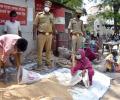
In the three months leading up to the Assembly elections, Chief Minister Yogi Adityanath's government distributed over 1.4 million tonnes (MT) of wheat, 0.95 MT of rice, 0.10 MT of chana (gram), 101.9 million litres of soybean oil and 100,000 tonnes of salt as free ration. This was part of the Covid relief package, officials said.
The government's subsidies on food, fertilisers and petroleum are estimated to decline by 39 per cent to Rs 4,33,108 crore this fiscal and fall further by 27 per cent to nearly Rs 3.18 lakh crore in 2022-23. In its revised Budget (RE) estimate for the 2021-22 fiscal, the government has pegged total subsidies to be at Rs 4,33,108 crore against the actual Budget estimate of Rs 7,07,707 crore in the previous financial year. Out of which, the food subsidy is estimated to decline to Rs 2,86,469 crore in the current fiscal from Rs 5,41,330 crore in 2020-21, while petroleum subsidy is estimated to fall to Rs 6,517 crore from Rs 38,455 crore in the said period.

If Modi wants to leave a real legacy, breaking India's strategic triangulation would be the real gift, notes Shekhar Gupta.
Why did Karnataka's economic prosperity fail to influence the nature of electoral promises made by political parties in the run-up to the assembly elections? asks A K Bhattacharya.

The Union Cabinet on Wednesday approved a proposal to extend distribution of 5 kg foodgrains per month for free under the Pradhan Mantri Garib Anna Yojana (PMGKAY) to over 80 crore ration card holders for four months till March 2022, a decision that will cost an additional Rs 53,344 crore to the exchequer.
The government on Wednesday extended by three months its programme to provide free rations to the poor at a cost of Rs 44,762 crore as it looked to ease pain from high inflation and make political gains in the upcoming Gujarat elections.

Is it a case of poor targeting of a welfare scheme, or is it a reflection of the government's desire to expand the scope of this benefit to secure greater electoral dividends? asks A K Bhattacharya.
5-kg free food grains per person per month would be given to around 80 crore people for the two months.
A study by eminent economists, by Jean Drze, Reetika Khera and Meghana Mungikar released few days back shows that more than 100 million people are excluded from the PDS because the central government insists on using 2011 population figures to calculate state-wise coverage under the National Food Security Act.
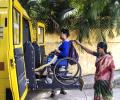
"Fact that persons with disabilities get marginalised from every scheme does not require a debate," the court said.
Initially, the additional free benefit under the PMGKAY was provided for a period of three months (April-June 2020) to ameliorate distress caused by the COVID-19 pandemic. However, with the crisis continuing, the programme was extended for another five months (July-November 2020).
The initiative has been taken so that only the needy can avail the benefits of the governments' scheme.

Finance Minister Nirmala Sitharaman has brought down the budgetary allocation for the fertiliser subsidy for FY21 to Rs 71,309 crore, from the RE of Rs 79,998 crore for FY20, while increasing food subsidy to FCI through "ways and means advance" to Rs 50,000 crore for FY21, from Rs 36,000 crore in RE for FY20, and under the National Food Security Act (NFSA) to Rs 77,982 crore, from Rs 75,000 crore.
A recent study shows that more than 100 million people are excluded from the public distribution system because the central government insists on using 2011 population figures to calculate state-wise PDS coverage, which effectively leaves out 100 million people, reports Sanjeeb Mukherjee.
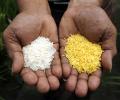
After missing several deadlines, only 11 states could introduce the plan

8 crore migrant workers will get 5 kilogram of grains per person and 1 kilogram of 'chana' for two months.
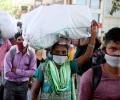
The government on Monday ruled out the possibility of free food-grains distribution to migrants saying there is no panic situation and no complete national lockdown unlike last year.
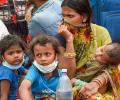
Only two in every five migrants said they received ration or cooked food from the administration either daily or at times.

Assam Chief Minister Himanta Biswa on Tuesday said that the Centre is likely to sign a peace accord with militant organisations from the state's Adivasi communities within September.
Last-mile verification with Aadhaar-Based Biometric Authentication have the worst record among other options available to check PDS pilferage. So the Centre's insistence on that option is bewildering, says Reetika Khera.
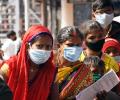
Migrant workers play a very vital role in building the nation and their rights cannot be ignored at all, the Supreme Court said on Thursday while asking the Centre to devise a mechanism so that they receive food grains without ration cards.
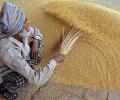
A head of its meeting, the Reserve Bank of India (RBI) can take some solace from the softening food commodity prices. However, the events surrounding the last few weeks show that the fall may not be uniform across all commodities, and cereals like wheat and rice could be the outliers. A Reuters report said that local wheat prices jumped to a record Rs 23,547 per tonne on Wednesday. That is a 12 per cent rise from the recent lows that followed the government's surprise ban on exports on May 14.

The government's subsidies on food, fertilisers, LPG and kerosene are pegged at Rs 5.96 lakh crore in the current fiscal, over 2.5-fold jump from the initial budget estimates as the Centre distributed additional foodgrains free of cost to help poor mitigate the impact of COVID-19 pandemic. In February 2020 Budget, presented in the pre-COVID scare, the government had estimated the subsidy bill at Rs 227,794 crore. However, all the budget estimates, have undergone major revisions as the country imposed strict lockdown to check the spread of COVID-19.

The proposed National Food Security Act (NFSA) may have to be put off to 2012 due to financial constraints, going by a recent Planning Commission document which points out that additional resources of Rs 77,000 crore will be required to implement the programme.
