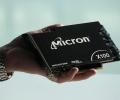
Prime Minister Narendra Modi inaugurated Micron Technology's semiconductor plant in Sanand, Gujarat, highlighting India's growing presence in the hardware sector and its strong partnership with the United States in AI and chip technologies.
The Indian government has approved two major manufacturing initiatives worth nearly Rs 1.9 lakh crore (USD 22 billion) to expand the country's semiconductor ecosystem and scale up mobile phone production, aiming to strengthen its position as a global electronics manufacturing hub.

Apple has increased the starting prices of MacBook and iPad models by 20-42 per cent compared to their launch prices across the globe, including India, mainly due to higher memory chip costs. The new price list on Apple India's website shows that the company has increased the price of the MacBook Pro built on the M5 series chip by about 20 per cent.

'India has initiated a bear market and we will still go lower. It has nothing to do with the economy.'

A new study reveals that human cells, including cancer cells, possess the ability to sense their environment far beyond their immediate point of contact, potentially influencing cell movement and cancer spread.
A new study reveals that human cells, including cancer cells, possess the ability to sense their environment far beyond their immediate point of contact, potentially influencing cell movement and cancer spread.

Micronations are small, self-proclaimed nations that claim to be independent or sovereign states but are not reconginsed by international organisations.
Prime Minister Narendra Modi is set to inaugurate a semiconductor plant in Sanand, Gujarat, and launch multiple development projects worth over Rs 20,000 crore, marking a significant boost to India's semiconductor industry and infrastructure.

The first leg of Micron's semiconductor play in Sanand is crucial for the company to sprint towards India's goal of joining the chip race.
Computer storage chip maker Micron will set up a semiconductor assembly and test plant in Gujarat entailing a total investment of $2.75 billion (around Rs 22,540 crore), the company said on Thursday. Micron will invest up to $825 million in setting up the plant in two phases. Micron's plant has been approved under the government's "Modified Assembly, Testing, Marking and Packaging (ATMP) Scheme,".
US-based chipmaker Micron Technology is expecting demand for semiconductors to rise significantly in the next few years, globally and in India, as memory consumption is going up, largely driven by the widespread adoption of technologies like artificial intelligence (AI). "Memory consumption is expected to double by the end of the decade and the biggest driver in this is AI. "While it's natural to talk about compute and GPUs (graphics processing units) in the context of AI, it is not to be forgotten that the true enabler for AI is memory ... in all the AI engines that we talk about, there is a lot of need to access memory quickly," Anand Ramamoorthy, managing director, Micron Technology India, told Business Standard.

The government is close to approving a proposal by Micron Technology to set up an assembly, testing, marking and packaging (ATMP) facility in the country involving an investment of about $1 billion. The world's fifth largest semiconductor company, based in Idaho, USA, will use the facility to process some of its own wafers, manufactured across the globe.

Micronations are small, self-proclaimed nations that claim to be independent or sovereign states but are not reconginsed by international organisations.

The government has cleared US-based chip maker Micron's project to set up a semiconductor test and packaging unit worth USD 2.7 billion in the country, according to sources. The approved project is expected to create 5,000 jobs. "The project was cleared about a week back," a source said, confirming details of the project.

...compared with 153,000 in all of 2024.

Tata Projects on Tuesday said the construction of the US-based chip company Micron Technology's semiconductor assembly and test facility at Sanand near Ahmedabad is going on in full swing. The facility is coming up in nearly 50 acres of area at Sanand industrial area and the construction began in July last year.

Uttar Pradesh Police's Special Task Force unearths a fake embassy operating in Ghaziabad, arresting a man who claimed to be a diplomat of a non-existent country.

Procter & Gamble has announced Shailesh Jejurikar as its next CEO, effective January 1, 2026. Jejurikar, an India-born executive, will succeed Jon Moeller in the role.
Micron Technology, a global leader in memory and storage, is considering supplying Made-in-India chips from its Gujarat plant to one of its key global clients, Apple, whose vendors assemble iPhones in the country. Micron is setting up an assembly test marking and packaging (ATMP) plant in Sanand, Gujarat. Currently, Apple vendors import chips for manufacturing iPhones. Sources in the know say the aim is to use part of the production to supply to Micron's clients in India directly.

Major recruiters, with double-digit offers at IIT campuses this year so far, include American Express, Barclays, BCG, Cars24, Deutsche Bank, Goldman Sachs, Google, Intel India, Meesho, Micron Technology, Microsoft, OLA, Oracle, Reliance, and Qualcomm.

India currently performs around 6,00,000 to 7,00,000 laser-assisted in situ keratomileusis (Lasik) and refractive procedures a year, and the uptake is accelerating.

Four cities in neighbouring Pakistan and one in China are among the world's top 20 polluted cities.

Over 100 Indian institutions offer semiconductor design curricula, but hardly any of them focuses on manufacturing and process technology, a top official from global memory and storage major Micron Technology said on Thursday. There is significant global demand for such chip engineers, its president and chief executive Sanjay Mehrotra said at the 10th Vibrant Gujarat Global Summit in Gandhinagar. "While more than 100 Indian institutions provide a semiconductor design curriculum, hardly any focus on semiconductor manufacturing and process technology.
Due to the prevailing geopolitical situation, like-minded countries are collaborating with India to make it a major semiconductor manufacturing destination, a top Electronics and IT ministry official said on Sunday. In an interview with PTI, Ministry of Electronics and IT Secretary S Krishnan said pilot facilities of US storage semiconductor maker Micron and Tata Electronics have already rolled out chips, and their main plants in Gujarat will begin to produce made-in-India chips from the later part of 2025.

Union Minister of Heavy Industries and Public Enterprises, H D Kumaraswamy on Saturday clarified that he was misquoted on his purported remarks regarding the United States semiconductor firm Micron.

Data from the ministry of environment, forest and climate change reveals that 30 cities recorded an increase in PM10 levels compared to 2017-18 (FY18), indicating deteriorating air quality.
India is all set to make its presence felt in the $47 billion global outsourced semiconductor testing and packaging market, an arena where Malaysia and Vietnam have been way ahead so far. The Cabinet last Thursday cleared two projects, the Tata's assembly testing and packaging plant (ATMP) and the Murugappa-owned CG Power with Renesas from Japan as its tech partner. These, together with Micron's assembly and testing plant which is already being constructed in Sanad in Gujarat, will collectively invest Rs 47,300 crore to set up the factories.

Our politicians need to take a leaf out of Mr Trump's personalised merchandise sale: It keeps his image in the public eye, continuing to engage him differently and innovatively with his supporters, points out Sandeep Goyal.
India and Vietnam are vying with each other to woo semiconductor companies to their country. With the tension between the US and China escalating, and Taiwan getting vulnerable both countries are trying to present themselves as alternative destinations for global players. Vietnam, which started the effort as early as 2010, has got a leg-up after US President Joe Biden's visit last month.

How much do you know about the Vibrant Gujarat Global Summit 2024?

Smaller than a grain of sea salt and narrow enough to pass through the eye of a needle, a bag so small you need a microscope to see it.
In a move to deepen manufacturing in electronics in India, the Centre is targeting 35-40 per cent value-addition through the yet-to-be launched production-linked incentive (PLI) scheme for electronics components, sources in the government

In the technology (tech) world, especially storage, Sanjay Mehrotra is a well-known name. Co-founder of SanDisk, a flash memory storage company in 1988, it was eventually acquired by Western Digital in 2016 for a whopping $19 billion. For a boy from Kanpur, who went on to pursue higher studies in the US, becoming the chief executive officer of Micron Technology, Inc - one of America's largest memory chip makers - and now setting up the company's first plant in India, it has been quite a ride.

Micron plans an assembly testing, marking and packaging project of $1 billion, and talks are on to set up a memory chip plant for captive requirements.

Semiconductor makers need thousands of engineers and technicians, and though India has one of the largest pool of engineers in the world, they do not have experience in the semiconductor manufacturing space.
The exclusive club that dominates the global semiconductor fab scenario is about to get a new member. Taiwan, South Korea, and China control nearly 70 per cent of the global capacity. SEMI, the global industry body for semiconductor and electronics design and manufacturing, projects all fabs collectively will churn out 30 million wafers a month this year.

OSAT majors have concerns about India's ability to provide a stable, predictable, and lasting policy environment for years to come, which is key for making a decision in a capital-intensive business.

Prime Minister Narendra Modi on Wednesday said the world looks at India as an important pillar of stability, a trusted friend, an engine of growth in the global economy, a technology hub for finding solutions and a powerhouse of talented youth. He also said that in the rapidly changing world order, India is moving forward as 'vishwa mitra' (friend of the world). Speaking at the inauguration of the 10th edition of the Vibrant Gujarat Global Summit, which saw participation of state hea
The Indian government is keen to woo major semiconductor players, but a global race to attract them to countries where there is already an ecosystem is making it difficult for India to attract the biggies in the business. On Wednesday the government decided to throw open the doors to more players to participate in its semiconductor scheme. It is now looking at not only 28 nanometre (nm) chips and below, but higher nodes like 40 nm.

'Similar to the case of the digital payment system where the government created a public platform and others joined in, we are exploring a similar structure to create a PPP platform where the compute required for AI could be accessed by the small player.'
