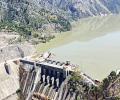
India has stopped releasing water from the Baglihar Dam on the Chenab River and is planning similar measures at the Kishanganga Dam on the Jhelum River, following a recent terror attack in Jammu and Kashmir. These hydroelectric dams offer India the ability to regulate water releases. This decision potentially affects the Indus Waters Treaty, a decades-old agreement between India and Pakistan governing the use of the Indus River and its tributaries. The Baglihar and Kishanganga dams have been points of contention between the two nations in the past.

The Indus Waters Treaty, brokered by the World Bank, has governed the use of the Indus River and its tributaries between India and Pakistan since 1960.

Indian authorities have told Pakistan -- during a recent visit to the site of the Kishanganga Dam which is being built on Neelum Jhelum River -- that it has stopped work on the project and will not violate the stay order granted by an international court, officials have said.
Kamal Majidulla, special assistant to the prime minister on water issues, claimed that the neutral expert's verdict of 2007 on the Baglihar project was a "travesty of justice" and an "inversion of the Indus Waters Treaty" that allocated three Western rivers to Pakistan.
The man who represented Pakistan at the International Court of Arbitration to explain the country's case on the Kishanganga Dam is believed to have played into India's hands and wrongly projected Islamabad's loss as its gain.
In a significant development in an India-Pakistan dispute, the International Court of Arbitration at The Hague on Tuesday upheld India's right to divert water from the Kishanganga hydroelectric project in Kashmir.
India and Pakistan have rejected each other's proposed nominees for the Court of Arbitration to adjudicate on a dispute over the Kishanganga hydropower project in Jammu and Kashmir.

'India's letter to Pakistan on April 24 (2025; two days after the Pahalgam terrorist attack) didn't tear up the treaty -- but it did put it on ice.'
The Indus system of rivers comprises the main river -- the Indus -- along with its five left bank tributaries, namely, the Ravi, the Beas, the Sutlej, the Jhelum and the Chenab. The right bank tributary, the Kabul, does not flow through India.

India has served a formal notice to Pakistan seeking a review of the Indus Water Treaty, arguing that 'fundamental and unforeseen' changes in the circumstances require a reassessment of the pact.

Inflencer and vlogger Shenaz Treasury chooses her favourite quiet spots.

The talks will be the first official engagement between India and Pakistan since Khan became prime minister on August 18.
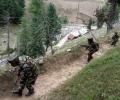
At least 12 militants and an army officer were killed and two jawans wounded in an infiltration bid on the Line of Control in north Kashmir Bandipore district on Saturday.
Pakistan has invited India for a meeting to discuss the appointment of neutral experts for the controversial Kishanganga hydel power project.The meeting is scheduled to take place on July 13 in Islamabad. Both India and Pakistan have agreed on international arbitration over the controversial project in Bandipora district of Jammu and Kashmir.However, if the two countries fail to reach a consensus during the talks, the experts will be decided by a draw of lots by World Bank,UN
Pakistan has decided to approach the International Court of Arbitration to halt the construction of the Kishanganga hydropower project by India, on the ground that it violates the Indus Waters Treaty of 1960, and has formed a team of legal experts to fight the case.Professor Kaiyan Homi Kaikobad, an international legal expert of Pakistani origin, will lead the team at the International Court of Arbitration.
Pakistan has asked the US to nudge India to address contentious issues in order to bridge the trust deficit between the two countries instead of looking at the distrust solely through the prism of terrorism, a media report said on Wednesday. "We want the US to encourage India to take steps for improving the human rights situation in Kashmir, moving forward on Siachen and Sir Creek and agreeing to arbitration on the Kishanganga hydropower project."
Pakistan has decided to approach the World Bank to request the appointment of a neutral expert to resolve a dispute with India over the Kishanganga hydroelectric project if bilateral efforts fail to settle the matter, according to a media report.
Pakistan has been opposing the construction of the Kishanganga hydropower project on Ganga river in Kashmir, which is called Neelum upon entering Pakistan. Pakistan has said that the diversion of the waters of the Neelum is not allowed under the 1960 Indus Waters Treaty, and that it will face a 27 per cent water deficit when the project gets completed.
Pakistan has said India violated the Indus Water Treaty.
In the first meeting in Lahore last November, both sides had agreed to sort out their differences within three months.
It has been delayed by two days because of incomplete infrastructural work.

After frequent incursions in Ladakh area, Chinese People's Liberation Army troops have been spotted at forward posts along the Line of Control on the Pakistani side of Kashmir, ringing alarm bells in the security grid.

Kartarpur Sahib in Pakistan is located across the river Ravi, about four kilometres from the Dera Baba Nanak shrine in Punjab's Gurdaspur district.

During the meeting, Pakistan was expected to highlight concerns about the three Indian hydro projects being built on the rivers flowing to Pakistan.
"Pakistan will not accept any modifications or changes to the provisions of the Indus Waters Treaty. Our position is based on the principles enshrined in the treaty. And the treaty must be honoured in... letter and spirit," Special Assistant to Prime Minister Tariq Fatemi told Dawn News.

'If Modi had followed Vajpayee in Kashmir, then there would have been absolutely no problem in Kashmir.'

Speaking for the first time after the government announced an halt to anti-militancy operations in the state during the holy month of Ramzan, the prime minister said there is no alternative to peace and stability.
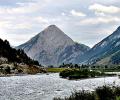
Traveller and trekker Amit Tyagi writes about the hidden gems of Kashmir. You won't regret including them in your next itinerary.
'In the last 55 years India and Pakistan have gone to wars, but nobody spoke about scrapping the Indus Waters Treaty.'

'Attempts at long-term rapprochement have been rather feeble from both sides. The primary cause of the lack of progress is that these efforts do not appear to have the support of the Pakistan army,' says Brigadier Gurmeet Kanwal (retd).
'In the last 55 years India and Pakistan have gone to wars, but nobody spoke about scrapping the Indus Waters Treaty.'
