
Officials said good rain in August - though it might not improve acreages much for most crops except urad, moong, and paddy - would help in improving yields in the crops already planted.

The coronavirus outbreak has brought a large part of the world's second-largest economy China to a standstill and its impact has been felt across industries.

The fall in urban sentiments in June is worrisome, observes Mahesh Vyas.
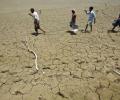
Rain deficiency in eastern and western Uttar Pradesh, Bihar, Jharkhand, Gangetic West Bengal, Assam and Meghalaya is 20-46 per cent less than normal as of June 17.

Experts say it will make GDP growth target of 5.7-5.8% difficult to achieve, while ministries feel late resurgence will help in sowing of rabi crops.

Pushed by rising prices of essential kitchen items, the retail inflation rose to an eight-month high of 7.34 per cent in September, making the RBI's task to push growth by reducing the interest rate even more difficult in coming the days. The Consumer Price Index (CPI)-based inflation was 6.69 per cent in August and 3.99 per cent in September 2019. Inflation has been hovering above 4 per cent since October 2019.

While the likelihood of these states going the Lanka or Greece way may be an alarming assessment, the financial situation of some states such as Punjab and West Bengal is indeed quite weak.

Eleven per cent increase in post-monsoon rain and new farm technologies are likely to more than make up for drought-hit kharif crop and result in a bumper grain production of about 220 million tonnes in 2004-05

People normally pray for good rain. But in a few villages of Chhattisgarh this year, it is a different story.

The fund allocated for pulses buffer is more than 40% of entire farm ministry's 2016-17 budget.
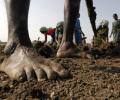
At present, 100 days of work is provided to rural job card holders under the Mahatma Gandhi National Rural Employment Guarantee Act (MGNREGA).

'I hope the trend is sustainable and that economic activity accelerates going forward.'

Analysts said the demand recovery in two-wheeler and car segments was skewed towards the semi-urban and rural markets.

Prices have continued to move up in Delhi's markets, wholesale and retail, on supply worries and spoilage due to record cold weather.
Agriculture Minister Sharad Pawar said on Thursday onion prices will ease in the next two-three weeks as fresh output arrives from Maharashtra and other states, providing relief to consumers.
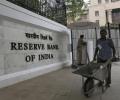
In all, RBI has cut interest rates by 110 bps this year. But this has not yet led to a boost in economic activity. While the growth rate has slowed to a five-year low, consumer confidence is waning and foreign direct investment has plateaued.

Only vaccinations can eliminate the threat of new waves, help raise sentiments and allow sellers and buyers to participate aggressively in the much awaited economic recovery, observes Mahesh Vyas.

India is expected to harvest 291.95 mt of foodgrain in 2019-20
The government on Thursday said based on the current monsoon situation, India's foodgrains output may rise by 29 per cent to 115 million tonnes.
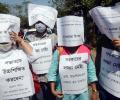
The cumulative loss of salaried jobs since the pandemic is even larger at 12.6 million, reveals Mahesh Vyas.

A meeting convened by Congress president Sonia Gandhi on Friday afternoon will see the leaders of around 20 opposition parties come together on a common platform through video-conferencing.

Since April, India has seen multiple strains of the coronanavirus sweep the nation, upending life and businesses alike. Out-of-home retail and discretionary categories such as durables, auto, fashion, lifestyle, hospitality, food services, travel, and tourism have been the worst-hit as Covid cases remain high, leaving state governments with no option but to curtail mobility and economic activity.
The reforms will help FPOs procure directly from farmers, something that they have been pressing for long.

Syed Firdaus Ashraf/Rediff.com lists 11 Modi flagship schemes that may have been gamechangers in the Lok Sabha election.

With the farmers' protest against the three new laws and in support of legalising the minimum support price (MSP) going strong, state governments have announced a slew of measures in their annual Budgets to placate farmers. The Centre kicked things off in the Union Budget by assuring farmers that the MSP would continue and coming out with a report card to demonstrate its commitment. However, these efforts don't seem to have yielded tangible results. In their respective Budgets, states chose to go a step further by announcing a variety of measures.
The Centre for Monitoring Indian Economy on Tuesday said industrial production growth is likely to decline in the second half of the current fiscal, while the first advanced estimate of kharif crop showed a 10 per cent drop in food production.\n\n\n\n

While reforms may translate into new opportunities for firms like ITC, Adani Wilmar and Reliance Retail, farmers are unlikely to use it for fear of upsetting commission agents.

Last month, the agriculture ministry had projected 10 per cent fall in kharif foodgrains production at 117.18 million tonnes in view of poor rains and drought in more than 360 taluks in Karnataka, Maharashtra, Rajasthan and Gujarat.

The move came a day after Parliament approved two agriculture sector-reform bills which have been bitterly opposed by the opposition parties like Congress and TMC.

Where do the four members of the Supreme Court appointed panel to interface with farmers stand on the Modi government's farm laws?
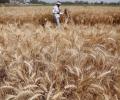
The decision will help farmers earn an additional income of Rs 62,635 crore

The rains have so far been four per cent below normal.

In its Fifth Bi-monthly Monetary Policy Statement, 2017-18, RBI said the second quarter growth was lower than the one that was projected in the October review, and the recent increase in oil prices may have a negative impact on margins of firms and Gross Value Added (GVA) growth.
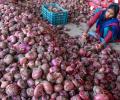
The Reserve Bank of India on Thursday raised its inflation projection to 5.1-4.7 per cent for the second half of the current fiscal on the back of spike in prices of vegetables such as onion and tomatoes.
NCDEX benchmark index up 10% over a month, as expectations on sowing gather pace

He said the government would provide meal at Rs 10 to common citizens and build a super-speciality hospital in every district of the state.
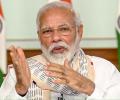
Modi said "timing" is very important to deal with any crisis and "decisions taken at the right time have helped a lot in controlling the coronavirus infection in the country".
