
A court in northern Mymensingh delivered the verdict Sunday under the tough Emergency Powers Act 2007.
Ten militants of a banned Bangladeshi Islamist outfit were sentenced to death ON Thursday by a fast-track court in Dhaka after they were found guilty of involvement in a deadly suicide bombing in 2005 that claimed eight lives.

All the convicts belonged to outlawed Jama'atul Mujahideen Bangladesh.

Neo-Jamaat-ul-Mujahideen's wanted leader Nurul Islam alias Marjan and another unidentified extremist were killed by Counter-Terrorism and Transnational Crime unit in Mohammadpur Beribadh area of the capital.

"The government has identified the masterminds of the two attacks, they will be exposed to justice," Home Minister Asaduzzaman Khan said.

He said the militant was killed in a pre-dawn encounter in Dhaka and was named in a police list as Shariful or Sharif, but he previously used several other names like Sakib alias Saleh alias Arif alias Hadi-1.

In a tit-for-tat, Bangladesh and Pakistan have reportedly detained each other's diplomatic staff amid a spat between them over the 1971 war crimes trial.
"The five terrorists killed at Gulshan (cafe) were JMB members. The police had their details and been looking for them for a while," Inspector General of Police AKM Shahidul Haque told media persons.

The five terrorists in the video, believed to be recorded sometime before the Gulshan attack, made statements to justify their stance, criticising the democratic system and political leaders.

Bangladeshi-Canadian Tamim Ahmed Chowdhury and dismissed army officer Syed Md Ziaul Haque have been identified as the brains behind the two terror attacks.

Immigration officials confirmed that Arshad, who was the second secretary at the political section of the high commission, left Dhaka on a Pakistan International Airlines flight on Wednesday afternoon.
Hoque said he alerted the chiefs of NIA and CBI against Chowdhury.

Police said they have recovered the body and sent it for an autopsy. An investigation was launched into the incident.

Security forces in the past 10 days have witnessed four major anti-militancy assaults against Islamic-State inclined Neo-Jamaatul Mujahideen Bangladesh in which seven people including an army lieutenant colonel and two police inspectors lost their lives while the assaults killed 15 militants and their children.
A woman and a teenage boy on Saturday blew themselves up in Dhaka when Bangladesh police's elite counter-terrorism unit raided a three-storey building where heavily-armed militants, belonging to an Islamist group blamed for the deadly cafe attack, were hiding.

A Bangladeshi-Canadian was on Saturday identified as the mastermind of Bangladesh's worst terror attack at a cafe in Dhaka.

Canadian-Bangladeshi Tamim Ahmed Chowdhury and his two associates were killed during an encounter at the militants' hideout.
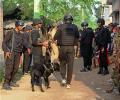
Three more suspects have been arrested in Dhaka in connection with the blast in West Bengal's Burdwan, amid a joint Indo-Bangla operation along the borders to nab over 100 militants of the outlawed Jama'atul Mujahideen Bangladesh.
Bangladesh has launched a nationwide manhunt for 400 members of a banned Islamic militant outfit and its allies, suspected to be responsible for Wednesday's serial blasts across the country.
"A seal from a factory in Bihar was found on the three AK22 rifles recovered after the Gulshan terror attack," Counter-Terrorism and Transnational Crime chief Monirul Islam was quoted as saying by the Dhaka Tribune.
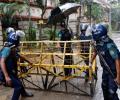
Bangladesh on Tuesday pressed anti-terrorism charges against several suspects and identified the fifth assailant in the country's worst terror attack as authorities intensified efforts to unravel the plot behind the brazen assault in which 22 people were slaughtered by Islamists.
Sheikh Hasina's government has launched a relentless war against terrorism since the Dhaka cafe carnage in July 2016, but as Bangladesh's terror networks exploit new technologies and new tactics, the challenge to eliminate jihad gets tougher, points out Binodkumar Singh.

Bangladesh on Monday banned an Islamist militant outfit that is believed to be behind the gruesome hacking deaths of three secular bloggers.

Sunil Gomes, 65, was found dead inside his grocery shop at around midday in northwestern Notore district, police superintendent Shyamal Mukherjee told PTI over the phone.
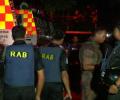
The Bangladesh government on Sunday claimed the attackers who slaughtered 20 hostages inside a cafe in Dhaka in the country's worst terror attack were members of "homegrown" Islamist terrorist outfits and not Islamic State of Syria and Iraq militants.
The chief of the terror group blamed for Bangladesh's worst terror attack at a Dhaka cafe was among the four Islamist militants killed in one of the country's longest anti-terror operations in Sylhet, police said on Tuesday.

"Our initial investigation suggests both the attacks were carried out by homegrown Jamaatul Mujahideen Bangladesh," said the home minister.

Acting deputy vice chancellor of a private university has been arrested in Dhaka along with two others for sheltering militants who carried out Bangladesh's worst terror attack at a cafe in which 22 people were killed by suspected Islamic State militants.
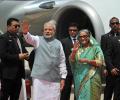
'When we have a terrorist outfit in a neighbouring nation, we need to do whatever we can to neutralise that threat,' says Ramananda Sengupta.
 © 2026 Rediff.com - Advertise with us - Disclaimer - Privacy Policy - Sitemap - Feedback - About us - Terms of use - Grievances