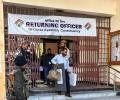
'PM Modi would have swept the elections in Kashmir after notebandi but then he scrapped Article 370 so all his good work went down the drain.'

Imran Khan's Pakistan Tehrik-e-Insaf is set to form government in the militancy-hit Khyber-Pakhtunkhwa province with the backing of the Jamaat-e-Islami while the Pakistan Muslim League-Nawaz and several smaller parties are expected to form a coalition in the restive Balochistan rovince.
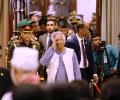
People in Bangladesh have welcomed the new interim government led by Nobel laureate Muhammad Yunus, hoping it would restore order, end repression and hold a fair election to facilitate a democratic transition of power.

In a remarkable display of resilience and commitment to democracy, the residents of villages that had long been deprived of polling due to terrorist threats and separatist-sponsored boycott calls turned out in large numbers to cast ballots in the sixth phase of Lok Sabha polls on Saturday.
Mohammed Saleem Engineer is the National Secretary of the Jamaat-e-Islami-e-Hind, the hardline Islamic organisation that has its headquarters in New Delhi. The organisation is an offshoot of the Jamaat-e-Islami party whose objective it is to establish an Islamic state in Pakistan that is ruled by the Shariah law.

Bangladesh is in turmoil, which is not good news for India, which shares a porous 4000 km border with it. There is a danger of fundamentalism growing there, and India has to move in to reset its ties with the new dispensation before China and Pakistan make capital out of it, alerts Ramesh Menon.
The Bangladesh police on Tuesday arrested two senior leaders of the Jamaat-e-Islami for their role in a massacre during the country's Liberation War in 1971.Muhammad Kamaruzzaman and Abdul Quader Molla were arrested at the gate of the Supreme Court in Dhaka for the massacre in Mirpuri, Dhaka, in 1971. Senior Jamaat-e-Islami leaders including Ameer Motiur Rahman Nizami and General Ali Ahsan Mohammad Mojahid have been named as the co-accused in the case.

Bangladesh Prime Minister Sheikh Hasina on Sunday secured a record fourth straight term as her Awami League party won two-thirds of the seats in the general elections marred by sporadic violence and a boycott by the main opposition BNP and its allies.
At least 23 people were killed when a suicide bomber struck during a protest organised by the Jamaat-e-Islami in the northwestern Pakistani city of Peshawar on Monday, hours after a blast outside a police-run school killed a young boy.
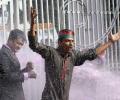
Bangladesh's decision to execute Jamaat-e-Islami chief Motiur Rahman Nizami for war crimes committed in 1971 has provoked anger across the Muslim world. Foreign Secretary S Jaishankar arrived in Dhaka hours after the execution, an important expression of India's support to Prime Minister Sheikh Hasina, explains Rajeev Sharma.

The increase in home-grown radicalised Islamic groups and the rise of Islamic State and Al Qaeda in Bangladesh should be a matter of worry for India, which shares a 4,100 km border with its eastern neighbour, says Rajeev Sharma.

Te Congress slammed the Centre's order, alleging that Prime Minister Narendra Modi wants to politicise employees on an ideological basis.
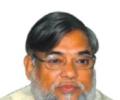
A top leader of the fundamentalist Jamaat-e-Islami party was sentenced to death on Wednesday by a special Bangladeshi tribunal for committing "crimes against humanity" during the country's 1971 liberation war.

Jailed ex-Pakistan premier Imran Khan's party-backed independent candidates on Friday sprang a surprise by winning 86 seats out of the 201 results declared following unusual delays and allegations of rigging, as the country appeared heading towards a hung assembly.

New Delhi -- which has had a disastrous neighbourhood policy that has alienated almost all the States with which it has a land or sea border -- seemed to be unwilling over the past years to even consider that its unquestioning support of Sheikh Hasina was painting it into a corner, points out Mihir S Sharma.

Both factions of the Jamiat Ulema-e-Hind (Arshad Madani and Mahmood Madani) slammed the Bill and expressed grave concerns over the proposed legislation.
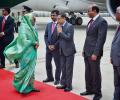
Sheikh Hasina, who was elected for a record fourth consecutive term and fifth overall term this year, was always admired by her supporters as "Iron Lady", before the dramatic development that abruptly ended her 15-year-rule in Bangladesh.
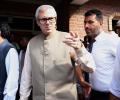
The former chief minister said if there was any danger of his losing from Budgam, then his party colleagues would not have allowed him to contest from Budgam.

Will Lieutenant Governor Manoj Sinha, who gets his orders from New Delhi, call the shots or allow a democratically elected government to independently govern, questions Ramesh Menon.
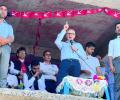
'If the country felt very strongly about the BJP, then why did the country not put money where the mouth is?'

The Bharatiya Janata Party on Tuesday clinched a stunning hat-trick win in Haryana overcoming anti-incumbency and dashing Congress' hopes of a comeback while the National Conference-Congress combine pulled off a spectacular victory in maiden elections in Jammu and Kashmir after abrogation of Article 370 in 2019.

India on Thursday described as 'matter of serious concern' reports that said some members of the Indian community in Canadian province of British Columbia received 'extortion calls'.

Alamgir said that even after the fall of the Hasina government following a people's uprising, the 'Indian establishment is yet to reach out to BNP, even though China, the US, the UK, and Pakistan have already done so.'
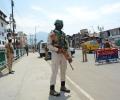
The action, announced by Union Home Minister Amit Shah, is a response to the group's involvement in fomenting terrorism and spreading anti-India sentiment within the Union territory of Jammu and Kashmir.
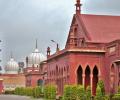
About 20 scholars had recently written to Prime Minister Narendra Modi complaining about the inclusion of the work of the two authors in the syllabus.

Bangladeshis on Sunday began voting in the general elections expected to be won by Prime Minister Sheikh Hasina in the absence of the main Opposition Bangladesh Nationalist Party (BNP) which is boycotting it.

It's intriguing that the prime minister now wants his American partner to help protect the Hindu minority in Bangladesh. That's conceding to the Americans a pre-eminence India has always contested, resented and feared, asserts Shekhar Gupta.

'In Kerala, if the Left had worked on stopping fascism the BJP would not have become a force today.'

'Bangladesh has become unstable and this instability will impact India.'

The clashes broke out this morning when protesters attending a non-cooperation programme to demand the government's resignation faced opposition from the supporters of the Awami League, Chhatra League, and Jubo League activists.

'The dominance of her party also meant that the institutions became lopsided -- whether it was the bureaucracy or the courts or the military.' 'She centralised power to the extent that you would see her representatives or her party office bearers having overly represented in these institutions.' 'That perhaps would have been the biggest blunder that she committed.'
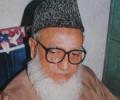
A 91-year-old top leader of the fundamentalist Jamaat-e-Islami was sentenced to 90 years in jail on Monday by a special Bangladeshi tribunal for masterminding atrocities during the 1971 war of independence against Pakistan.

The Supreme Court on Wednesday quashed the Centre's denial of security clearance to Malayalam news channel MediaOne, and pulled up the ministry of home affairs for raising national security claims in "thin air" without facts.

'If, as happened in Baramulla during the 2024 Lok Sabha election, the youth in the Valley get triggered enough to jump into the wider fray, the end result would be difficult to predict, especially as the state's post-August 5, 2019 political format remains substantially fragmented and foggy,' points out Mohammad Sayeed Malik, the veteran commentator on Kashmir affairs.

He was convicted of running a militia torture cell, Al Badr, which carried out killings of several people.
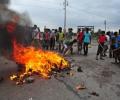
Fundamentalist Jamaat-e-Islami activists on Saturday held violent demonstrations, exploding several homemade bombs, to protest a Bangladeshi court ruling that barred it from contesting future polls.

The detentions come ahead of a crucial hearing on Article 35-A in Supreme Court which is likely to take place on Monday. The article, incorporated into the Indian Constitution in 1954, grants special rights and privileges to the citizens of Jammu and Kashmir.
A high-level government committee has accused activists of ruling Awami League alongside main opposition Bangladesh Nationalist Party and fundamentalist Jamaat-e-Islami for the attack on Buddhist temples and localities in south-eastern Bangladesh last month, reports said on Friday.
