
The Global Times, a prominent state-run Chinese media outlet, published an article titled "China and India are cooperation partners, not rivals: Xi," highlighting President Xi Jinping's remarks about the bilateral meeting, saying, "as long as the two countries stick to this overarching direction, China-India relations can sustain steady and long-term growth."

Why can't the Indian government propose to the Chinese a corridor circumambulating the Holy Mountain where people from both sides could perform the yatra again? asks Claude Arpi.
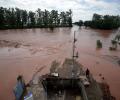
Pakistan has urged India to fully adhere to the Indus Water Treaty (IWT), expressing concerns about the level of detail in flood information shared through diplomatic channels.
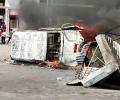
Former Indian ambassadors urge New Delhi to closely monitor the unfolding political crisis in Nepal, citing regional instability and potential implications for India's interests.
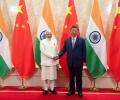
Prime Minister Narendra Modi and Chinese President Xi Jinping held bilateral talks focusing on economic ties and global stability amid trade tensions and the aftermath of the Ladakh border row.
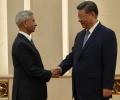
External Affairs Minister S Jaishankar met Chinese President Xi Jinping and apprised him of recent developments in India-China bilateral ties during the Shanghai Cooperation Organisation (SCO) Foreign Ministers' meeting in Beijing.

Putin further described the Ukraine conflict as a mere "pretext" by Western powers to take these broader punitive measures against countries maintaining strong economic ties with Russia.
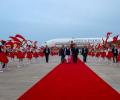
Prime Minister Narendra Modi arrived in China for the Shanghai Cooperation Organisation (SCO) summit. His meeting with President Xi Jinping is significant given global economic concerns.

A meeting with Chinese President Xi Jinping on the sidelines of the SCO summit is being planned.
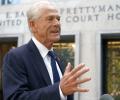
Former White House trade advisor Peter Navarro has criticised India for continuing to procure Russian oil, alleging profiteering and contributing to the Russia-Ukraine war. India defends its energy procurement as driven by national interest and market dynamics.

'However, we must implement a tit-for-tat approach -- reciprocating their conduct with precision.' 'If they demonstrate respect, we respond accordingly. If they adopt hostile positions, we mirror that hostility with equal intensity.'
Two senior Chinese ministers attended India's Independence Day reception in Beijing, signaling a potential improvement in relations ahead of Prime Minister Modi's expected visit to China for the Shanghai Cooperation Organisation summit.

India will look at disengagement and de-escalation of the situation along the Line of Actual Control (LAC) in eastern Ladakh after restoration of the status quo of April 2020, Army Chief General Upendra Dwivedi said on Tuesday, a day after New Delhi announced striking an agreement with Beijing to end the over four-year border row in the region.
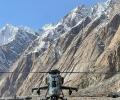
Disengagement of Indian and Chinese troops has started at two friction points in Demchok and Depsang Plains in the Eastern Ladakh sector, defence officials said.

Skipper Harmanpreet fired a hat-trick but India were far from impressive in their narrow 4-3 win over lower-ranked China in their Asia Cup opener, in Rajgir, Bihar, on Friday.
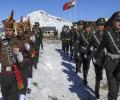
India on Monday announced it has reached an agreement with China on patrolling along the Line of Actual Control (LAC) in eastern Ladakh, in a major breakthrough in ending the over four-year-long military standoff ahead of a likely meeting between Prime Minister Narendra Modi and Chinese President Xi Jinping in Russia this week.
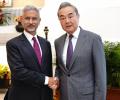
China promised to address three key concerns of India, the sources said.
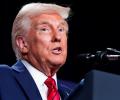
Earlier, Trump has already talked about slapping "100 per cent tariffs" on the BRICS grouping, a bloc that includes India as well.
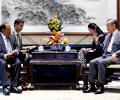
Chinese Foreign Minister Wang Yi will visit India for border talks with NSA Ajit Doval, ahead of PM Modi's visit to China for the SCO summit. The visit aims to improve bilateral ties after recent tensions.
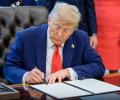
The collective West has always opposed strong leaders and economic development in India, asserts Colonel Anil A Athale (retd).
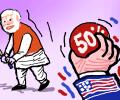
'Things may get much worse before they get better,' predicts Ajay Chhibber.

India and China on Wednesday held 'constructive' and 'forward-looking' diplomatic talks to resolve the over four-year border standoff along the Line of Actual Control (LAC) in eastern Ladakh but there was clear no indication of any breakthrough.

National Security Advisor Ajit Doval stated that India-China relations have shown an "upward trend" in the past nine months, with peace prevailing along the Line of Actual Control (LAC). This statement was made during talks with Chinese Foreign Minister Wang Yi on the boundary issue, ahead of Prime Minister Modi's visit to China for the SCO summit.

Chinese Foreign Minister Wang Yi said that it is imperative for the two sides to view each other as partners and opportunities rather than rivals or threats, and invest their valuable resources in development and revitalisation.
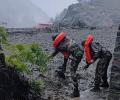
The NDRF has deployed its first-ever team of cadaver dogs to help locate those feared dead in the cloudburst incident in Uttarakhand. Disaster swept through the Himalayan village of Dharali on the way to Gangotri on Tuesday with a massive cloudburst leading to flash floods that barrelled through homes, trees, and cars, trapping 60-70 people and leaving at least four dead.
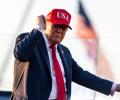
President Trump threatens to impose a 10% tariff on countries aligning with BRICS anti-American policies. This follows BRICS criticism of increased tariffs. Trump also announced tariff letters to various countries.

'If China shows greater concerns for Indian interests, ties could improve. Otherwise, the thaw could be short-lived.'

Hockey: India seek World Cup berth through Asia Cup triumph; up against China in opener

Prime Minister Narendra Modi is expected to visit Japan and China starting around August 29. The visit to China would be his first after the Ladakh border standoff.
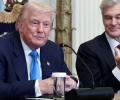
US President Donald Trump announced a deal with Pakistan to develop its oil reserves, suggesting Pakistan might sell oil to India in the future.
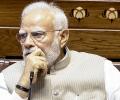
China welcomes Prime Minister Narendra Modi's planned visit to the Tianjin Summit of the Shanghai Cooperation Organisation (SCO), expressing hope that the event will be a 'gathering of solidarity, friendship and fruitful results'.
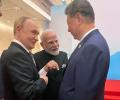
'One Chinese interlocutor said India should realise that "China can do without India, but India could not do without China", pointing to its inability to do without Chinese intermediates and components,' former foreign secretary Shyam Saran discovers on a visit to China.

External Affairs Minister S Jaishankar on Saturday credited the breakthrough agreement with China on patrolling along the Line of Actual Control to the military which worked in 'very very unimaginable' conditions and deft diplomacy.

United States President Donald Trump has warned that countries aligning with the BRICS economic bloc will face additional 10 per cent tariffs on their goods, as he seeks to protect the dollar's global dominance.

"The Modi government's approach to the entire crisis could be described as DDLJ: Deny, Distract, Lie and Justify," Ramesh said.
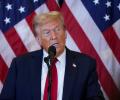
President Donald Trump on Tuesday claimed that BRICS was established to "hurt" the US and "degenerate" the dollar as he warned that the member countries of the bloc would face a 10 per cent tariff. Trump made the remarks while talking to reporters at the sixth Cabinet meeting at the White House.

National Security Advisor Ajit Doval on Monday emphasised the need to counter terrorism in all its forms for overall regional peace and stability during a meeting with Chinese Foreign Minister Wang Yi in Beijing.

United States President-elect Donald Trump on Saturday warned BRICS countries against any move to replace the US dollar and has sought a commitment from the nine-member group that includes India, Russia, China, and Brazil.

Trump's method are more destabilising than his policy. So, a good idea these couple of years is to sip Kool-Aid, and savour the joys of Trumplomacy, asserts Shekhar Gupta.

Rijiju also hit out at Congress leader Rahul Gandhi, saying that his own party MPs "get uncomfortable" when he speaks in Parliament and are apprehensive that he will do "anap-shanap baatein" and the party will have to bear the consequences.
