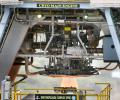
The Indian Space Research Organisation (ISRO) on Saturday said it has successfully conducted the flight acceptance hot testing of the cryogenic engine identified for the sixth operational mission of LVM3 launch vehicle (LVM-M6) at ISRO Propulsion Complex, Mahendragiri in Tamil Nadu.
Rigorous testing demonstrates the engine's mettle, it said, adding the CE20 engine identified for the first uncrewed flight LVM3 G1 also went through acceptance tests.
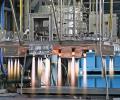
With these successful tests, ISRO has moved a step closer to India's first human spaceflight mission, Gaganyaan.
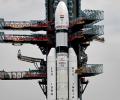
'The LVM3 rocket will orbit one Block 2 BlueBird satellite in Low Earth Orbit.'
'The work is already on with various data being studied.'
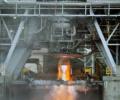
India's first indigenously designed and developed high-thrust cryogenic rocket engine generating a nominal thrust of 19 tonnes was successfully endurance hot-tested for 800 seconds.

The engine is earmarked for the LVM3-M3 mission identified for launching the next 36 OneWeb India-1 satellites, the Indian Space Research Organisation said.

'The ISRO has done enough simulations and also redundancies have been built in so that chances of such failure are remote. Still, we have to keep our fingers crossed'

K Sivan has to hasten the effort to bring in private players into satellite and rocket building and replicate India's software success in aerospace.
The fuel cost will come down if rockets are launched from Kulasekarapattinam as they will have a straight trajectory and need not have to avoid Sri Lanka, which is being done by rockets flown from Sriharikota.
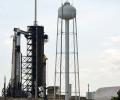
Indian astronaut Shubhanshu Shukla and three others are expected to travel to the International Space Station on June 19, after SpaceX successfully resolved the liquid oxygen leak in its Falcon-9 rocket, the Indian Space Research Organisation (ISRO) announced on Saturday.

This is the second of the series conducted at Aeronautical Test Range, Chitradurga, in Karnataka at 7.10 am.

Interspersing their tweets and posts with an occasional 'Welcome buddy!' and 'Thanks for the ride, Mate!', ISRO's social media handles occasionally departed from using just technical terms to give updates about India's ambitious Moon mission Chandrayaan-3.

The rocket flight was aborted in order to plug the liquid oxygen leak identified during post-static fire Falcon 9 rocket inspections.

Four years after it broke many hearts, Indian Space Research Organisation's Chandrayaan is all set to soar towards the moon in its third expedition on Friday in an attempt to put the country in an elite club of nations that accomplished lunar missions with a soft landing.
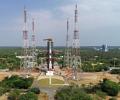
Days after landing on the Moon, India will aim for the Sun on Saturday with its maiden solar expedition, as ISRO's trusted PSLV will carry the Aditya L1 mission on a 125-day voyage to the Sun.

ISRO aims to send humans into space on a Low Earth Orbit of 400 km for a three-day mission and bring them safely back to earth.
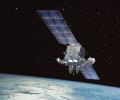
The Indian Space Research Organisation said it successfully carried out an "extremely challenging" controlled re-entry experiment of the decommissioned orbiting Megha-Tropiques-1 (MT-1) satellite.
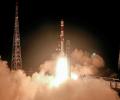
The Indian government has approved the construction of a third launch pad at Sriharikota, capable of sending heavier spacecraft into orbit. This new facility will support India's ambitious space program, including the Gaganyaan human spaceflight mission and a lunar landing. The launch pad will be built at the Satish Dhawan Space Centre and is expected to be operational within four years.

The entire mission operations of Chandrayaan-3, right from the launch till landing, "happened flawlessly" as per the timeline, the team that led India's third mission to the Moon said on Wednesday.

Skyroot Aerospace has become the first private company in India to give wings to the Indian space programme, after the sector was opened to private players by the Centre in 2020.

All spacecraft parameters are normal, the Bengaluru headquartered space agency said after the maneuver on the spacecraft.

Chandrayaan 3 follows the Chandrayaan 2 mission which did not achieve the desired soft landing on the surface of the moon in 2019, disappointing the scientists.

The 3,357-kg satellite, which was deployed from the lower passenger position of Ariane-5 launch vehicle (VA 251) into the geostationary transfer orbit, is configured on ISRO's enhanced I-3K Bus structure to provide communication services from Geostationary orbit in C and Ku bands.

The landing on the moon near the South Pole, an uncharted territory so far, would be on September 6 or 7, Sivan told reporters, as the Indian space agency is all set to embark on its most complex mission.

The soft landing of the spacecraft is planned for late August. The mission is expected to be supportive to future interplanetary missions.

Here is a glimpse of the journey of India's third lunar exploration venture has taken so far.

The ISRO is aiming for a soft landing of the lander in the South Pole region of the moon where no country has gone so far.

The ISRO had earlier said Chandrayaan-2 will be launched in a window from January-February 16, 2019.Sources said it is expected by the middle of next month but no date has been finalised.

Only three countries (United States, Russia and China) have successfully landed spacecraft on the airless lunar surface.

ISRO Chairman K Sivan described the GSAT-11 as the "richest space asset" for India.

The 3,423 kg GSAT-29 carries Ka and Ku band high throughput transponders intended to meet the communication requirements of users, including in the North East and in Jammu and Kashmir.

ISRO launched 12 Indian, 22 foreign satellites and successfully flight-tested India's first winged-body aerospace vehicle.

The rocket is almost 49 meters high -- as much as a 17-floor building. It weighs 415 tons -- as much as the combined weight of 80 full grown elephants.

It also carries equipment for meteorological data relay and satellite based search and rescue services being provided by earlier INSAT satellites.

Indian Space Research Organisation's plan to soft land Chandrayaan-2's Vikram module on the Lunar surface did not go as per script in the early hours of Saturday, with the lander losing communication with ground stations during its final descent.
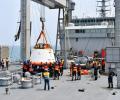
Nerves gave way to smiles at the spaceport in Sriharikota as delays and an anomaly-triggered 'hold' forced Indian Space Research Organisation (ISRO) scientists to revise the launch schedule of a test vehicle carrying payloads related to the country's ambitious human space flight mission, Gaganyaan which soared into skies after initial hiccups.
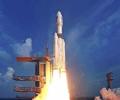
Taking its baby steps towards realising India's ambition to send humans into space, Indian Space Research Organisation on Thursday successfully tested the atmospheric re-entry of a crew module after its heaviest launch vehicle GSLV MK III blasted off from Sriharkota.

India will become the fourth country to master the technology of soft-landing on the lunar surface after the US, China and the erstwhile Soviet Union.

If all goes on well, the NISAR satellite will be launched in 2021 from India using the Geo-synchronous Satellite Launch Vehicle (GSLV).
 © 2026 Rediff.com - Advertise with us - Disclaimer - Privacy Policy - Sitemap - Feedback - About us - Terms of use - Grievances