
'The finance minister and the government have met the immediate challenge. The wine this time is new and also in a new bottle, which, though not full, is less than half empty.'

The Supreme Court on Tuesday ruled out making "wholesale changes" in the collegium system of appointment of judges for higher judciary.

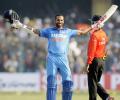
Shikhar Dhawan set the Green Park Stadium in Kanpur alight as India beat the West Indies by five wickets in the final One-day International and clinched the three-match series 2-1 on Wednesday. After the home side restricted the visitors to 263 for 5, the dashing opener scored a breezy 119 off 95 deliveries to overhaul the target with 23 balls to spare.

'We have been found seriously wanting in addressing our undersea warfare capability and China's emergence is a cause for concern.'

Cheteshwar Pujara and Rohit Sharma hit hundreds, but it was batting maestro Sachin Tendulkar who stole the limelight with a majestic 74 in his farewell match as India took a firm grip of the second Test against the West Indies, at the Wankhede stadium, in Mumbai, on Friday. When stumps were drawn on Day 2, the home side had the West Indies tottering at 43 for 3 in the second innings.

The Nobel Prize for Malala may have caused deep divisions across the globe and disturbed the peace, while the award to OPCW, though not without critics, may have served the cause of peace by eliminating a weapon of mass destruction from the face of the earth, says Ambassador T P Sreenivasan.

The choice before the next government is not between being a soft State and a tough State; it is between being a smart State and a dumb State, says former foreign secretary Shyam Saran.

'The Kashmiri wants freedom, the dignity that comes from it and the intellectual versatility that flows from the combination of the two,' says political historian Siddiq Wahid.

'India today has to fight many a battle, all of which cry out for innovation. This is where the experience of the Diaspora could be the most productive well-spring.'

The 20-time English Premier League champions are far from their best, but, in the final analysis, it is the results that matter, and at the moment they are on a winning spree, says Bikash Mohapatra
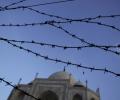
Everyone wants a piece of the Taj Mahal, but do they care about the deteriorating condition of India's best-loved monument

Do Modi's foreign visits actually serve India or they nothing more than expensive tools for domestic positioning and image-building, asks Shehzad Poonawalla.

From early indications, the Modi government's foreign policy seems to be pragmatic and reciprocal, says K G Suresh.

'In the merry-go-round of Indian cricket, amid abhorrent match-fixing scandals and incessant politicking, Ravi Shastri is a multifaceted personality who, when called upon, can don any hat with ease.'

How can 'first food' meet the challenge posed by factory-made 'fast foods' which are backed by marketing money and often come with 'traditional taste' tags attached to them? The first step would be to preserve knowledge about first foods, says Dinesh C Sharma.
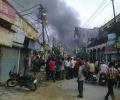
'If the BJP wants to build a minimally inclusive and secure society, in which vulnerable groups and religious minorities don't feel persecuted, then the Sangh Parivar, the party and its government must change their ways. Or else, they risk dividing India further -- violently and irreparably -- for narrow political ends,' argues Praful Bidwai.

'After many rudderless years, India and Japan have prime ministers with a sense of purpose and direction,' says Brahma Chellaney.

'Chinese leaders rarely receive their foreign guests in cities other than Beijing. Such respect for India!' 'Does it mean that Modi could replicate "the warmth and unconventional way" by sending Indian troops into Tibet, as Xi did in Chumur (Ladakh) when he arrived in India? Of course, Indians are far too polite to do so,' says Claude Arpi.

On Kishore Kumar's 86th birthday, we revisit a Rediff.com exclusive special by Pritish Nandy on the late legend.

Meet the US Attorney who took on Donald Trump.

Only reforms that accelerate economic growth can generate the revenues to finance expenditure on social infrastructure for the poor, not the other way round, insists Jagdish Bhagwati.

Prince William and Princess Catherine, the Duke and Duchess of Cambridge, collected quite a few Mumbai hearts on a hot two days in April.

It is rare for communal riots to spread to rural areas. The UP riot is the first time after the September 1969 Gujarat riots that a rural area have been affected. Electoral politics which divide society in majority/minority, going on since the early 1990s, is a major contributing factor to this heightened tension between communities, says Colonel (retd) Anil Athale in the first of a two part series.

'Communalism and communal riots happened in India only during and due to colonialism. Pre-colonial India didn't have this problem of communal conflicts and religious strife.'


Desis in the US recall their earliest celebration of the festival of lights on American soil. Chaya Babu reports
