
Here's the full text of address to the nation by President Droupadi Murmu on the eve of the Republic Day 2023.

A three-member crew will be sent to space for at least seven days.

ISRO hopes to put a crew on the moon, but it has to learn how to keep people alive and healthy in space first.

He said in almost all areas of security-related activities, the space -- earth observation, communication and electronic intelligence, among other things -- plays a very major role.

Thursday's launch is the last one of 2020 for ISRO.

The Indian Space Research Organisation has resolved to alight its lander on the lunar surface with Chandrayaan-3 in addition to a maiden solar expedition in 2020.

Dr Bhabha and Dr Sarabhai didn't feel guilty for their ambitions; it was for those 'mad scientists' that India is a powerhouse -- both at the atomic level and in the vastness of space, observes Kumar Abishek.

The ISRO had earlier said Chandrayaan-2 will be launched in a window from January-February 16, 2019.Sources said it is expected by the middle of next month but no date has been finalised.

Sivan asserted that though Chandrayaan-2 did not go as per script, it will have no bearing with on the 'Gaganyaan' mission.

The PM said Japan and the Indian diaspora has a big role to play in India's growth story.

India will be the fourth country after the United States, Russia and China to send humans to space.

The 3,423 kg GSAT-29 carries Ka and Ku band high throughput transponders intended to meet the communication requirements of users, including in the North East and in Jammu and Kashmir.
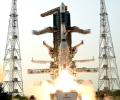
Over 32 missions -- satellites and rockets -- have been planned for the year.
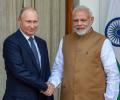
CAATSA was aimed at Moscow and not intended to damage the military capabilities of its 'allies and partners', US said.

President Ram Nath Kovind addressed the nation on the eve of India's 75th Independence Day. Here's the text of what he said:

'When the Americans are talking about colonising Mars by 2030, India cannot be lagging behind.'

Prime Minister Narendra Modi addressed the nation from the ramparts of Red Fort in New Delhi as India celebrates the 72nd Independence Day. This is Modi's fifth and final address as PM in the current tenure. During his speech, Modi reflected on the achievements of the National Democratic Alliance government and presented a report card of his four-year tenure. Here are the main takeaways from his address:
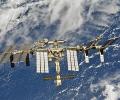
Once ISRO masters the technology to send humans into space, the next step will be experimenting with technologies allowing humans to live in space.

Stressing that both the government and the opposition have 'important roles to play', the President said, "While giving expression to their political ideas both must move forward in tandem to ensure that development of the country and welfare of its people are promoted consistently."

Chandrayaan-3's success is a must for India's space ambitions; we can't afford to lose out. And for realising our space dreams, the Indian private sector must be encouraged because if we lose this race, the moon, Mars, and mineral-rich asteroids will already be crowded before we reach there.

His remarks without naming any country came against the backdrop of tension between India and Pakistan after New Delhi revoked Jammu and Kashmir's special status.

Microsat-R, an imaging satellite, is meant for military purposes, but the ISRO did not give any details about it.

Scientists also expressed the hope that any technical problem will be sorted out by ISRO, and the mission will be launched successfully.

Here's the full text of President Ram Nath Kovind's address to the nation on the eve of 71st Republic Day.

Ahead of the G20 Summit, Prime Minister Narendra Modi met his Japanese counterpart Shinzo Abe in Osaka, Japan and discussed a range of issues of mutual interest.

"We are committed to building a new India. We have to do this as early as possible," he said.
 © 2026 Rediff.com - Advertise with us - Disclaimer - Privacy Policy - Sitemap - Feedback - About us - Terms of use - Grievances