
In one of the worst school shootings in American history, an 18-year-old gunman has killed 21 people, including 19 children, and two adults at an elementary school in Texas state, with an emotional President Joe Biden urging lawmakers to 'turn this pain into action' to control the powerful gun lobby.

'Instead of doing reforms and restructuring, the present government is busy with the perception that everything is fine and the economy is hunky-dory.' 'Such hollow perceptions are very dangerous for the Indian economy in the long run.' 'The real risk to India is the lack of decent employment opportunities for youth in general and educated youth in particular.'

'The government's full five-year term is unlikely to deliver more than 7+ per cent growth.' 'That's creditable, but no different from the 7.2 per cent achieved in the previous five years (2009 to 2014).' 'Those who expected the change of government to deliver a change of tempo would be disappointed,' says T N Ninan.

Pencilling in a GDP growth in third and fourth quarters, SBI Research on Wednesday revised its contraction forecast for the current fiscal year to 7 per cent. The agency had earlier forecast a 7.4 per cent contraction in 2020-21 GDP numbers. In April-September, the economy contracted 15.7 per cent but the second half may see a surprise 2.8 per cent growth, if the SBI analysis turns out to be correct.

The monetary authority said it was worried on three fronts with regard to inflation as well as the economy.

Agriculture activity, according to recent channel checks by Prabhudas Lilladher, is expected to continue at a strong pace in FY22.

The economic activities that registered growth of over 6 per cent in the second quarter are manufacturing, electricity, gas, water supply, other utility services and trade, hotels, transport and communication, and services related to broadcasting.

However, the growth, driven largely by a bumper rabi harvest and facilitated by relaxation in lockdown, may not have resulted in a big rise in income for a section of farmers.

Growth in the third quarter (October-December) is expected to be the weakest in years, with spending hit due to unavailability of enough replacement currency.

The services sector, which plays the biggest role in shaping the economy, is facing loads of issues currently. The largest segments, financial and real estate, are struggling to cope with bad debts and low demand for houses.

It is not a good idea to take the line that since demonetisation happened in the third quarter, everything that happened then was a consequence of that, says Chief Statistician TCA Anant.

The survey, however, said that GDP is expected to revert to growth terrain next year, when it is likely to grow by 7.2 per cent.
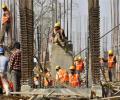
The First Advance Estimates of National Income, 2016-17 did not reflect the impact of demonetisation, effected on November 9 and are based on sectoral data for only seven months to October.

'The answer for a quicker boost to growth is simple -- run a much larger deficit, use the resulting public resources to ensure adequate price support for agriculture, subsidise wage costs of MSMEs and accelerate public sector construction-intensive activities,' advises Nitin Desai.

Economic growth has slipped to a six-year low of 5 per cent for the June quarter and is expected to turn in lower than that in the September quarter. Lack of consumption is seen as one of the key factors pulling down growth.

Small and medium enterprises have been struggling to raise bank credit even as they have been powering India's manufacturing growth in recent years.

This is mainly due to GST impact on manufacturing and subdued farm output.

The minders of the Modi government's economic policy believe it would take 7 to 8 quarters -- or till around late 2018 -- for the economy to reap the rewards of demonetisation.
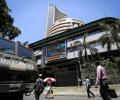
Bank Nifty pared all its intraday gains to end over 1% lower led by losses in BoB, ICICI Bank, Axis Bank and Bank of India

India's GDP may turn positive at 1.3 per cent in the third quarter of 2020-21, having witnessed contraction in the previous two quarters due to the coronavirus pandemic, as the number of cases is falling and public spending has started rising, according to a report. The government will release the GDP numbers for the October-December quarter of the current fiscal on Friday. Projecting that the gross domestic product (GDP) may have returned to the black in the last quarter of the calendar year 2020, DBS Bank in the report said the full-year growth in real terms may be at a negative 6.8 per cent.

Infrastructure, stricter implementation boost commercial vehicle sales

Although demonetisation and improper implementation of GST along with falling prices are being blamed for much of the distress in rural India for some time, experts believe those may not be the only reason.

India showed revival signs in the March quarter.

RBI has pegged the GVA growth of 7.6 per cent for the current fiscal and 7.9 per cent the year after

A good monsoon could rein in food inflation. Largely good corporate results mean better days are ahead. Nifty may reach record levels, points out Devangshu Datta.
The NCEAR has indicated some improvement in the fourth quarter of the current financial year.

Declaring demonetisation a complete failure may turn out to be hasty, argues economist Ashok K Lahiri.
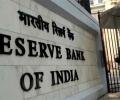
Headed by Urjit Patel, MPC for the fourth straight time kept the repo rate unchanged, at which it lends to the banks, at 6.25 per cent. The reverse repo, at which RBI borrows, will be 6 per cent.

The RBI announced its monetary policy on Tuesday.

Current Account Deficit is projected at 1.2 per cent and 1 per cent of GDP in 2014-15 and 2015-16.

ADB too had projected Indian's economic growth for current fiscal at 7.6 per cent

While rising food inflation is a matter of grave concern for a significant chunk of the population and for policy makers as well, it marks a turnaround in the fortunes of the farmer, reports Sanjeeb Mukherjee.

Recent estimates show that foodgrain production in 2016-17 has touched a new record of 273.4 million tonnes or 8.7 per cent higher as compared to last year.

The previous high in quarterly GDP growth was recorded in the January-March quarter of 2015-16 at 9.3 per cent.

This rate of growth has a number of implications.


The new series claims GDP grew at seven per cent between April and June 2015, while gross value added (GVA) grew at 7.1 per cent.

Rajan also said the outlook for agriculture is subdued, in view of both rabi and kharif prospects being hit by monsoon vagaries.

The economic growth is likely to moderate to 6.1 per cent, slowest in over seven quarters, from 6.6 per cent last year same period.

There were 86 million salaried jobs in India during 2019-2020. In August 2020, their count was down to 65 million. The deficit of 21 million jobs is the biggest among all types of employment, points out Mahesh Vyas.
