
If the industrial sector expanded, growth rate is likely to rise in the remaining quarters to reach 7.6-7.8 per cent for 2017-18.

'We would like to develop Andhra Pradesh into a logistics hub not only for India, but also for South Asia.'

Rating agencies Crisil and Icra on Monday revised down their India growth projections for the current fiscal and the second quarter mainly due to the ripple effect of slowdown in global growth and mixed crop output. Crisil downgraded the India growth forecast by 30 bps to 7 per cent while Icra pegged the economic expansion at 6.5 per cent for the second quarter of FY2022-23. "We have revised down our forecast for real gross domestic product growth to 7 per cent for fiscal 2023 from 7.3 per cent, primarily because of the slowdown in global growth that has started to impact our exports and industrial activity.

India's GDP is estimated to contract by a record 7.7 per cent during 2020-21 as the COVID-19 pandemic severely hit the key manufacturing and services segments, as per government projections released on Thursday. Amid overall decline in economic activities, some respite was provided by the agriculture sector and utility services like power and gas supply, which have been projected to post positive growth during the current fiscal ending March 2021.

India's economic growth slowed to 7 per cent in the three months through June from 7.5 per cent in the previous quarter

As the growth figures relate to pre-Covid lockdown period it does not reflect the real picture of distress which unfolded from April onwards in the sector, when acute supply disruption led to sharp drop in prices of many commodities largely perishables impacting farmers.
'I expect fourth quarter GDP growth to be sharply down.' 'I would imagine it would shave off at least one percentage point, if not more, as compared to the third quarter.'

In its Fifth Bi-monthly Monetary Policy Statement, 2017-18, RBI said the second quarter growth was lower than the one that was projected in the October review, and the recent increase in oil prices may have a negative impact on margins of firms and Gross Value Added (GVA) growth.

India said its economy grew 7.3 percent in the October-December quarter.

Central Statistics Office has come out with GVA to measure growth.

The biggest loss of jobs among salaried employees was of 'white-collar professional employees and other employees'. Among these are engineers including software engineers, physicians, teachers, accountants, analysts and so on, who are professionally qualified and are employed in some private or government organisation All the gains made in their employment over the past four years were washed away during the lockdown, reveals Mahesh Vyas.

Chief economist at State Bank of India has revised downward the full-year growth forecast to a low 6.8 per cent from 7.5 per cent earlier for FY2023, citing "the way below GDP numbers for the first quarter". The National Statistical Office on Wednesday released the Q1 growth numbers which showed a consensus growth of 13.5 per cent, pulled down by the poor show of the manufacturing sector, which reported a paltry 4.8 per cent expansion in the first three months of FY23, negating the robust show by the services sector. Consensus forecast was 15-16.7 per cent of which the RBI made the highest forecast of 16.7 per cent.

The country's gross domestic product (GDP) is likely to grow more than 9.5 per cent in fiscal 2021-22, an SBI research report-Ecowrap said. The economy grew at 8.4 per cent in the second quarter of the current fiscal, according to data released by the National Statistical Office (NSO) on Tuesday. The growth in the April-June quarter of this fiscal stood at 20.1 per cent. In October's monetary policy review, the Reserve Bank of India had retained its projection for real GDP growth at 9.5 per cent in 2021-22, consisting of 7.9 per cent in Q2; 6.8 per cent in Q3; and 6.1 per cent in Q4 of 2021-22.
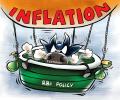
'Election years tend to see high government expenditure on unproductive schemes, though that money sloshing around can boost private consumption.' 'Again, it can mean higher inflation,' explains Devangshu Datta.

The previous high was recorded at 7.5 per cent in the July-September quarter of 2016-17.

Exim Bank pointed out that recent performance of the manufacturing sector in India is indicative of an underlying inertia.

A month-long national lockdown to arrest the spread of COVID 2.0 could shave off 100-200 bps of GDP, leading to a 300 bps risk to annual growth, a brokerage report has flagged while expressing doubts over the ability of local lockdowns to control the pandemic. The second wave of the coronavirus inflection has caught the government off-guard with the daily cases jumping over 6.5 times in the past 30 days. With close to 3.53 lakh fresh daily infections, the country is the worst hit globally.

A ramp-up in COVID-19 vaccination, healthy advance estimates of kharif (summer) crop and faster government spending were the factors which led to the revision, the agency said in a statement. It can be noted that after the 7.3 per cent contraction in 2020-21, there were expectations of a higher growth number in 2021-22.

RBI lowers GDP forecast for FY16 to 7.4%

But lower growth numbers in the quarters to come may not mean renewed weakness in the economy at the ground level, says Pranjul Bhandari.

India's growth slowed in three months through December from a revised 7.4% expansion in the previous quarter, but it was much stronger than expected.

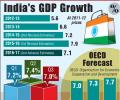
RE of GDP for 2015-16 show that the economy grew 7.9% in 2015-16, rather than the earlier estimate of 7.6 per cent.

Gross value added and low investment activity by the private sector remain areas of concern

The chief statistician feels there should be a rebound after companies integrate and adopt the GST system

The greatest disconnect lies in the estimates of industrial growth.

While India's GDP growth slowed to five-year low of 5.8% in Q4, China grew at 6.4%.

American brokerage BofA Securities on Friday said the Indian economy continues to be "weak", pointing to activity indicators tracked by it. On the positive side, the brokerage said credit demand is bottoming out and the real lending rates adjusted for wholesale price inflation are falling. It can be noted that there has been a slew of reports lately about a stronger recovery being underway after the jolt caused by the pandemic.

NSO has pegged economic growth at 5 per cent in 2019-20 in its second advance estimates.

The Indian economy remains on track to regain its position as the world's fastest-growing major economy after official estimates on Friday put the expansion at a tempered 9.2 per cent this fiscal amid concerns over the impact of a resurgent virus on the fragile recovery. The growth in the gross domestic product (GDP) of 9.2 per cent in April 2021 to March 2022 fiscal (FY 2021-22) given by the National Statistical Office (NSO) in its first advance estimate compares with 9.5 per cent expansion forecast by the Reserve Bank of India (RBI) last month. The economy had contracted by 7.3 per cent in the previous financial year.

The country's gross domestic product (GDP) growth is likely to be 8.8 to 9 per cent in the current financial year, driven by agriculture and industry sectors, Care Ratings said in a report. The country's economy had contracted by 7.3 per cent in fiscal 2020-21. The agency said the outlook for the Indian economy on almost all counts in FY22 would look seemingly better than FY21 on account of the negative base effect.

The technical report of the NSSO has generated controversy following its observation that as much as 36 per cent units forming part of MCA-21 database, used in computing GDP, could not be either identifiable or traceable in the field.

Private consumption is looking up and will get better as the full effect of the good monsoon is felt on rural income, and the effect of the payout from the Seventh Pay Commission is felt on urban income, say Anis Chakravarty & Rishi Shah.

To do so, the government will have to tackle a number of broad development challenges successfully, says Shankar Acharya

After contracting for two quarters in a row, the Indian economy entered the positive territory with a growth of 0.4 per cent in the October-December quarter, mainly due to good performance by farm, services and construction sectors, official data showed on Friday. Trade and hotel industry registered a contraction of 7.7 per cent during the third quarter this fiscal, as the sectors continued to suffer on account of coronavirus pandemic. According to the data released by the National Statistical Office (NSO), the farm sector recorded a growth of 3.9 per cent, and the manufacturing sector output grew by 1.6 per cent in the quarter under review.

Nothing in India's recent history suggests that India can provide 8-9 million jobs a year, let alone generate 50 million jobs in any reasonable time, notes Mahesh Vyas.

This time there has been a rather peculiar criticism of the latest GDP numbers.

The size of the GDP in the second quarter of 2018-19 is estimated at Rs 33.98 lakh crore, as against Rs 31.72 lakh crore a year ago

Recalibrating data of past years using 2011-12 as the base year instead of 2004-05, the Central Statistics Office estimated that India's GDP grew by 8.5% in the financial year 2010-11 and not at 10.3% as previously estimated.

The experience of direct cash transfer under PM-Kisan will be useful in designing a larger scheme of DBT for farmers combining all subsidies and support for the agriculture sector in the future, say Ramesh Chand & SK Srivastava.

Economic growth was revised from 4.7 per cent in FY14.
