
Most members of the Reserve Bank of India's Monetary Policy Committee (MPC) expressed concerns about inflation becoming generalised and highlighted uncertainties surrounding both inflation and growth prospects due to the West Asia conflict, according to the recently released minutes.

Nomura has increased its March 2027 target for the Nifty 50 to 25,900, driven by strong corporate earnings and attractive market valuations, even as risks from the West Asia conflict and high oil prices persist.

'You have seen the retrenchments by big corporates in the IT industry because they are not getting enough offers.' 'MSMEs in the manufacturing sector are really struggling. They do not know what to do. They are not able to predict what will happen tomorrow.'

Private hospitals accounted for 30.8 per cent of current health expenditure in FY23, while pharmaceuticals and medical goods contributed more than 21 per cent, underlining continued dependence on private healthcare and medicine spending.

The Indian economy is likely to grow at 7.4 per cent in 2025-26, up from 6.5 per cent in the previous fiscal, mainly on account of better performance of manufacturing and services sectors, as per the government data released on Wednesday.

The Indian stock market mythos of 36 years is wrapped in a diaphanous negligee, lashed together by a delicate, etheric sash of 1.6 bull markets. To make money from here on will require a ground invasion, trench by trench, rather than carpet bombing. Way more difficult, points out Shankar Sharma.

India's mergers and acquisitions (M&A) market is projected to maintain an annual run-rate of approximately $200 billion, evenly split between domestic, inbound, and outbound transactions, despite global geopolitical turbulence, according to Rajesh Singhi, global co-head, M&A Advisory, Standard Chartered Bank.

Indian benchmark indices Sensex and Nifty closed marginally lower due to profit-taking, following the Reserve Bank of India's decision to keep the repo rate unchanged while lowering its growth expectations for the current fiscal year and forecasting higher inflation.

JSW Motors, part of the JSW group, is set to enter India's passenger vehicle market with plans to launch 15 new-energy vehicles (NEVs) over the next four years, with deliveries commencing from December 2026.
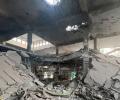
Under Mission Sudarshan Chakra, the country's national security shield is to be expanded by 2035 to ensure comprehensive protection of both strategic and civilian critical infrastructure.

Russian President Vladimir Putin and Chinese President Xi Jinping have reaffirmed their commitment to dismantling global hegemonism and building a 'multipolar world' during high-level talks in Beijing.

The IMF on Monday raised India's growth projection to 7.3 per cent for fiscal 2025-26, up 0.7 percentage point from its October forecast, on the back of better-than-expected performance of the economy. The Washington-headquartered multilateral lending agency has also revised India's Gross Domestic Product (GDP) growth forecast to 6.4 per cent for fiscal year 2026-27 beginning April 1, 2026, from its earlier estimate of 6.2 per cent.

Analysts predict that developments in West Asia, their impact on crude oil prices, and the trading activity of foreign institutional investors (FIIs) will be crucial factors influencing the Indian stock market this week.

A joint study by IBM and IndiaAI, a MeiTY initiative, indicates that Artificial Intelligence (AI) has the potential to contribute over USD 500 billion to India's economy by 2030. The report highlights the need for improved AI literacy, infrastructure, and data quality to fully realise this potential.

India emerged reasonably well from 2025. But now, the oil shock and war-related supply disruptions have again driven funds out of India and significantly weakened the rupee, points out Ajay Chhibber.

Prime Minister Narendra Modi has urged states to balance the opportunities presented by artificial intelligence with the need to safeguard against social challenges like cyber fraud and drug abuse. He also warned of the risks posed by El Nino conditions, calling for stronger water conservation measures and emphasising the collective resolve towards a 'Viksit Bharat'.

A prolonged supply shock can transmit to lower incomes, and dampen confidence and sentiment, warns Aditi Nayar, chief economist, head-research and outreach, ICRA.
The Indian economy recorded a six-quarter high growth of 8.2 per cent in July-September, as factories churned out more products in anticipation of a consumption boost from the GST rate cut, according to government data.

India's household debt climbed to 41.3 per cent of gross domestic product (GDP) at the end of March 2025, marking a sustained rise from its five-year average of 38.3 per cent, with consumption-related loans accounting for bulk of the borrowings, the Reserve Bank of India (RBI) said in its Financial Stability Report.

The IMD is predicting close to a 60% probability of deficient rainfall, which means there is a strong possibility that the monsoon this year will be poor.

'We won not (only) because we were able to carry out long-range precision strikes.' 'That is, of course, one of the reasons but we had better situational awareness about what's happening than Pakistan.'

Moody's Ratings on Friday said with a 7 per cent GDP expansion in 2025 and 6.4 per cent in the next year, India will lead growth among emerging markets and across the Asia Pacific region.

India's defence expenditure surged to $92.1 billion in 2025, making it the world's fifth-largest military spender, according to SIPRI data. This 8.9 per cent year-on-year rise was primarily driven by operational and procurement needs following heightened regional tensions with Pakistan in May 2025.

The Reserve Bank of India (RBI) and the central government have introduced a package of measures, including tax exemptions for FPIs on government securities and a concessional foreign-exchange swap facility, aiming to attract up to $50 billion in foreign capital. This initiative is designed to strengthen India's balance of payments and potentially cover the projected BoP gap for FY27.

India's real gross domestic product (GDP) is likely to grow at 7.5 per cent in FY26 and moderate to 7 per cent in the subsequent fiscal year, a domestic rating agency said on Wednesday.
Fitch Ratings on Thursday raised India's GDP growth forecast for the current fiscal to 7.4 per cent, from 6.9 per cent, on increased consumer spending and improved sentiment boosted by GST reforms.

'If the war continue for a longer period of time, it is just a matter of time before the government will pass on some of the price increases.'

'Once the currency goes out of the hand, then possibly your major challenge is that it will not come back.'

Uttar Pradesh Chief Minister Yogi Adityanath announced that the state has secured investment proposals worth approximately Rs 50 trillion over the past nine years, attributing this economic revival to the enforcement of the rule of law and strategic policy changes. He affirmed UP's trajectory towards becoming a $1 trillion economy by 2029-30.

If TVK MLAs and ministers are perceived as clean, or demonstrably cleaner than their predecessors, the credibility dividend will be enormous. The voter will feel rewarded, points out Ramesh Menon.

A State Bank of India report indicates a sharp increase in precautionary cash holding in India, with the gap between per capita currency in circulation and ATM withdrawals widening significantly, driven by global uncertainties despite record digital payment transactions.

'Unfortunately, today most ministers are busy with either election duty or praising duty. They are not interested in serving duty.' 'Ministers have become relaxed like retired people still holding onto jobs.' 'Look at how the NEET paper leaked. But there is no accountability.' 'After 12 years, they have become saturated. They are short of ideas.'

Brokerage Bernstein has warned Prime Minister Narendra Modi that India risks squandering recent economic gains unless it accelerates structural reforms, particularly in jobs, manufacturing and innovation.

India is conducting a special audit of 101 cities to assess ease of living from the citizen's perspective, Comptroller and Auditor General K Sanjay Murthy said.

Karan Adani of Adani Ports & Special Economic Zone emerged as the top absolute value creator, adding Rs 2.67 trillion as the company's mcap rose from Rs 42,149 crore in March 2020 to Rs 3.09 trillion in March 2026 (7.3x) -- the largest rupee addition on the list.

We who were dreaming of being the third largest economy in dollar terms, have slid back to sixth, thanks to the falling rupee. We are moving about with begging bowls for investments and trade opportunities, which will be a while in materialising, if ever, notes Shreekant Sambrani.

Insights from behavioural economics suggest that an ambitious nudge can be effective if three conditions are met, points out Ram Singh Insights from behavioural economics suggest that an ambitious nudge can be effective if three conditions are met, points out Ram Singh, director, Delhi School of Economics.
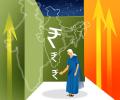
'I will not be surprised if there is a 7 per cent handle in front of the decimal place for the full financial year.'

Reserve Bank of India (RBI) Governor Sanjay Malhotra stated that preventing second-round effects of supply shocks, where inflation expectations rise due to prolonged disruptions, is the primary role of monetary policy. He also defended the RBI's foreign exchange market interventions, asserting it did not commit to an 'indefensible peg'.

India's first trillion-dollar company will be built on technology it owns, not just operates, predicts Ajay Kumar.
