

Opposition MPs in Rajya Sabha are questioning the Modi government's economic policies, particularly regarding energy security and the handling of the LPG crisis, raising concerns about financial transparency and regional equity.
Key Points
- Opposition MPs allege the LPG crisis reveals the Modi government's lack of a robust energy security policy.
- Concerns are raised about the Rs 1 lakh crore Economic Stabilisation Fund, questioning its legal framework and parliamentary oversight.
- The government is accused of withholding significant dues to West Bengal ahead of elections, impacting state finances.
- MPs highlight the vulnerability of the Indian agrarian economy to global supply chain shocks and rising fertiliser prices.
- Criticism is directed at the government's handling of education expenditure and teacher shortages, falling short of New Education Policy goals.
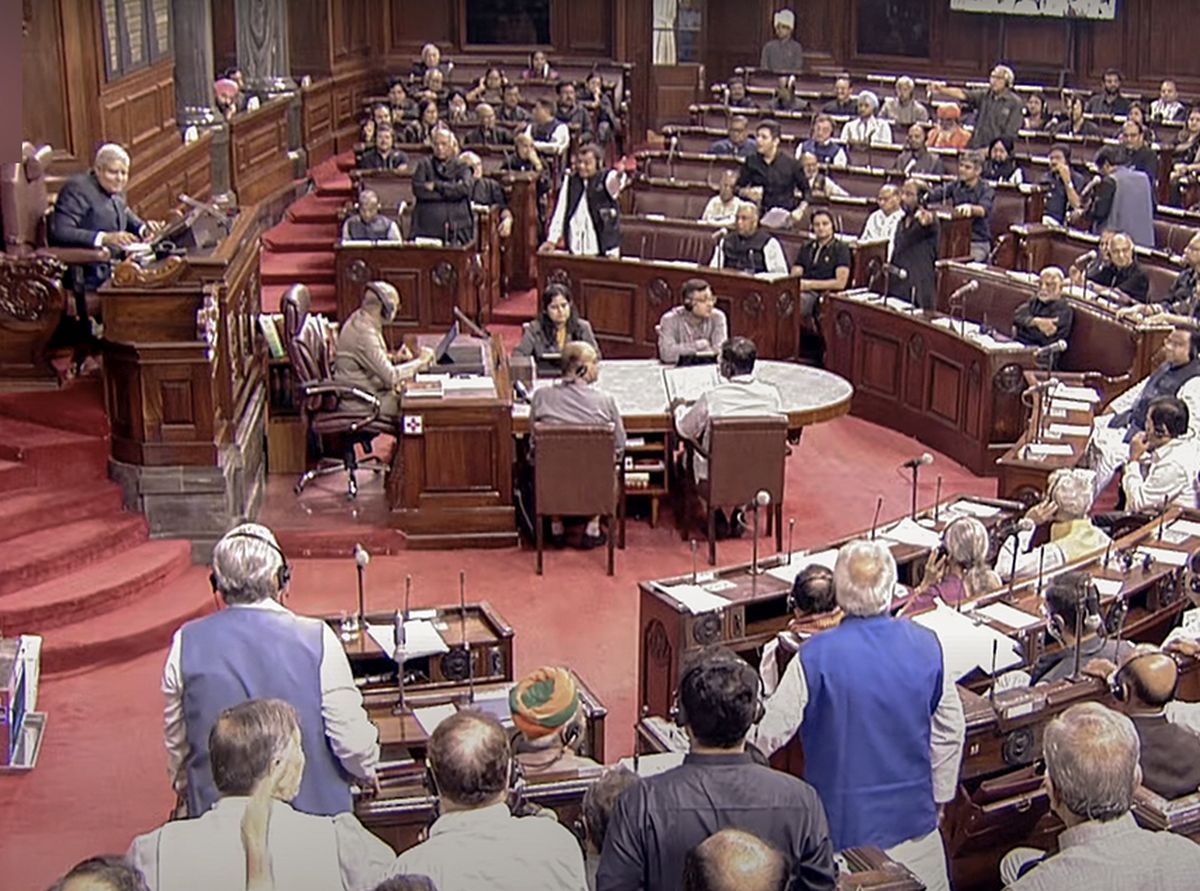
Opposition MPs in the Rajya Sabha on Tuesday alleged that the LPG crisis due to the West Asia conflict has exposed that the Modi government has no energy security policy and raised questions over the setting up of Rs 1 lakh crore Economic Stabilisation Fund.
Finance Minister Nirmala Sitharaman had on Friday said the Rs 1 lakh crore Economic Stabilisation Fund will give fiscal headroom to allow India to respond to global headwinds.
Participating in a debate on the Appropriation Bill, 2026, in the House Saket Gokhale of Trinamool Congress accused the Centre of withholding dues worth Rs 2 lakh crore to poll-bound West Bengal.
He asked whether the government will accept the motion for the removal of the Chief Election Commissioner which is being brought by all Opposition parties in Parliament.
"Like seasonal migratory birds PM Modi and Home Minister Amit Shah recently started visiting Bengal again to campaign for elections... The silence of the Prime Minister and Home Minister on the deprivation of the people of Bengal will give them an even nastier surprise in the upcoming elections," he claimed.
The TMC MP further alleged that 1.3 crore voters were marked as logical discrepancies using the AI software in West Bengal and even after election dates have been declared, over 60 lakh voters are under adjudication. They still don't know whether they will get a chance to vote in the upcoming elections.
"We have about 3-4 weeks until West Bengal goes to polls. Will the Union Government at least as a token to the people of Bengal release Rs 2 lakh crore worth of dues owed to the state including Rs 52,000 crore under MNREGA before the state elections," Gokhale said.
Concerns Over Economic Stabilisation Fund
Referring to the Economic Stabilisation Fund, Gokhale claimed there is no legislation governing it, there are no rules on when it can be drawn, by whom or for what purpose. He said there is no oversight mechanism from Parliament for this fund of Rs 1 lakh crore.
He asked what is the legal framework governing the Economic Stabilisation Fund, under what statutes was it created, who decides how the fund is deployed, and sought to know how different is this fund from the existing Contingency Fund of India.
"This fund has no Parliamentary oversight.. this is the government writing a blank cheque for itself," the TMC MP claimed and alleged that this government is an expert at creating non-transparent, opaque funds.
"With this (Appropriation) Bill the government is asking for Rs 4.13 lakh crore in supplementary demands. This means that the government's own Budget which they presented last year was off by nearly 8 per cent of the total expenditure," Gokhale said.
Impact of Global Events on Indian Economy
Asserting that there is an LPG shortage across the country, he observed that the rupee has fallen to a historic low of 92 per dollar.
"Today it has been tragically exposed that this government has no energy security policy... The West Asia crisis has predictably resulted in a massive hike in fertiliser prices. This shows that the Indian agrarian economy remains highly vulnerable to global supply chain shocks. With Gulf countries accounting for around 70 per cent of India's urea imports ... the government's inability to hedge against changing commodity prices is going to affect the farmer on the ground," he said.
The TMC MP said earlier this month, the government hiked domestic LPG cylinder prices by Rs 60.
"It is a pretty accepted fact that when 4 major states are going to elections no government has the courage to hike LPG prices ... you only do it because you have absolutely no other option left. So it is clear that there is an LPG crisis otherwise this government would not have increased prices by Rs 60 before 4 crucial (state) elections," he claimed.
Broader Economic Criticisms
Kanimozhi NVN Somu of DMK alleged that the 12 years of the Narendra Modi government from 2014 to 2026 were "a dark period in the annals of independent india marked by economic backsliding, economic distress and social polarisation".
She said India is currently facing an oil and LPG crises triggered by the West Asia conflict affecting the fuel supply.
Referring to the Economic Stabilisation Fund, Priyanka Chaturvedi of SS-UBT said, "Just yesterday we saw the Rajya Sabha elections happen in various states. Perhaps the funds are now being called as horse trading funds to be able to buy and sell MLAs to get votes to ensure the stability of BJP and its allies through independent MLAs".
Ramji from BSP drew the government's attention towards the allocated expenditure for education at 4.1 per cent of GDP amounting to Rs 1.39 lakh crore, saying the New Education Policy (NEP) recommends it be raised to 6 per cent of GDP. He also raised the issue of shortage of teachers, and school dropouts across the country.




 © 2026