
Indian benchmark indices Sensex and Nifty experienced a decline in early trade, mirroring weak global market trends and persistent outflows from foreign institutional investors (FIIs), exacerbated by ongoing geopolitical uncertainties in West Asia.

Indian stock market benchmarks, Sensex and Nifty, saw gains in early trading, driven by anticipation surrounding the Reserve Bank of India's monetary policy decision, despite mixed global cues and significant FII outflows.

The Reserve Bank of India (RBI) has reported a significant increase in the use of the Indian Rupee (INR) for import and export invoicing and settlement, highlighting its growing internationalisation and mutual benefits for trading partners.

Prime Minister Narendra Modi announced that the India-UK Comprehensive Economic and Trade Agreement (CETA) will come into effect on July 15, 2026, anticipating a significant boost to bilateral trade and investment.

Indian benchmark indices Sensex and Nifty rebounded in early trade, driven by strong buying in blue-chip stocks and positive cues from Asian markets, following a significant selloff in the previous session.

Indian benchmark indices, Sensex and Nifty, experienced a decline in early trade due to uncertainty surrounding the upcoming US-Iran negotiations in Doha. Foreign fund outflows and a dip in major IT stocks further contributed to the market's cautious sentiment, despite mixed performance in global markets.

US Secretary of State Marco Rubio arrived in Kolkata for a four-day diplomatic tour to India, marking the first visit by a US secretary of state to the city in 14 years. His itinerary includes meetings with Indian officials, energy talks, and a Quad Foreign Ministers Meeting.
The BSE benchmark traded 44.43 points up at 76,521.93, and the Nifty quoted 17.20 points higher at 24,048.85. Track Stock markets on May 26.

Indian benchmark indices, Sensex and Nifty, experienced subdued trading and turned flat on Tuesday as investors engaged in profit-booking following a recent rally, compounded by weak Asian market trends and fresh foreign fund outflows.

Delhi Police busted an illegal forex trading call centre in Indore, arresting six individuals involved in defrauding victims nationwide through fake online investment schemes. The syndicate allegedly used a fake trading platform to lure people into investing in forex and online trading products, showing fabricated profits and gains.

Indian equity markets experienced a significant decline in early trade, with the BSE Sensex and NSE Nifty dropping, as escalating geopolitical tensions in West Asia and a surge in global oil prices dampened investor sentiment. Track Sensex, Nifty50 movement and key market drivers for May 8, 2026.

Indian stock market benchmark indices Sensex and Nifty rebounded in early trade, driven by a decline in crude oil prices, supportive global cues, fresh foreign fund inflows, and buying in blue-chips like Reliance Industries and HDFC Bank. Track Sensex, Nifty movement on June 22, 2026.

Indian benchmark indices Sensex and Nifty experienced volatile trade, declining in early deals before fluctuating, as investors reacted to unabated foreign fund outflows and rising geopolitical uncertainties, particularly in West Asia.

Market benchmark indices Sensex and Nifty drifted lower in early trade on Monday amid renewed hostilities between the US and Iran. The 30-share BSE Sensex declined 63.65 points to 77,047.63 during initial trading. The 50-share NSE Nifty went marginally up by 16.55 points to 24,070.20. Later, the BSE benchmark dropped 246.54 points to 76,853.93, and the Nifty dipped 50.55 points to 24,005.45. Track Sensex, Nifty on June 29.

Indian benchmark indices Sensex and Nifty rebounded in early trade, recovering from previous losses, driven by softening crude oil prices and renewed buying interest in blue-chip stocks. Analysts note that the fall in Brent crude below USD 77 has removed significant macro headwinds for India, contributing to market stability.

Indian benchmark indices Sensex and Nifty rallied in early trade, driven by a significant decline in Brent crude oil prices, which fell below the USD 73 per barrel level, and positive trends observed across most Asian equities.

Indian benchmark indices, Sensex and Nifty, experienced a significant drop of over 1 per cent, driven by a bearish trend in global markets, weakness in HDFC Bank and IT firms, and fresh foreign fund outflows.

India has launched anti-dumping investigations into imports of thermal paper, Biaxially Oriented Polyamide (BOPA) Film, and certain antioxidants from China, following complaints from domestic manufacturers alleging material injury due to cheap imports.

The Indian stock market's movement this week will be significantly influenced by the outcome of US-Iran talks, global crude oil prices, and the trading activities of foreign institutional investors (FIIs), according to market analysts.
Indian benchmark indices Sensex and Nifty experienced a significant downturn in early trade, ending a five-day rally, primarily due to heavy selling in IT firms following a revenue growth guidance cut by global consulting giant Accenture.
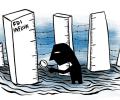
India's net foreign direct investment (FDI) surged more than fourfold to $6.58 billion in April 2026, driven by a significant increase in equity inflows and reduced repatriation by foreign investors, according to the Reserve Bank of India (RBI).
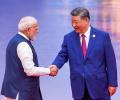
India's dual pursuit of a robust strategic partnership with Washington and a pragmatic, tension-management policy with Beijing represents the essence of modern multi-alignment. By embracing economic pragmatism, learning to compartmentalize political differences, and engaging in continuous dialogue, India can secure its borders, grow its economy, and contribute to a stable, multipolar Asian century, points out Ambassador Rajasekhar.

Following a Memorandum of Understanding between the US and Iran to resolve the West Asia conflict, eleven India-bound vessels have successfully transited the Strait of Hormuz. This development signals a positive shift for maritime trade, with more Indian-flagged ships expected to pass through the crucial waterway soon.

Prime Minister Narendra Modi has begun a six-day tour of the UAE, the Netherlands, Sweden, Norway and Italy to strengthen bilateral relations amid geopolitical challenges. The trip will focus on energy security, trade, and technological cooperation.

Indian benchmark indices, Sensex and Nifty, opened lower on Tuesday, driven by a surge in global crude oil prices and continued outflows by Foreign Institutional Investors (FIIs), reflecting fragile market sentiment influenced by external factors.

US President Donald Trump is set to visit China for talks with President Xi Jinping on trade, global issues, and the Gulf war. The visit aims to address trade frictions and other key issues, with high expectations for progress.

Monthly gold imports have declined to 25-30 tonnes from 70-80 tonnes while recycling of old jewellery has increased following the recent hike in import duties.

Indian benchmark indices Sensex and Nifty rallied in early trade, driven by a positive trend in global markets, cooling crude oil prices following a US-Iran peace deal, and fresh foreign fund inflows.
Indian equity benchmark indices Sensex and Nifty rebounded in early trade, driven by buying in blue-chip stocks and a positive trend in Asian markets, with domestic institutional investors providing crucial support.
Indian benchmark indices Sensex and Nifty recovered early losses to trade higher, supported by encouraging developments on the geopolitical front, specifically the US-Iran peace deal, and easing crude oil prices.
Indian benchmark indices Sensex and Nifty experienced a significant tumble in early trade, driven by surging global oil prices, continuous outflows by Foreign Institutional Investors (FIIs), and persistent geopolitical uncertainties, particularly in West Asia.
Indian stock markets, including the Sensex and Nifty, rebounded significantly, driven by a decline in crude oil prices and positive global cues stemming from hopes of diplomatic progress in US-Iran negotiations.

Chinese Foreign Minister Wang Yi met with National Security Advisor Ajit Doval in New Delhi, stressing the importance of respecting each other's "core interests" and implementing leaders' consensus for stable bilateral relations. Wang highlighted that India and China should view each other as partners, not rivals, and properly handle sensitive issues like the border dispute to foster cooperation and accelerate the modernisation of the Global South.

Iranian President Masoud Pezeshkian is on a state visit to Pakistan to discuss the full implementation of an agreement signed between Iran and the US, alongside regional and international developments. The visit also aims to strengthen bilateral cooperation across various sectors, following recent high-level talks between the US and Iran in Switzerland regarding regional security.
Indian equity benchmark indices Sensex and Nifty closed lower on Thursday, driven by escalating tensions between the US and Iran, persistent foreign fund outflows, and concerns over rising US inflation.

US President Donald Trump received a red carpet welcome in Beijing for talks with Chinese President Xi Jinping on trade, the Iran war, and other key issues. The visit underscores the importance both nations place on their relationship amid ongoing tensions.

Industry bodies representing alcoholic beverage manufacturers have welcomed the India-UK Free Trade Agreement (FTA), which will see tariffs on UK whisky and gin reduced, boosting bilateral trade and supporting premiumisation. However, domestic manufacturers are calling for state governments to withdraw concessions currently enjoyed by imported liquor brands.
Indian stock market benchmark indices, Sensex and Nifty, experienced declines in early trade due to escalating tensions between the US and Iran, which led to a surge in crude oil prices and weak global equity trends.
Indian benchmark equity indices, Sensex and Nifty, rebounded nearly 1 per cent, with the Sensex jumping 790.54 points to 76,991.22, driven by softening crude oil prices and strong buying in banking, financial, and IT shares.

Indian markets on Dalal Street rallied sharply as easing tensions in the US-Iran conflict and stable oil prices boosted sentiment. Track Nifty 50 and BSE Sensex performance and key global triggers.
