
Top Indian military commanders highlight the success of Exercise Trishul in enhancing jointness and interoperability among the Army, Navy, and Air Force. The exercise, culminating in Amphex 2025, involved 30,000 troops, multiple aircraft, and naval vessels, including INS Vikrant.
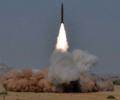
Pakistan on Thursday successfully test-fired a ballistic missile capable of carrying nuclear and conventional warheads to targets as far as 1,500 kilometres, bringing many Indian cities under its range.
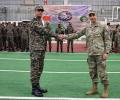
'When our soldiers trained side by side, we demonstrated to the world that our partnership is strong, enduring and prepared to meet any challenge.'
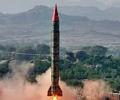
Pakistan on Wednesday tested the Hatf-V nuclear-capable ballistic missile with a range of 1,300 km, with the military saying that the launch was aimed at strengthening the country's deterrence capability.

Pakistan on Saturday test fired two short-range ballistic missiles capable of carrying nuclear and conventional warheads and striking Indian cities, with Premier Yousuf Raza Gilani saying it was time for the world to recognise his country as an atomic power.The armed forces conducted 'training launches' of the Shaheen-I missile with a range of 650 km and the Ghaznavi missile with a range of 290 km at the conclusion of an annual field training exercise.
Pakistan on Friday test-fired a 700-km-range nuclear-capable ballistic missile which could hit targets inside India as its Army Chief dismissed as an "irresponsible alarm" concerns about the country's atomic weapons falling into the hands of terrorists.
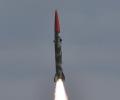
Pakistan on Tuesday successfully test-fired a short-range surface-to-surface ballistic missile Hatf III (Ghaznavi), capable of carrying nuclear and conventional warheads to a range of 290 kilometres, that could cover parts of India.
Pakistan on Monday test-fired the Shaheen-II long-range ballistic missile for the second time in three days, which can carry nuclear and conventional warheads and hit targets within India. The Shaheen-II or Hatf-VI surface-to-surface ballistic missile, which has a range of 2,000 km, was launched for the first time during a field training exercise by the army's Strategic Forces Command, the military said in a statement.
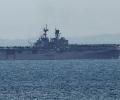
Although extensive air attacks have been carried out to destroy most of Iran's defence capabilities, the latter's resilience and sustenance during the war clearly indicate that the US landing force would encounter severe resistance in the operation, explains Commodore Venugopal Vengalil (retd).

The commanders' conclave in a forward area in Sikkim, which is close to the Line of Actual Control, comes amid the lingering border row in eastern Ladakh.
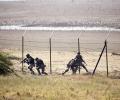
India's combat capability and readiness to confront any multi-dimensional security threat was elaborately tested at a four-day mega military exercise conducted in the Creek sector of the Kutch peninsula that concluded on Monday, military officials said.
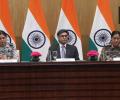
"It is shocking to note that Turkey, the second-largest arms supplier to Pakistan after China, has played a key role in modernising Pakistan's navy and enhancing its aerial warfare capabilities. "This defence collaboration is not just commercial; it is ideological, targeting the stability of South Asia and emboldening Pakistan's military adventurism," SJM national co-convenor Ashwini Mahajan said in a statement.

India is no longer shying away from playing a role on the regional and international stages and is willing to don a bigger role in regional politics. It is showing traits of a responsible stakeholder in the regional security dynamics, says Dr Rahul Mishra.

China supplied more than $20 billion worth of arms to Pakistan. These include 20 J-10CE and JF-17 Block III fighter aircraft, Wing Loong drones, frigates, submarines, Hongqi HQ-9P surface-to-air missiles, 240 PL-15E air-to-air missiles, LY-80 air defence systems, ZDK early warning aircraft and other weapons.

Reports (not denied by India) that the USA had 'for the first time provided real-time details to their Indian counterparts on the Chinese positions and force strength in advance of a PLA incursion' into Tawang at the LAC in December 2022, helping India thwart China's expansionist designs, show how operationally effective the USA-India friendship has become on the ground. A engaging excerpt from Sreeram Chaulia's must-read new book, Friends: India's Closest Strategic Partners.
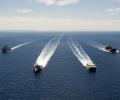
In the lead up to this week Indo-US Strategic Dialogue, for which United States Secretary of State, John Kerry, will be coming to Delhi, the Indo-US defence engagement is even more intense than usual.

General Naravane's UAE and Saudi Arabia visits communicate India's long awaited arrival in the domain of integrated foreign policy where the diplomatic and the military domains both complement each other much more substantially, observes Lieutenant General Syed Ata Hasnain (retd).
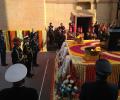
According to convention, Lieutenant General Praveen Bakshi should be named as General Dalbir Singh Suhag's successor as army chief
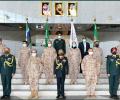
'The attacks made clear to all the Gulf States that Pakistan was the nursery and sanctuary of extremist violence and that this violence threatened all the countries in the region.'

The 2.3 million strong People's Liberation Army, the world's largest, adopts a more aggressive posture with massive structural revamp.

India failed to extract the 'price' from Pakistan for its Kargil misadventure.
The price could have been military in terms of loss of territory/soldiers/equipment or destruction of terrorist training infrastructure. Giving a 'face saving' option to Pakistan proved disastrous for the future, asserts Colonel Anil A Athale (retd).
Three takeaways for individuals living in a global society today, where misinformation and disinformation are rife.

'My adrenalin kicked in and the happiness returned! It was time to go in for the kill again.' IAF Veterans Group Captain Dilip Kumar Dass tells Air Commodore Nitin Sathe about how the IAF decimated tanks in the famous Battle of Longewala.
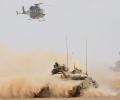
'Offensive operations to capture objectives across the LoC to eliminate terrorist launch pads and deny the use of the most dangerous routes of infiltration, are likely to be limited to brigade-level attacks.' 'These limited operations are unlikely to escalate to war across the international boundary,' says Brigadier Gurmeet Kanwal (retd).

General T N Raina was an iconic Indian military leader whose contributions to the nation should be more widely known, notes Lieutenant General Syed Ata Hasnain (retd).
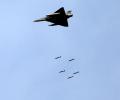
'Crucial intelligence was obtained by a R&AW operative from a couple of moles inside the camps four days before the Balakot operation.'
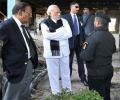
The Indian Army and more recently the Indian Navy have already set up dedicated intelligence branches. It is surprising indeed that the IAF, where real time and timely intelligence is most vital for effective and safe prosecution of the air war, has still not done so itself, says Group Capt (retd) P I Muralidharan.
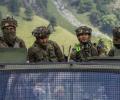
'The leverage created by the Indian military must not be lost.'
India has experienced hands and will emerge with flying colours, declares Inspector General Gurdip Singh Uban (retd).

'The strategy has to be restoring order in one part and countering the very effective propaganda through a very nimble monitoring and response system,' says Lieutenant General Syed Ata Hasnain, who retired as the General Officer Commanding of the Srinagar-based 15 Corps.

'Ensuring through diplomatic means and in conjunction with strategic partners that India will not be required to fight a simultaneous two-front war with China and Pakistan.' Brigadier Gurmeet Kanwal (retd) lists what India must have in its national security strategy.

During a war, there are just four possibilities a soldier faces. One: Victorious and safe. Two: Wounded. Three: Killed in action. Four: Prisoner of War. It was my fate to face the fourth, says Colonel Anil A Athale (retd) on the year spent as a prisoner of war in Pakistan during the 1971 War.
 © 2026 Rediff.com - Advertise with us - Disclaimer - Privacy Policy - Sitemap - Feedback - About us - Terms of use - Grievances