
Mihir Tanna, Associate Director, S K Patodia & Associates, answers your tax queries.

'Some of the launches may get deferred due to the semiconductor shortage, which is unlikely to get resolved before the second half of 2022.'

'The overall death claims have gone up.'

The budget underscores government's previous emphasis on capex to sustain near-term recovery from the pandemic, while simultaneously paving the way for longer-term restructuring of the economy, it stated. But the various spending initiatives are not offset by any significant announcements related to further increase revenue generation; rather, the announced revenue-related measures are aimed at other objectives such as fostering startup innovation, ensuring more equitable treatment for cooperatives and state employees, and promoting tax compliance through simplification, Christian de Guzman, a senior vice-president, sovereign risk group, Moody's Investors Service, said.

In 2017, when Infosys announced that Salil Parekh would be its next chief executive officer (CEO) and managing director (MD), very few in the industry or the analyst community doubted his ability to bring the company back to a healthy growth trajectory, improve morale within the company and, more importantly, win the promoters' trust and investor confidence. There were reasons for this confidence. He was not only the deputy CEO of the Paris-headquartered IT services major Capgemini, but also one of the only non-European faces on the executive board of the company.

Edtech giant Byju's is set to lay off nearly 2,500, or 5 per cent, of its employees as part of an "optimisation" plan. The move by India's most valuable start-up comes amid a funding winter and steep losses. "To avoid redundancies and duplication of roles, and by leveraging technology better, around 5 per cent of Byju's 50,000-strong workforce is expected to be rationalised across product, content, media, and technology teams in a phased manner," said the company in a statement. In June, Byju's laid off about 600 employees at its group companies -WhiteHat Jr and Toppr.


International Monetary Fund Chief Economist Gita Gopinath tells Indivjal Dhasmana high-frequency indicators for the third quarter of 2021 indicate momentum in economic recovery in India.

The country's largest carmaker Maruti Suzuki India will not "walk away" and fight to get back to 50 per cent market share in the domestic passenger vehicle segment, according to company Chairman R C Bhargava. The auto major, which is commemorating 40 years of operations, has seen its market share drop to 43.38 per cent in FY22 from a peak of 51.21 per cent in FY19. In order to get back its dominant leadership, the company plans to drive in models catering to both urban and smaller cities and rural areas.

'We suggest investors with suitable risk appetite to consider allocating 40-50 per cent in large-caps, 25-30 per cent of funds in quality mid and small-caps and the rest in debt and high yield products.'
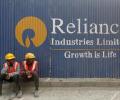
Institutional shareholders of Reliance Industries Limited (RIL) are expecting big-ticket announcements from the company, including timeline for listing of its telecom and retail subsidiaries. They expect this to unlock value in the company, which has seen a sharp fall in market valuation on Friday. This is due to windfall tax imposed by the Centre on refiners and oil producers.

Domestic equity markets are in elite company. In May, Indian markets joined select developed markets (DMs) such as the US, UK and Germany to record new all-time highs. Among emerging markets (EMs), Brazil is the other market to have logged new highs this month. Asian peers such as South Korea, Taiwan and New Zealand are currently between 2 per cent and 10 per cent below their previous highs made earlier this year. The domestic markets were among the worst-performing major global markets in April amid a lethal second-wave of covid-19 infections.

Despite near-term headwinds of rising input costs and the possibility of lower demand for products as Covid dented rural & urban India, and impacts both production & consumption, analysts remain bullish on stocks of fast moving consumer goods (FMCG) companies and expect the index to relatively outperform its peers in the second half of fiscal 2021-22 (FY22). In the past one year, prices of key commodities such as groundnut oil, mustard oil, Vanaspati, soya oil, sunflower oil and palm oil have shot up in the range of 20 per cent to 60 per cent, data show. The FMCG sector macros in this backdrop, according to analysts, have further deteriorated because of weakness in consumer demand and likely margin pressure due to elevated crude oil, palm oil and global food prices.

The next auction for bauxite blocks in Odisha may see heightened interest with Adani Group charting an entry into alumina refining and existing players looking to boost capacity. Hemant Sharma, principal secretary, Odisha industries department, said that three bauxite blocks have been scheduled for auctions this year. Adani Group - which will be setting up a 4-MMTPA alumina refinery and may enter aluminium production - is expected to bid for mines, though raw material linkages shall be available from Odisha Mining Corporation (OMC).

'The inflection point that really happened in the sector was during the pandemic when buyers' perception changed towards consumption and that gave a trigger to pent-up demand with the increased affordability.'

Logistics services provider Delhivery is likely to launch its downsized initial public offering (IPO) this week, said people in the know. The Softbank-backed firm may trim its issue size from Rs 7,460 crore to Rs 5,500 crore to align with the volatile market conditions, sources said. Sources added the fresh issue component of the IPO could be reduced to Rs 4,500 crore and the OFS component to Rs 1,000 crore.

The ongoing key reforms such as sops for manufacturing, easier labour laws, wooing FDI inflows and privatisation will help improve productivity and support long-term growth at 7.5-8 per cent levels, which if played out well, can help India contribute 15 per cent of global GDP growth by FY2026, says a report. According to a report pencilled by the India economist at UBS Securities, Tanvee Gupta Jain, the country has the lowest manufacturing costs among peers, even though China retains significant ecosystem advantages and despite that India and Vietnam appear most likely to benefit from a shift out of China.

'...to address the serious faultlines that had got exposed during the pandemic.' 'If the economy is looking up this year, we could have been allocated an increase of at least 20%.'

Billionaire Mukesh Ambani's Reliance Industries Ltd on Friday reported a 22.5 per cent rise in net profit for the quarter ended March on the back of bumper oil refining margins, steady growth in telecom and digital services and strong momentum in the retail business. The oil-to-retail-to-telecom conglomerate's consolidated net profit rose to Rs 16,203 crore in the quarter ended March 31, 2022 from Rs 13,227 crore, the firm said in a statement. Net profit, however, fell 12.6 per cent sequentially -- breaking a six-quarter chain of quarter-on-quarter improvement.

For non-banks, the IL&FS crisis was nothing short of India's Lehman moment, which has for a foreseeable future reset the sector on multiple grounds.

The recent currency volatility - rupee's depreciation against international currencies - may have given heartburns to automakers that rely on imports or pay royalty to parent companies abroad. But for Maruti Suzuki India, favourable movement of the yen - the currency that matters the most - against the Indian rupee, has given it reasons to cheer. The yen's sharp fall against the rupee and the rupee's depreciation against the US dollar, which in turn will bump up export realisations, are set to give a margin boost to the maker of Baleno and Brezza, said analysts. The softening of commodity prices and slew of new SUV launches in the coming months will also aid margins, they said.

The government's total liabilities rose to Rs 128.41 lakh crore in December quarter from Rs 125.71 lakh crore in the three months ended September 2021, according to the latest public debt management report. The increase reflects a quarter-on-quarter increase of 2.15 per cent in October-December 2021-22. In absolute terms, the total liabilities, including liabilities under the 'Public Account' of the government, jumped to Rs 1,28,41,996 crore at the end of December 2021.

In a bull-case scenario it sees the Sensex at 61,000 levels, while it's bear case scenario pegs the Sensex at 41,000 levels by December 2021.

The cooking oil national industry body -- Solvent Extractors' Association (SEA) of India has suggested immediate initiation of government to government (G2G) dialogue with Indonesia on the proposed palm oil export ban from April 28 by them as it would have an adverse repercussions in India. Indonesia, which is the world's largest producer of palm oil and meets nearly 50 per cent of the total palm oil requirement in India annually, had announced to ban exports till further notice apparently to contain edible oil prices in their domestic market. "We have suggested our government initiate dialogue with Indonesian counterparts at the highest diplomatic level on the cooking oil export ban.

'Last year (FY21), we had about 1 million intimated claims for Covid.' 'This year (FY22), in six months, we got about 1.6 million claims.'

Already retail inflation has risen to 6.07 per cent in February, crossing the upper band of the Parliamentary mandate. This is the second consecutive month in 2022 when retail inflation has crossed the 6 per cent mark having hit 6.01 per cent in January.

Spending through the credit card in March 2022 jumped 48 per cent year-on-year to top Rs 1 trillion -- five months after it had hit the same figure for the first time in October 2021, buoyed by festive season expenditure. The jump has been driven by the pickup in consumption as the pandemic recedes. Expenditure in March, at Rs 1.07 trillion, was up 24.5 per cent over February, the data put out by the Reserve Bank of India (RBI) showed.

Riding on an improved show across parameters, TVS Motor (TVS) outperformed larger two-wheeler peers Hero MotoCorp (Hero) and Bajaj Auto (Bajaj) during the September (Q2 of FY23) quarter. The Chennai-based firm, which has the most-diversified portfolio among two-wheeler majors, posted a 28 per cent jump in revenues. This compares to 18 per cent growth for Bajaj Auto and single-digit uptick for Hero MotoCorp.

Billionaire Mukesh Ambani-led Reliance Industries Ltd's plans for investing Rs 75,000 crore in solar, batteries, fuel cells and hydrogen could create valuation of $36 billion (Rs 2.6 lakh crore) for the new energy business, Wall Street brokerage Bernstein Research said in a report. Reliance currently has three verticals -- oil-to-chemical (O2C) business that houses its oil refineries, petrochemical plants and fuel retailing business; digital services that comprises telecom arm Jio; and retail including e-commerce. New Energy will be the fourth vertical. At the company's annual general meeting of shareholders last month, Ambani announced a plan to invest Rs 75,000 crore in a new energy business over the next 3 years in the next stage in its transformation.

Three stockmarket experts give their best picks for the New Year.

If the banks throw caution to the winds for building loan books, the hydra-headed bad loans may resurface and spoil the party, warns Tamal Bandyopadhyay.

Passenger vehicle wholesales in India declined nearly 4 per cent to 279,501 units last month, auto industry body SIAM said on Wednesday. Passenger vehicle (PV) dispatches from factories to dealerships in March 2021 stood at 290,939 units. As per the latest data by the Society of Indian Automobile Manufacturers (SIAM), two-wheeler sales also fell 21 per cent to 11,84,210 units as compared with 14,96,806 vehicles in March 2021.

Mihir Tanna, Associate Director, S K Patodia & Associates, answers your income tax queries.

India's economy has bounced back amazingly from the Covid-19 pandemic and nationwide lockdown over the last one year, but it is not out of the woods yet, according to the World Bank, which in its latest report has predicted that the country's real GDP growth for fiscal year 21/22 could range from 7.5 to 12.5 per cent.

Could it have been more reformist? Of course, but this is an election year Budget, observes Akash Prakash.

Indian officials will focus on expanding the country's footprint in oil-rich Siberia when they meet their Russian counterparts at the four-day 7th Eastern Economic Forum beginning Monday in Vladivostok. The two sides will discuss the possibility of joint oil exploration in the area and cooperation in running offshore oil and gas fields Western companies are in the process of exiting, officials said in New Delhi. Pavan Kapoor, India's ambassador to Russia, will lead the official-level talks at the summit scheduled September 5-8.

IT services major Infosys on Wednesday posted a 17.5 per cent rise in net profit to Rs 5,076 crore for the March quarter, and announced up to Rs 9,200 crore buyback offer at a maximum price of Rs 1,750 per share.

Mihir Tanna, Associate Director, S K Patodia & Associates, answers your tax queries.

Moody's Investors Service has warned that India, along with the Philippines, Thailand, and Vietnam are highly vulnerable to volatile food and energy prices in the Asia-Pacific region as the Russia-Ukraine conflict continues to disrupt supplies and raise the cost of agricultural products, especially cereals and vegetable oils, as well as fertilizers and other agricultural inputs. This is so because these countries have a higher weighting of energy and food prices in their consumer price index (CPI) baskets, Moody's said in its report released on Tuesday. The weighting of energy and food in overall Indian CPI stands at over 55 per cent.

'Periods of high volatility are usually bad for mid-caps and this is something that has to be kept in mind.' 'Focus on quality is of paramount importance.'
