
Brokerages have cut their estimates of listed diagnostics players for the financial year 2023-24 (FY24) after mixed December quarter results and muted near-term outlook. Their volumes and realisations will be under pressure due to weakness in Covid-adjusted performance and higher competitive pressures, the brokerages believe. In a post-Q3 results note on Dr Lal Pathlabs, Bhavesh Gandhi of YES Securities pointed out that there has been a lack of volume revival in recent quarters, with an increasing likelihood that FY24 too would be a work-in-progress year for the company's initiatives to bear fruit.

The combined net sales of 42 listed construction and capital goods companies that have declared their third-quarter results so far were down 2.3 per cent year-on-year in Q3FY21 while core operating profit was up just 4.9 per cent YoY during the quarter.

Smaller stocks have continued to give higher returns to equity investors so far this fiscal, significantly outperforming bigger peers on indices. The BSE smallcap index has zoomed 7,333.47 points or 35.51 per cent, while midcap index has jumped 5,096.41 points or 25.25 per cent so far this fiscal. In comparison, the 30-share BSE benchmark Sensex has gained 9,797.78 points or 19.78 per cent.

If that happens, India's economic size will be just shy of $20 trillion and its annual per capita income will be about $10,000, when the country celebrates its centenary of independence.

The impending merger between Housing Development Finance Corporation (HDFC) with HDFC Bank may create challenges for large-cap fund managers, most of whom are already grappling to match the returns generated by their benchmarks. The combined weight following the merger in the benchmark Sensex and Nifty 50 indices is likely to be much higher than permissible limits for active mutual fund (MF) schemes. This could have a bearing on the performance of large-cap funds if HDFC Bank shares outperform the markets, as the schemes will be forced to remain underweight on the stock to adhere to the single-stock cap.

The new mantra was to align Apple's ambition with the government's, focusing on Modi's favourite themes of Make in India, employment generation and India as a high-tech export hub.

Headline inflation will come down under the 6 per cent mark in July itself but will stay at an elevated level of over 5 per cent for some time, Chief Economic Advisor K V Subramanian said on Thursday. Such an outcome will get the price rise back into the upper-end of the target band given to RBI, he said, adding that consumer price inflation had breached the mark for three consecutive quarters last fiscal because of supply side issues like challenges in movement of goods. "With reasonable probability, I expect this month the (inflation) print to come less than 6 per cent," Subramanian told a conference organised by industry lobby Ficci. Right after data for May showing inflation at 6.4 per cent had come out, Subramanian said he had predicted it will cool down in internal meetings and also during "deliberations with the regulator".

Shares of MRF crossed a first time Rs 100,000 mark, hitting a record high of Rs 100,300, up 1.4 per cent on the BSE in intra-day trade. on June 13, 2023. The stock surpassed its previous high of Rs 99,879.65, touched May 8, 2023. Thus far in the current calendar year 2023 (CY23), MRF has outperformed the market by gaining 14 per cent on improved financial performance.

This is the Mukesh Ambani-led company's second entry into the dairy segment and it will directly compete with Amul and Mother Dairy.

India's top IT companies have shown a hiatus between their performance on the bourses in the pandemic period and earnings growth. The combined market cap of the top five IT companies - Tata Consultancy Services, Infosys, Wipro, HCL Technologies, and Tech Mahindra - is up 87 per cent since the end of March 2020. In comparison, the benchmark BSE Sensex is up 68 per cent during the period. So the industry beat the broader market by a big margin in the last one year.

Novelis' results for the January-March quarter of the 2022-23 financial year (Q4FY23) disappointed investors and as a result, the share price of Hindalco (Novelis is a 100 per cent subsidiary of Hindalco) has slid. The non-ferrous metals major is suffering from the impact of a down-cycle in aluminium and copper, as well as the slowdown imposed in Europe by the Russia-Ukraine war. Prospects for the firm look gloomy, at least for the first half (H1) of FY24.

'When we look at the quality of our retail loan book, the non-performing asset percentage is low.'

The sharp increase in commodity prices on account of the Russia-Ukraine war has put automakers in a fix. After the frequent price hikes in the current fiscal, manufacturers fear that any more price increases may further dent the already weak demand in certain segments. "We have taken several hikes and cannot immediately do it again. "We will have to closely watch the situation and act accordingly," said an official at an auto firm, declining to be identified. Even for companies like Tata Motors Passenger Vehicles, which has had a strong volume run and a robust order book, passing on the entire costs has been tough.

Paytm founder and chief executive officer (CEO) Vijay Shekhar Sharma will receive his stock grants only after the company's market capitalisation (m-cap) stabilises at its initial public offering (IPO) level, the financial technology (fintech) major said on Wednesday. Paytm's stock price has been in free fall since its IPO at Rs 2,150 apiece, with m-cap at around Rs 1.4 trillion - plunging 76 per cent to a lifetime low of Rs 520 on March 23, when m-cap dropped below Rs 34,000 crore. Since then, the company's share price on the BSE has recovered some value and closed at Rs 637 on Wednesday.

Automotive retail sales saw a 14 per cent rise in March on a year-on-year (YoY) basis, according to data released by the Federation of Automobile Dealers Associations (FADA). For the whole of financial year 2022-23 (FY23), sales grew 21 per cent YoY. For both March and the financial year, all categories, except for tractors, and including two-wheelers, three-wheelers, passenger vehicles (PVs), and commercial vehicles (CVs), posted double-digit growth. However, the total retail sales of 22.1 million for the financial year were still 12 per cent lower than the pre-Covid (FY20) level of 25 million, owing to an 18 per cent dip in the two-wheeler segment.

Telecom operator Bharti Airtel on Tuesday posted a 49.2 per cent jump in its consolidated net profit to Rs 3,005.6 crore for the January-March quarter of 2022-23 on the back of new 4G customers and strong growth in average revenue per user (ARPU). The company had recorded a net profit of Rs 2,007.8 crore in the same period a year ago. Bharti Airtel's consolidated revenue from operations grew by 14.31 per cent to Rs 36,009 crore during the reported quarter from Rs 31,500.3 crore in the March 2022 quarter.

Abbott India outperformed the Indian pharmaceutical market (IPM) with a year-on-year (YoY) growth of 23 per cent in February. The domestic market grew at a robust 20 per cent on a low base, primarily led by volume growth and price hikes. Abbott continued to outperform the sector in the anti-diabetic space with a growth of 20 per cent and key brands such as Thyronorm (hypothyroidism), biliary agent Udiliv, insulin Ryzodeg posted robust growth.

Gold and diamond retail chain Malabar Gold & Diamonds will be investing Rs 1,600 crore in FY22 to launch 56 stores globally with 40 across India and 16 internationally in FY22 to further boost its retail presence across the globe. The move is expected to generate over 1,700 jobs. In India, the expansion strategy is centred in states like Tamil Nadu, Telangana, Andhra Pradesh, Karnataka, Maharashtra, Delhi, West Bengal, Uttar Pradesh, Odisha and Kerala. Internationally, the expansion will be in markets such as Singapore, Malaysia, Oman, Qatar, Bahrain and UAE.
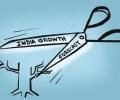
The Indian economy is estimated to grow at 7 per cent in the 2022-23 fiscal, down from 8.7 per cent a year ago, mainly due poor performance of mining and manufacturing sectors. As per the first advance estimates of national income released by the National Statistical Office (NSO) on Friday, the manufacturing sector output is estimated to decelerate to 1.6 per cent in the current fiscal from 9.9 per cent in 2021-22. Similarly, mining sector growth is estimated at 2.4 per cent in the current fiscal as against 11.5 per cent in 2021-22.

In the June quarter of FY24, 51 per cent of consumers who took small-ticket personal loans already had more than four credit products at the time of accessing yet another new loan, compared with just 17 per cent in the June quarter of FY20, points out Tamal Bandyopadhyay.

Attrition is driving the hiring effort on campuses.

Despite enduring a weak first quarter of the 2023-24 financial year (Q1FY24), Power Grid Corporation (PGCIL) has laid out an ambitious capex plan going forward. It is looking to invest around Rs 1.8 trillion on an existing asset base of Rs 2.7 trillion to aim at keeping over 50 per cent market share in the transmission market. This includes opportunities from the Rs 2.4 trillion green energy corridor.

'Hope they don't tinker around with capital gains tax in any way.'

It may plan a significant hike in budgetary support aimed at completing the balance 8.4 million dwellings by March 2024.

The key risks against a fast recovery would include long delays in business travel resumption, delays in commissioning, etc.

In the early part of 1800, a 30-acre plot next to Fort Gloster on the banks of river Hooghly in Howrah district of Bengal was the nerve centre of industrial activity; it housed India's first steam-powered cotton mill, Bowreah Mills, which was set up by a British merchant and went on to become a hub of factories - a rum distillery, foundry, cotton yarn factory, an oil mill and a paper mill, et al. Spearheaded by Dwarkanath Tagore, the industrialist grandfather of Rabindranath Tagore, the commercial complex was possibly the first of its kind in the country. Close to 200 years later, after much ebb and flow of history, the hub is set for a resurgence of sorts.

Starting with the third quarter of financial year 2020-21 (Q3FY21), we have seen "unlock" trades at various times. Whenever lockdowns have been eased, traders have taken long positions in consumer-facing businesses. Let's look at the logic. Since March 2020, sectors like retail, personal vehicles, hospitality, aviation, fast-moving consumer goods (FMCG), multiplexes, etc., have been under severe pressure. As a result, there's been a low base effect. Every company in these spaces has suffered top line contraction. Many suffered losses, especially in the first half of FY21.

India is poised to be the fastest-growing major economy in the world and an engine of global growth despite global headwinds, says leading industrialist and Aditya Birla Group Chairman Kumar Mangalam Birla. The economic activity in India has witnessed a sharp recovery to pre-pandemic levels on the back of a rapid and widespread rollout of the vaccination programme, Birla said in the latest annual report of UltraTech Cement Ltd. "A strong digital ecosystem, fiscal and monetary policy and various government schemes helped small and medium enterprises and the worst affected sections of the population to survive while reviving demand and bringing the economy back on track," said Birla while addressing UltraTech's shareholders.

'They have got the advisory council, a CEO has been appointed finally, and they have made some headway on the term loan B.'

'The formula now is even if there is no profit there should be break-even.' 'We green-light a film only if we can see break-even in it.'

A careful reading of the national income accounts suggests that after a strong recovery from the pandemic, there has been a significant ebbing of dynamism over the last three quarters to more modest levels recently, note Arvind Subramanian and Josh Felman.

In a multi-year first, the country's largest software exporter TCS on Monday reported a marginal decline in its overall employees for the December 2022 quarter but announced that it will be hiring over 1.25 lakh staff in FY24. The software firm posted a decline of 2,197 people in its employee base for the October-December period to 6.13 lakh. The Tata group company, however, made it clear that this was due to the higher hiring done over the last 18 months, and not driven by the demand environment.

Since arraignment under money laundering is a tougher offence, the CBDT hopes it will also overcome its dismal score sheet to prove satisfactorily to the courts that these cases were genuine ones of tax evasion.

Shares of Adani Green Energy (AGEL) continued their upward movement, hitting a new high of Rs 1,955.90, up 2.6 per cent on the BSE in Wednesday's intra-day trade in an otherwise weak market. The S&P BSE Sensex was down 0.77 per cent at 60,285 at 11:01 am. In the past 14 trading sessions, the stock of the renewable energy arm of the diversified Adani Group has zoomed 50 per cent from Rs 1,307.05 on December 30, 2021. In comparison, the S&P BSE Sensex was up 4.3 per cent during the same period.

HCL Technologies plans to double its fresher hiring for the upcoming financial year (FY23) as attrition continues to inch up. The company said that it will hire 40,000-45,000 freshers for FY23, up from 20,000-22,000 target for FY22. The company also stated that to ease supply-side constraints and to have access to diversified skills, it was expanding into other geographies over the next three-four quarters. "Some of the geographies that we are investing in to source talent include countries like Romania, Hungary, Bulgaria, Guatemala, Costa Rica. We are also ramping up our presence in Sri Lanka, Vietnam, Australia, New Zealand, etc.

This is following revival of demand from the corporate sector and small and medium enterprises (SMEs), even as a nascent economic recovery is taking shape. Credit growth of scheduled commercial banks had accelerated to 9.2 per cent year-on-year (YoY) by the end of December 2021 after breaching the 7 per cent-mark in November, for the first time since April 2020.

Maruti Suzuki is set to launch a new multi-purpose vehicle (MPV) -- Invicto -- next month. It will be the company's first passenger vehicle with an ex-showroom price tag of Rs 20 lakh or more, said Shashank Srivastava, executive director (sales), on Tuesday. The upcoming MPV will compete with the likes of Toyota Innova Hycross, Kia Carnival, Hyundai Alcazar, MG Hector Plus, Tata Safari, Mahindra & Mahindra XUV700, and Mahindra & Mahindra Scorpio-N - all having three rows of seats. Invicto will be based on the Hycross by Toyota, which will manufacture Maruti's most expensive car at its Bidadi plant in Karnataka.

Alternative investment funds (AIFs) - pooled investment vehicles catering to high net worth individuals (HNIs) - saw a 30 per cent increase in investment commitments during financial year 2022-23 (FY23). At the end of March 2023, the total investment commitments raised stood at Rs 8.33 trillion, up Rs 1.92 trillion from Rs 6.41 trillion at the end of March 2022. A commitment is the money clients are willing to put into AIFs.

The government, it would seem, is reserving its firepower to spend on big-ticket items that will be announced in the Budget, reports Subhomoy Bhattacharjee.

Size matters on the road. Small is not dominating India's car market any more. The share of cars priced up to Rs 5 lakh in the passenger vehicle market has fallen to 10.5 per cent in the first 11 months of 2021-22, compared with 26 per cent in 2018-19 (FY19), the lowest in four years, according to data from industry sources. Even the share of those in the price range between Rs 5 lakh and Rs 7.5 lakh has dropped to 32.4 per cent in the same period, from 34.9 per cent.
