
The Supreme Court on Tuesday agreed to hear next week a plea which flagged Bharatiya Janata Party MP Nishikant Dubey's recent criticism of the apex court and Chief Justice of India Sanjiv Khanna, and sought removal of derogatory videos from social media platforms.
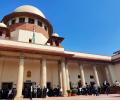
Chief Justice of India D Y Chandrachud on Friday termed Justice Ajay Rastogi, who will be demitting office on June 17, a "great ally" who possessed judicial compassion and sensitivity for every cause.

The Centre on Wednesday told the Supreme Court that nobody can claim right over government land and it is legally empowered to reclaim properties which are declared waqf by using the waqf by user principle.

The Supreme Court of India has agreed to hear on May 6 the pleas of the Kerala government against the governor over the delay in approving bills passed by the state assembly. The court will consider whether the issues raised in the Kerala petition are covered by a recent judgment on a similar plea by Tamil Nadu, which set timelines for governors and the President on granting assent to bills.

He said there used to be mutual respect between the government and the opposition, which is diminishing.
The Supreme Court on Monday agreed to consider listing for urgent hearing the petitions challenging the constitutional validity of the Waqf (Amendment) Act, 2025.

Chief Justice of India Uday Umesh Lalit Thursday said media reports claiming that a Supreme Court bench has criticised the new system of listing of cases are 'not correct' and all judges of the apex court are on the same page.
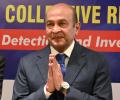
Justice Yashwant Varma, a Delhi High Court judge, has been transferred to his parent Allahabad High Court amid a controversy surrounding the alleged discovery of a large sum of cash at his official residence. The Supreme Court Collegium recommended the transfer, stating it was separate from an in-house probe ordered by the top court into the alleged cash find. The incident occurred following a fire at Justice Varma's residence on Holi night, March 14. Justice Varma has vehemently denied any involvement in the alleged cash discovery, calling it a conspiracy to frame him.

Chief Justice of India D Y Chandrachud on Friday said truth has become a "victim" in the age of false news and with the spread of social media, something which is said as a seed germinates into virtually a whole theory that can never be tested on the anvil of rational science.

The Supreme Court has agreed to examine a PIL alleging that Arunachal Pradesh Chief Minister Pema Khandu awarded government contracts to his family members. The court has asked the state government to provide details of the beneficiaries and inform if due process was followed. The bench also sought responses from union ministries of home affairs, finance and the Comptroller and Auditor General of India on the issue within five weeks.

Modi also said that Lord Ganesh was "put behind bars" in Karnataka by these people.
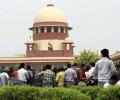
The executive committee of the Supreme Court Bar Association (SCBA) on Wednesday decided to call off the general body meeting scheduled for March 16 to vote on resolutions seeking explanation from senior advocates Kapil Sibal and Neeraj Kishan Kaul for apologising to CJI DY Chandrachud on behalf of the bar body.
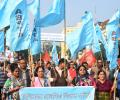
The Supreme Court of India has invalidated the appointment of 25,753 teachers and other staff in West Bengal's state-run and state-aided schools, deeming the selection process "vitiated and tainted." The court ordered the state government to conduct a fresh selection process within three months. The decision comes after a Calcutta High Court verdict in April 2024, which also annulled the appointments. The apex court, while upholding the high court's order, made some modifications, including exempting disabled employees from returning their salaries. The case stemmed from alleged irregularities in the 2016 recruitment process by the West Bengal School Service Commission (SSC), involving OMR sheet tampering and rank-jumping. The Supreme Court had previously termed it a "systemic fraud." Former West Bengal education minister Partha Chatterjee and Trinamool Congress MLAs Manik Bhattacharya and Jiban Krishna Saha are among the accused being investigated in the recruitment scam.

Justice Kamal Narain Singh, who was the CJI between November 25, 1991 and December 12, 1991, had a tenure of 18 days.
The Supreme Court collegium headed by Chief Justice of India S A Bobde is holding its scheduled meeting on Thursday to discuss possible candidates for the appointment of judges in higher judiciary, sources familiar with the development said.
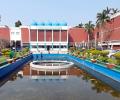
A two-judge bench of the top court in 1981 questioned the correctness of the 1967 verdict holding Aligarh Muslim University not to be a minority institution since it was created by a central law and referred the issue to a larger bench for decision.
The Supreme Court addressed concerns about misinformation spreading related to an incident involving Delhi High Court judge Justice Yashwant Varma. The court clarified that the proposal to transfer Justice Varma to Allahabad High Court was independent of an internal investigation into the discovery of a large sum of cash at his residence following a fire. The Delhi High Court Chief Justice is conducting the investigation and will submit a report to the Chief Justice of India today.

Modi asserted that judicial reform is not merely a policy matter.

Every word uttered by a minister has to be with a sense of responsibility at a time the country is undergoing "such a situation", the Supreme Court said on Thursday as it reprimanded Madhya Pradesh's Vijay Shah who is facing an FIR for his remarks targeting Col Sofiya Qureshi.

The verdict will have far-reaching implications for judicial service aspirants.

The Delhi high court on Friday dismissed with a cost of Rs 1 lakh a public interest litigation (PIL) challenging the appointment of Justice D Y Chandrachud as the Chief Justice of India.
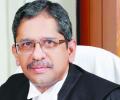
Presently, Justice Ramana is the senior-most Supreme Court judge after the CJI.

A three-judge Supreme Court bench will hear petitions challenging the constitutional validity of the Waqf (Amendment) Act, 2025, on April 16. The petitions, including those by politicians and the All India Muslim Personal Law Board (AIMPLB) and Jamiat Ulama-i-Hind, were filed in the top court challenging the validity of the newly-enacted law. The Centre has filed a caveat in the apex court, seeking a hearing before any order is passed.

The CJI, who hails from Andhra Pradesh, had said in the last hearing that he belonged to both the states and suggested 'mediation' to Andhra Pradesh and Telangana for settling their dispute, saying it did not want to interfere 'unnecessarily'.
The Supreme Court of India will hear a plea from the mosque management committee challenging an order rejecting its petition in the Krishna Janmabhoomi-Shahi Idgah dispute in Mathura, Uttar Pradesh on January 15. The Allahabad High Court had rejected the mosque committee's plea, stating that the religious character of the Shahi Idgah mosque needed to be determined. The case involves claims that the mosque was built after the demolition of a temple, a claim disputed by the mosque committee. The Supreme Court will now decide on the maintainability of the mosque committee's plea.

Outgoing Chief Justice of India (CJI) N V Ramana on Friday said the appointment of 11 Supreme Court and 224 high court judges, besides recommending the names of more women for judgeship during his tenure as the head of the judiciary, was a reflection of "the coherence and determination" of judges to strengthen the judiciary to further the goal of justice.

Inaugurating the 39th chief justices' conference in New Delhi, which is being held after a gap of six years, the CJI outlined the agenda of the meeting and said the 'aim and object of today's conference is to discuss and identify the problems that are affecting the administration of justice'.

Observing secularism means to 'live and let live', the Supreme Court on Tuesday said regulating madrasas was in the national interest as several hundred years of the nation's composite culture could not be wished away by creating silos for minorities.
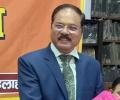
Justice Shekhar Kumar Yadav, an Allahabad High Court judge, is set to appear before the Supreme Court Collegium to explain his controversial statements made at a Vishva Hindu Parishad (VHP) function. The Supreme Court has sought a report from the Allahabad High Court after news reports surfaced regarding Justice Yadav's remarks, which were widely condemned as "hate speech". The judge's statements, made at a VHP event, sparked outrage from various quarters, including opposition leaders and lawyers. The Bar Association of India has also condemned the judge's remarks and called for an apology.

The media must confine itself to honest journalism and not use it as a tool to expand its influence and business interests, Chief Justice of India (CJI) NV Ramana said on Tuesday.

He said he was wondering where our institutions are going wrong, that students are forced to take their life.
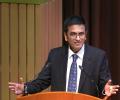
The sources said the CJI took his daughters to his chamber while explaining about his workplace and showed them the place where the judges sit and from where the lawyers argue their cases.

Chief Justice of India-designate Justice U U Lalit on Friday highlighted three areas on which he intends to work during his 74-day tenure as the head of the judiciary and said he would strive hard to ensure that at least one Constitution bench is functioning in the Supreme Court throughout the year.
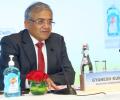
Congress general secretary K C Venugopal said in a hasty midnight move, the government has notified the appointment of the new CEC.
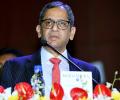
The CJI said "news mixed with views is a dangerous cocktail".

The former CJI was criticised for being part of a special bench set up to hear a suo motu case titled 'In Re: Matter of Great Public Importance Touching upon the Independence of the Judiciary' on a Saturday on April 20, 2019.
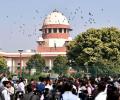
A bench comprising Chief Justice Sanjiv Khanna and Justice Sanjay Kumar also indicated that it may not take up the pending scheduled petitions, heard earlier by a three-judge bench, during the day as it was sitting in a combination of two judges.

The CJI also dealt with the principle of affirmative action by the state and said it was meant to achieve broader equality and was not against the right to equality.
The concept of investigative journalism is vanishing in the Indian media landscape, Chief Justice of India NV Ramana said on Wednesday.

Podcaster Allahbadia's remarks on parents and sex on comedian Samay Raina's YouTube show India's Got Latent triggered a controversy and several FIRs have been lodged against him and others in various parts of the country.
