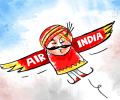
Air India sale will give a boost to India's privatisation drive, the Economic Survey said on Monday, as it suggested redefining the public sector role in business enterprises to encourage private participation in all sectors. The government earlier this month handed over ownership rights in national carrier Air India to Tata Group for Rs 18,000 crore. The amount includes the takeover of the debt burden of Rs 15,300 crore and another Rs 2,700 crore in cash.
The government is looking to sell shares of Reliance Industries (RIL) held through Specified Undertaking of the Unit Trust of India (SUUTI) and is soon going to appoint an intermediary to manage it. The plan is to sell about 8 lakh shares of RIL that will help the government garner around Rs 180 crore. The Department of Investment and Public Asset Management (DIPAM) will appoint an intermediary that will act as a custodian of these shares. The intermediary, based on its market analysis, will offload these shares at the best price, said an official. A final approval on the proposal is expected soon.
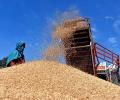
The uptick in prices ranging from steel to wheat could benefit lots of commodity-based companies -- from State-owned SAIL to the agro exporters.
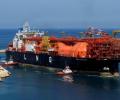
The dreary, cold months from December to February may prove to be the undoing of many a nation as they grapple with sky-high fuel prices - a result of the Ukraine conflict and the pandemic. Many - Europe, South Korea, Japan, and China - will still pull through on the strength of their wealth or because of strong storage infrastructure. But India will have its back to the wall. Signs of liquefied natural gas (LNG) rates hitting new records this winter are already evident.
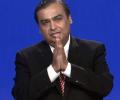
Billionaire Mukesh Ambani's oil-to-telecom conglomerate Reliance Industries Ltd slipped 59 places to rank 155th on the 2021 Fortune Global 500 list released on Monday. Reliance took a beating on the rankings as revenues dropped owing to the COVID-19 pandemic. This is its lowest ranking since 2017. Walmart continues to top the Fortune list with a revenue of $524 billion, followed by China's State Grid at $384 billion.
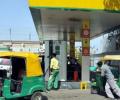
State-owned Indian Oil Corporation (IOC) and a joint venture of billionaire Gautam Adani's gas arm and Total of France -- Adani Total Gas Ltd -- have bid for maximum number of licenses to retail CNG to automobiles and piped cooking gas to households in the latest city gas bidding round.
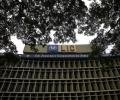
The government is unlikely to come up with the IPO of Life Insurance Corporation (LIC) in the current financial year ending March 2022, as the valuation of the state-owned behemoth is taking more than anticipated time, and the preparatory work is still far from complete. There are still some issues that need to be addressed with regard to the valuation of LIC, a senior official of one of the merchant bankers said. Even after the valuation, there are several regulatory processes that have concluded, the official said.
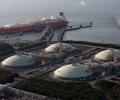
Around 15 years ago, when Reliance Industries (RIL) struck natural gas in the Krishna-Godavari (KG) basin off the east coast, the government made plans to supply that fuel cheaply to scores of generators that sprang up in India triggered by the discovery. Most of the plants, which account for 6 per cent of India's total generation capacity, operate sparsely after the KG-D6 area first failed to meet production targets, and then finally shut shop. Affordable domestic gas was why those thermal plants came up and the rate of the fuel today is why those generators hardly operate. Record liquefied natural gas (LNG) rates may yet again unravel India's ambitions to expand use of gas in industries, households and vehicles. Rates, while volatile, may stay strong this decade as developed nations with higher purchasing power embrace gas as the transition fuel.

Fernandes wanted Coca-Cola Company to not just transfer 60 per cent of the shares of its Indian firm but also the formula for its concentrate to Indian shareholders.
The department of investment and public asset management is racing against time to launch the LIC IPO, which could become the largest-ever listing on the Indian bourses. This would lead to some delay in the strategic divestment of IDBI Bank.
Petrol and diesel prices, which have been on a freeze for the past four months in view of assembly elections in states like Uttar Pradesh, need to be increased by over Rs 12 per litre by March 16 for fuel retailers to break even. International crude oil prices shot above $120 a barrel for the first time in nine years on Thursday before retreating a little to $111 on Friday, but the gulf between cost and retail rates has only widened. With international oil prices - on which domestic fuel retails are directly benchmarked - spiking in the last two months, state-owned fuel retailers "need a massive price hike of Rs 12.1 per litre on or before March 16, 2022, just to breakeven and a price hike of Rs 15.1 is required" after including margins for oil firms, ICICI Securities said in a report.
Petrol price in Delhi was hiked to Rs 77.28 per litre from Rs 76.73, while diesel rates were increased to Rs 75.79 a litre from Rs 75.19, according to a price notification from State oil marketing companies. Rates have been increased across the country and vary from state to state depending on the incidence of local sales tax or VAT.

Banking and financial stocks got more than their fair share of foreign portfolio investor (FPI) flows in February. Overseas investors pumped in $3.56 billion into domestic equities last month. Of this $1.96 billion went into financial stocks, data analysed by Edelweiss shows. "The sector now has 34.8 per cent of FPI assets, up from 33.8 per cent in January.

Govt's move will facilitate entry of global giants such as Total SA of France, Saudi Arabia's Aramco, BP Plc of the UK, and Trafigura's downstream arm Puma Energy.
Petrol and diesel prices were hiked by 80 paise a litre each on Wednesday, taking the total increase in rates in 16 days to Rs 10 per litre.

The three oil PSUs have told Air India that if it did not make the monthly lump sum payment, they will stop fuel supply from October 11 at six major domestic airports.

Ajit Mishra, vice president, Research, Religare Broking, answers your queries.

National oil companies are staring at inventory losses as they have to bring down refinery throughputs because of the plunging demand for fuels following the nationwide lockdown to contain the deadly coronavirus infection. India is the world's third-largest energy consumer but the lockdown has shut businesses, suspended flights, stopped trains and brought almost the entire vehicular movement to a halt, impacting fuel demand.

State-owned oil companies such as HPCL, BPCL, IOC, ONGC and OIL plunged on worries that the government may ask them to share the burden of higher petrol and diesel prices.

The price of petrol was hiked to Rs 101.39 a litre in Delhi from Rs 101.19 and to Rs 107.47 per litre in Mumbai, according to a price notification of state-owned fuel retailers. Diesel rates went to Rs 89.57 a litre in Delhi and Rs 97.21 in Mumbai.
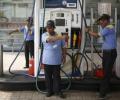
In nine hikes, petrol price has gone up by Rs 5 per litre and diesel by Rs 4.87 a litre.
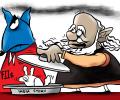
IT, FMCG and manufacturing sectors are less attractive to foreign portfolio investors

Diesel in Mumbai costs Rs 79.72 per litre at IOC outlets and Rs 79.79 at BPCL outlets.

After a hiatus of nearly two decades, the government's programme to privatise state-owned firms restarted with the handing over of debt-laden national carrier Air India to the Tata Group. With the new owner shelling out Rs 18,000 crore for the buyout of the 'Maharaja', this would be the highest-ever amount garnered through privatisation, and is even more than the cumulative sum mopped up through strategic sales from 1999-00 to 2003-04. The government had in October last year inked the share purchase agreement with the Tata Group for sale of national carrier Air India for Rs 18,000 crore. Tatas would pay Rs 2,700 crore cash and take over Rs 15,300 crore of the airline's debt.
Petrol and diesel prices are likely to be hiked this week as oil companies prepare to pare losses accumulated from keeping rates steady for over four months in the run-up to assembly elections in five states, including UP, despite international oil prices jumping to a 13-year high of $140 per barrel. West Texas Intermediate crude futures, the US oil benchmark, rose to $130.50 per barrel on Sunday evening, its highest since July 2008, before retreating. The international benchmark, Brent crude, hit a high of $139.13 at one point overnight, also its highest since July 2008.
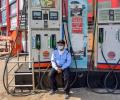
Petrol price on Tuesday breached the Rs 85 a litre mark in the national capital and diesel neared record high after rates were raised for the second consecutive day. Petrol and diesel prices were hiked by 25 paise per litre each, according to a price notification from oil marketing companies. This took the petrol price in Delhi to Rs 85.20 per litre and to Rs 91.80 in Mumbai. Diesel rate climbed to Rs 75.38 a litre in the national capital - just shying away from its record high - and to an all-time high of Rs 82.13 in Mumbai, the price data showed.
The Supreme Court on Friday reserved its order on petitions challenging the Union government's decision to privatise oil sector PSUs Hindustan Petroleum Corporation Ltd and Bharat Petroleum Corporation Ltd.
With the new owner shelling out Rs 18,000 crore for the buyout of 'Maharaja' this would be the highest ever amount garnered through privatisation or even the cumulative sum garnered through strategic sale in 1999-00 to 2003-04. The government had garnered roughly over Rs 5,000 crore during that five-year period by privatising 10 CPSEs.
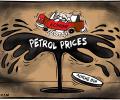
Petrol and diesel prices were raised for the second day in a row on Wednesday as state-owned fuel retailers resumed daily rate revision after a more than two-week long hiatus during assembly elections in states like West Bengal. Petrol price was increase ford by 19 paise per litre and diesel by 21 paise a litre, according to a price notification of state-owned fuel retailers. Petrol in the national capital now costs Rs 90.74 a litre and diesel comes for Rs 81.12 per litre.

OMCs' Digital India move is likely to have an impact on more than 80.3 million Pradhan Mantri Ujjwala Yojana consumers, majority of whom are not exposed to digital transact.
Eight renowned Indian and global merchant bankers will vie with each other on Friday to become the global advisors for privatisation of Bharat Petroleum Corporation.\n\n\n\n
The strike by workers of state-owned oil firms Hindustan Petroleum Corp and Bharat Petroleum Corp to oppose privatisation of the cash-rich refiners entered the second day on Wednesday but operations and petroleum product supplies remained unaffected.
Along with the opposition, key BJP allies Shiv Sena and Samata Party also slammed Divestment Minister Arun Shourie for going ahead with the strategic sale of the equity of the two public sector oil giants.
Along with the opposition, key BJP allies Shiv Sena and Samata Party also slammed Divestment Minister Arun Shourie for going ahead with the strategic sale of the equity of the two public sector oil giants.
The divestment ministry said on Thursday that the inter-ministerial group on the divestment of Bharat Petroleum Corporation would meet next week to discuss the quantum of shares to be offered in the domestic and global markets.
Diesel price on Monday was hiked by 25 paise per litre -- the third increase since last week -- and more rate hikes for both diesel and petrol are in the offing in the coming days as international oil prices have soared to a three-year high. The price of diesel was hiked to Rs 89.32 per litre in Delhi and to Rs 96.94 in Mumbai, according to a price notification of state-owned fuel retailers. This is the second straight day of increase in diesel prices and the third since September 24 when the state-owned oil firms ended a three-week hiatus in rates.

10 stocks which are most popular with brokerages right now and are expected to deliver maximum upside over the next 12 months.

'When you are travelling in Mumbai when the air quality is bad, you feel suffocated.' 'You may feel uncomfortable breathing Delhi air, but the level of discomfort is higher in Mumbai.'
International oil prices surged close to $100 a barrel on Tuesday after Russian President Vladimir Putin sent troops into Ukraine, but petrol and diesel prices in India continue to be on freeze and are expected to rise once assembly elections in states like Uttar Pradesh end. Amid fears of supplies being disrupted because of Russian aggression, the price of futures contract for Brent crude oil with April delivery on London's ICE rose by 4.18 per cent to $99.38 per barrel on Tuesday morning, before paring some gains to settle just above $98. The last time Brent exceeded $99 per barrel was in September 2014. Russia makes up for a third of Europe's natural gas and about 10 per cent of global oil production.
