
On Sunday, November 2, 2025, Iranian President Masoud Pezeshkian visited the Atomic Energy Organisation of Iran headquarters in Tehran, underscoring his administration's focus on advancing the country's nuclear technology for peaceful purposes.
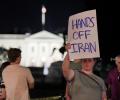
Following attacks on Iranian nuclear sites, including Fordow, Isfahan, and Natanz, the Atomic Energy Organisation of Iran (AEOI) has stated that the attacks are a violation of international law and that Iran's nuclear industry will continue its development.

The statement comes even as Tehran links the issue to ongoing efforts to bring a complete end to hostilities in West Asia involving the United States and Israel.

Tedros said that the war in the Middle East has reached a perilous stage with strikes reportedly hitting the Natanz Enrichment Complex in Iran, and the Israeli city of Dimona, where a nuclear facility is located.

The threat of wars hovers over the negotiations in Oman, but the good part is that Trump called the talks to be 'very good' and Iran's President Masoud Pezeshkian responded that they 'constitute a step forward', points out Ambassador M K Bhadrakumar.

The BRICS nations condemned the Pahalgam terror attack, advocated for a zero-tolerance approach to terrorism, and criticized rising tariffs during their summit in Rio de Janeiro. They also addressed global challenges and called for reforms in international institutions.

The Israel-Iran conflict has entered a 'decisive phase' after the United States bombed three major Iranian nuclear sites Sunday morning, feel strategic affairs experts with some of them arguing it was Washington, DC's 'responsibility' to not get involved in the military standoff.

The meeting of the foreign ministers of the P5+1 nations aimed to smoothen out major bumps in reaching a nuclear deal with Iran has ended with a positive note.

'With China investing in Iran's energy sector, India cannot afford to lag behind.'
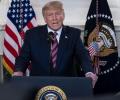
'Today, I am taking new actions to restrict Iran's nuclear, ballistic missile, and conventional weapons pursuits. My Administration will never allow Iran to have a nuclear weapon, nor will we allow Iran to endanger the rest of the world with a fresh supply of ballistic missiles and conventional arms,' Trump said in a statement.
Iran has accelerated its nuclear programme and currently possesses sufficient supply of uranium to make three nuclear devices, a United Nations nuclear watchdog report claimed.
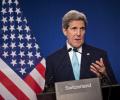
At scaling back Tehran's nuclear programme and relieving the Islamic Republic from the sanctions

The reversal of Trump's policy with regard to Iran, like the withdrawal from the Paris Agreement, may not be a matter of just turning the clock back, but one of patient negotiations, with uncertain consequences in the post-COVID-19 world, observes Ambassador T P Sreenivasan.
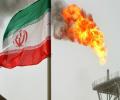
Iran is preparing for a trade and investment boom that could reshape the region after agreeing with world powers to curb its nuclear programme, paving the way for sanctions that have stifled its economy to be lifted.

Backing New Delhi's quest for a permanent seat in the UNSC, Rouhani asked why India, a nation with population of 1.3 billion, was not a member of the powerful club.

The first five months of 2023 have witnessed at least six major events/trends that augur badly for global economic and socio-political prospects, points out Shankar Acharya, former chief economic adviser to the Government of India.

The joint statement issued after Prime Minister Narendra Modi and President Barack Obama's first-ever summit is high on intent and ambition. Notably missing from the statement is India's refusal to be America's partner in its war against ISIS.

'This was undoubtedly a premeditated strategy to thwart India's entry into the NSG.' 'If India hopes to be a major player, it must use its rising clout on the world stage to influence amenable members of the group to alter such discriminatory practices and ensure fair rules of engagement,' says Vivek Gumaste.

'Unsurprisingly, the joint statement issued after Modi's visit contains a paragraph on terrorism.' 'It is on the usual lines that India would have with, say, Croatia.' 'The surprising part is that it shies away from getting into specifics,' points out Ambassador M K Bhadrakumar.

This is the joint statement issued by the ministry of external affairs on the visit of US President Barack Obama to India.

In perhaps the first major conference on the United States-India strategic partnership in the aftermath of the Khobragade controversy that plunged the bilateral relationship in a downward spiral and is now in the process of being resurrected, the undeniable consensus among the panelists and participants was that much ballyhooed strategic convergence between Washington and New Delhi has dissipated.
