

The threat of wars hovers over the negotiations in Oman, but the good part is that Trump called the talks to be 'very good' and Iran's President Masoud Pezeshkian responded that they 'constitute a step forward', points out Ambassador M K Bhadrakumar.
Key Points
- Iran has made it clear that Israel will be in its crosshairs from day 1.
- Iran has stated categorically that any form of US attack will be deemed an act of war.
- The backdrop of the current showdown between Donald Trump and Tehran remains the same -- the geopolitics of oil in the borderlands of political resistance..
The mutual hostility between the United States and Israel on one side and Iran on the other since the 1978 Islamic Revolution and the establishment of the unique political system known as Vilayat-e Faqih or guardianship of Faqīh (an Islamic jurist) is almost half a century old.
The new political order of Islamic democracy pivoted on Iranian nationalism posed an unprecedented challenge and perceived threat to the US and the regional States in its strategic orbit, including the petrodollar monarchies, for whom the very idea of representative rule based on the doctrine of justice, fairness, and resistance was anathema.
But that is not the whole story. Michel Foucault, the French philosopher, historian of ideas, writer, political activist and literary critic, had another explanation.
One night as he was walking the streets of Tehran that were heaving with the birth pangs of the Islamic Revolution, Foucault encountered a stranger who told him, 'They (Americans/em>) will never let go of us of their own will. No more than they did in Vietnam.'
Foucault wrote later in his famous essay What Are the Iranians Dreaming About?, 'I wanted to respond that they are even less ready to let go of you than Vietnam because of oil, because of the Middle East. Today they seem ready, after Camp David, to concede Lebanon to Syrian domination and therefore to Soviet influence, but would the United States be ready to deprive itself of a position that, according to circumstance, would allow them to intervene from the East or to monitor the peace?'
This much recapitulation of history becomes useful today, since the backdrop of the current showdown between US President Donald Trump and Tehran remains quintessentially the same -- the geopolitics of oil in the borderlands of political resistance.
However, any longtime observer of the epochal events that unfolded in Iran in 1978 will also agree that much water has flown down the Straits of Hormuz through these turbulent decades.
The 'alchemy' of the US-Israeli standoff with Iran has transformed beyond recognition.
Iran Puts Tel Aviv in Its Crosshairs
Notably, several templates have surfaced through the past one-year period that turn out to be highly consequential.
First of all, the guardrails that prevented the US-Iran standoff from degenerating into military confrontation have simply disappeared during the Trump presidency.
Iran realised this in tragic circumstances in June last year when in an act of deception, feigning peace talks, Israel and the US attacked Iran.
But, a terrible beauty was born, too. First, surprise as an element of war is no longer workable vis-a-vis Iran.
Alongside, two other things happened -- Iran retaliated and left Tel Aviv and Washington in no doubt that it had second strike capability; secondly, Israel had to approach Trump to arrange a ceasefire as its own missile stockpiles got depleted and its anti-missile defence capabilities got exposed as unreliable, including the Iron Dome.
Iran has asserted its deterrent capability with empirical evidence.

Israeli Prime Minister Benjamin Netanyahu always made sure he led Trump from the rear. But all that has become irrelevant today.
Iran has made it clear that Israel will be in its crosshairs from day 1. But then, the Israeli spy agency Mossad and the CIA are openly interfering in Iran's recent protests, and they even boasted about it openly.
Israel, which already had a first-hand experience of the scale of destruction that Iran can inflict even in a sub-par performance with one hand tied behind its back, fears retribution.
In fact, Israel now prioritises in its threat perceptions Iran's missile development programme over its nuclear programme.
Again, the Israeli claims to have vanquished the forces of resistance aligned with Iran -- principally, Hamas, Houthis and Hezbollah -- turn out to be far from the reality.
The resistance groups are regrouping and Iran continues to work with them.

Any US Attack Means Full-Scale War
On its part, the US too has developed some healthy respect for Iran's indigenously developed missile and drone technology.
This means that Trump's approach that was based on delivering a rapid strike followed by extensive media operations to project strength has exhausted its potential.
In the revised Iranian doctrine of 'total war', Iran's response will not be limited to proportional retaliation to external attack, but targeting the roots of the US' regional presence.
This means Iran's response would move beyond a purely defensive framework and shift toward an offensive strategy.
Put differently, Tehran has abandoned the defensive logic hitherto based on limited and proportional responses; that said, unlike in the June war, there is no 'match-fixing' to be expected either.
Iran has stated categorically that any form of US attack will be deemed an act of war.
Last week, Iran briefly took the veil off one of its new underground 'missile city' operated by the Islamic Revolutionary Guard Corps to display Khorramshahr-4 in the heavy ballistic missile class, with an operational range of 2,000 kilometers capable of delivering over one ton of explosives.
Khorramshahr-4 reportedly reaches speeds of up to Mach 16 outside the atmosphere and about Mach 8 within it.
With a total flight time estimated at 10 to 12 minutes, Iranians have warned, all US military bases in the region will be targeted.
This is a paradigm shift. The US' military superiority is in no doubt but the risk of suffering loss of American lives becomes exceedingly high and that will be politically costly for Trump as the 2026 US midterms on November 3 are already looming large.
Loss of control over the US Congress is a high possibility as things stand and a Middle Eastern war will be the ultimate clincher.

Oman Talks Under the Shadow of War
The threat of wars hovers over the negotiations in Oman, but the good part is that Trump called the talks to be 'very good' and Iran's President Masoud Pezeshkian responded that they 'constitute a step forward'.
Iran has categorically ruled out any deal that denied its right to enrich uranium and refuses to discuss its missile development programme.
Nonetheless, Iran's Foreign Minister Abbas Araghchi responded that Iran is seeking to have US economic sanctions lifted in exchange for 'a series of confidence-building measures concerning the nuclear programme'.
The day after Araghchi spoke, Mohammad Eslami, head of the Atomic Energy Organisation of Iran, said Tehran may consider diluting the 60% level of its enriched uranium stocks if all sanctions were lifted in return.
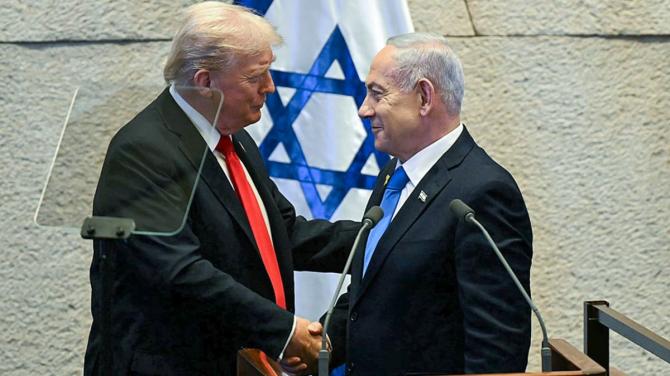
Meanwhile, an inflection point is arising as Netanyahu is due to be in Washington through Wednesday.
It is entirely conceivable that Netanyahu, who faces elections later this year, will put pressure on Trump to expand the scope of nuclear talks with Iran to include limiting ballistic missiles and 'ending support for the Iranian axis', as Netanyahu's office said over the weekend.
Such a demand is a non-starter, out of sync with the growing reality that the military option against Iran as such may be nearing the point of exhausting itself.
Ambassador M K Bhadrakumar served the Indian Foreign Service for 29 years.
Feature Presentation: Aslam Hunani/Rediff




 © 2026