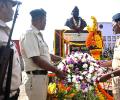
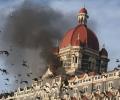
Sixteen years have passed since that horrific night in November that claimed 166 lives and wounded over 300 people.' On Tuesday, November 26, 2024, a grateful city paid homage to the martyrs who made the ultimate sacrifice while fighting the cowardly Pakistani murderers during the Mumbai terror attacks of November 26, 27, 28, 29 2008.

Ismail Khan, an accomplice of arrested terrorist Mohammed Ajmal Amir Iman alias Kasab, is the one who gunned down three top police officials in a gun battle at Cama Hospital, according to Kasab's statement recorded by the police. Anti-Terrorism Squad chief Hemant Karkare, Additional Commissioner of Police Ashok Kamte and encounter specialist Vijay Salaskar were shot dead by Ismail Khan.
The lone surviving gunman Mohammed Ajmal Amir Kasab and slain Lashkar-e-Tayiba operative Ismail Khan had planned to strike Raj Bhavan but could not succeed as they were overpowered by the police at Chowpatty enroute to Malabar Hill, the prosecution said on Monday.
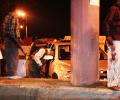
Rediff.com's A Ganesh Nadar spoke to Inspector Sanjay Govilkar, who intercepted Ajmal Kasab and his accomplice Ismail Khan when the duo approached them at Chowpatty in their stolen car on November 26, 2008.
Devika Rotawan, a survivor of the 26/11 Mumbai terror attacks, has demanded the death penalty for Tahawwur Hussain Rana, a key accused extradited from the US. Rotawan, a key witness in the case, identified terrorist Mohammed Ajmal Kasab in court during the trial. She believes the extradition is a "big win" for India and called for further action against other conspirators in Pakistan.
'Why is the Congress not tendering an unconditional apology to the citizens of India?'

'We began hitting Kasab hard.' 'In the melee it struck me that the man we were beating to pulp should remain alive.'

Date, a 1990 Indian Police Service officer of the Maharashtra cadre who once sold newspapers in Pune to financially support his family, was honoured with the President's Police medal for gallantry for his role in what has come to be known as the 26/11 attack.
What was shocking was the execution of the killings -- calculated, gory and intended to send a chill down the spine.
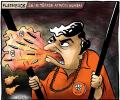
Uttam Ghosh offer his take on the Pragya Thakur controversy.
'If we have to restrict and fight terrorism, first and foremost, we have to ensure communal harmony in the country.'
New leads into the Mumbai terror attacks have revealed that the two bombs that went off at Vile Parle and Wadi Bandar were planted by slain terrorist Ismail Khan and his associate Mohammad Ajmal Amir Iman, who is in police custody.
The Mumbai terror attack trial began today with an eyewitness telling the special court that he had seen prime accused Mohammed Ajmal Amir Kasab firing from AK-47 rifle at Assistant Sub Inspector (ASI) Tukaram Omble, who fell to the bullets at Girgaun chowpaty on November 26 last year.

Various state governments had announced free transportation and accommodation, including West Bengal that ran special metro service for candidates.
Describing evidence against him in the 26/11 attacks as "weak", Pakistani gunman Ajmal Kasab asserted before Bombay High Court that police had not been able to prove beyond reasonable doubt he had killed police officers Hemant Karkare and Vijay Salaskar.
Special court Judge M L Tahiliyani said, "it appears that accused number one, Mohammed Ajmal Kasab and deceased accused number one, Abu Ismail were never destined to go to Chowpatty."
The investigation, currently being conducted by the National Investigating Agency, has highlighted the possibility that David Headley -- the American citizen arrested last month in Chicago by the Federal Bureau of Investigation on terror charges -- may have involved a couple of women in his plans.
At Mumbai's iconic Chhatrapati Shivaji Terminus station, where Abu Ismail and Ajmal Kasab had gunned down scores of innocent commuters on the night of November 26, 2008, people burst crackers and distributed sweets, after the latter was awarded the death sentence by a special anti-terror court on Thursday. One man in particular, NGO worker Pradeep Bhavnani, initiated the celebration. He had visited the Siddhivinayak temple earlier in the day to pray.

Jillu Yadav, a police constable attached to the Railway Protection Force, was among the 26/11 heroes and survivors invited to meet President Obama at the Taj Mahal hotel.
Vinita Kamte, slain Additional Commissioner of Police Ashok Kamte's wife, reveals her struggle to unravel the truth about her husband's death on the night of November 26, 2008.
A handwriting expert on Friday observed in a special court that markings shown on a map of 26/11 terror target spots recovered from slain terrorist Abu Ismail matched with specimen writings of accused Fahim Ansari, who is being tried along with Pakistani gunman Ajmal Kasab.
Family members of the slain cops who fell prey to the bullets of Pakistani terrorist Mohammad Ajmal Kasab and his cohorts feel the court should expedite the trial and punish Kasab.

Kasab, whose statement is being recorded by the court on evidences adduced by the prosecution, told Special Judge M L Tahaliyani that while one of the terrorists of the Taj hotel siege was a Kashmiri, another was from Gujarat.
A 26/11 survivor who saw the massacres at Chhatrapati Shivaji Terminus recounts a tale of horror.
'The 20 minutes that they drove around was the worst in my life. I spent each of those minutes thinking that I could be killed any moment.'
As Ajmal Kasab's trial comes to a close we catch up with 'Goli' Chauhan born just as the terrorists created havoc at Mumbai's Cama Hospital.
Three months ahead of the terror attacks in Mumbai, the group of ten terrorists who carried out the strikes were shown photos of their targets and not allowed to meet anyone lest the plot was leaked. The members of the group took turns at manning the watchtower of the boat and guarding the captain of the vessel Ajaysinh Solanki, who was later killed when the boat reached near Mumbai's shores.The police said the diary is proof that there were only ten terrorists on board.
Investigators working on the Mumbai terror attack have unearthed vital information about how the terrorists managed to enter Mumbai.The interrogations of the two arrested terrorists, Abu Ismail and Ajmal Kamal, have revealed that 20 men were involved in the terror attack. While eight terrorists set up base in Hotel Trident and Taj Mahal Hotel, 12 others came to Mumbai in a boat.
Mohammed Ajmal Amir Kasab, the lone terrorist arrested in the November 26 terror attacks in Mumbai, was on Monday remanded to police custody till February 2 in the Chhatrapati Shivaji Terminus firing case. Kasab has been in police custody since his arrest on the night of November 26 and has been booked in 12 cases by the city police.He was last remanded in police custody on January 4 for his involvement with accomplice Ismail Khan in the shootout at Cama and Albless Hospital.
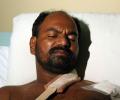
A police officer, who was injured in the terror attack, is struggling hard to cope with the constant media scrutiny.

Among those who remembered the slain bravehearts, who fell to bullets of Pakistani terrorists while repulsing the deadly attack on this day 11 years ago, were their kin, politicians, government officials, sports persons and common citizens.
'26/11 taught us we have to be ready for a direct attack. Today if anyone launches a similar attack we are more than prepared.'
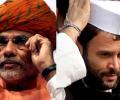
Even as the electioneering heats up for the third and the last phase polling in Assam, main opponents the Congress and the Bharatiya Janata Party have drawn up electioneering strategies to outsmart each other.

'In a fraction of a second everything started...'
'The government must covertly eliminate the leaders of terrorist organisations abroad so as to eliminate the problem at its roots,' recommends Brigadier Gurmeet Kanwal (retd).

Electioneering for the third and the final phase of polling in Assam to be held on April 24 in six constituencies - Gauhati, Dhubri, Kokrajhar, Barpeta, Mangaldoi and Nowgong -- came to an end on Tuesday afternoon with the election department expecting a high turn out on the basis of overwhelming response of voters in the last two phases of polling in the state.

Saroj Kumar Rath, author of the newly-published book Fragile Frontiers: The Secret History of Mumbai Terror Attacks, speaks to Rediff.com's Vicky Nanjappa.

Goli is a special child, born on 26/11 at the Cama hospital in Mumbai while the terrorists were raining bullets outside. Six years later, Vaihayasi Pande Daniel/Rediff.com finds a family determined to give their children the best life they can afford.
