
Bush said he would not have committed US troops if he had not been convinced the objective was achievable.
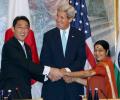
Amid China's growing assertiveness in South China Sea, India, Japan and the US at their first ever trilateral ministerial dialogue in New York.

Modi knew in his heart that India does not have the financial muscle to support the new bank with offers of co-financing international projects, something China can do from the bank's base in Shanghai. If established in Mumbai, it may have employed a few Indian bankers and satisfied the national ego but there was little financial value to be drawn from it.
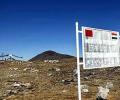
Prime minister likely to visit Beijing, Shanghai; also President Xi's home province, Shaanxi. Nayanima Basu reports

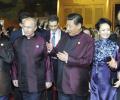
Was he just being a gentleman or was there more to it? Russian President Vladimir Putin has set the international media and Internet abuzz by putting his coat on the shoulders of China's First Lady Peng Liyuan.
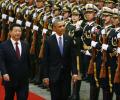
Chinese President Xi Jinping on Wednesday held formal talks with his US counterpart Barack Obama, a day after the two leaders pledged to push forward a new type of major-country relations between the world's two largest economies.
India will look to play a key role in the APEC, EU and Africa regions to increase its competitiveness.

Any additional effort to assuage the growing worldwide hunger for infrastructure funding is more than welcome, says Barun Roy.

The United States has suspended its military aid to Thailand in the wake of a bloodless coup there, as chief of the US army called his Thai counterpart urging him to return the country to democratic rule.
One of the biggest ways in which recent government actions have been seen as investor-unfriendly is New Delhi's decision to unilaterally revisit almost every Bilateral Investment Treaty it has signed with other countries, says Mihir S Sharma.

United States President Barack Obama came away with "renewed confidence" from his 90-minute meeting with his successor Donald Trump, the White House has said, adding that the emphasis of the discussions was on ensuring smooth transition to the next administration.

All the three issues raised by China at the Modi-Xi meeting are either intractable or peripheral to the bilateral relations and suggest conventional methods to placate the other side without yielding much, says Srikanth Kondapalli.

Modi assured Trump that India will try to 'live up to the expectations' of the US and the world and also thanked the US President for speaking 'highly' about India during his trips.

Four major political takeaways from Narendra Modi's much-anticipated trip to China

India and China will not rush to resolve differences over their contested border even as there has been steady progress in the overall relationship, said External Affairs Minister Salman Khurshid.

In daring raids, US commandos have captured a fugitive al-Qaeda leader from the streets of Libya and raided the seaside villa of an al-Shabaab militant in Somalia, signalling America's determination to pursue dreaded terrorists abroad.

India and Japan on Friday sought a peaceful solution to the territorial disputes in the strategic South China Sea, saying parties involved in the matter must not resort to "threat or use of force", in remarks that could anger China which is opposed to any outside interference.

In a diplomatic breakthrough, Chinese President Xi Jinping and Japanese Premier Shinzo Abe on Monday held their maiden talks, marking the "first step" towards mending ties between the two Asian rivals after years of territorial disputes and animosity due to wartime history.

'Presidents may come and go, but America will go on forever,' an American business leader tells Ambassador T P Sreenivasan in New York.

'One of the great assets that India has is its enormous intellectual content, enormous intellectual developmental content, and some of the things we need to be working on are unmanned systems, for example, the enormous opportunities for us to jointly partner and develop -- not simply sell our equipment to India -- but actually partner and develop in areas like drones, areas like advanced aircraft and even areas around certain missile systems, where we can have a win-win.'
The American, Russian and Chinese reactions to the Uri attack indicates how tough it will be for India to 'isolate' Pakistan internationally,' says Ambassador M K Bhadrakumar.

'Is Xi's China stable?'
'No one can say whether the regime will fall all at once or if its leaders are devising a new solid and competitive -- anything but democratic -- model.' A fascinating excerpt from Francois Bougon's Inside The Mind of Xi Jinping.

The strategic pacts were inked after the summit between Prime Minister Narendra Modi and his Japanese counterpart Shinzo Abe during which they also discussed international and regional issues of mutual importance including UN security reforms.

'In the past the US has been reluctant to name Pakistan directly in an US-India joint statement.'

Google Inc opened its first two data centres in Asia on Wednesday to cater to the world's fastest growing consumer technology markets, but the company has no plans to open one in China or India.
'There is nothing that Pakistan has done which deserves a resumption of dialogue. The assurances made in Ufa contain no commitment except a whole range of talks, which could take place without the paraphernalia associated with a joint statement of prime ministers.'

Modi, who is undertaking his first visit to China as prime minister, will reach the ancient city of Xi'an, the home town of President Xi Jinping, for a summit meeting, an unusual departure from normal protocol and seen as a reciprocal gesture by the Chinese leader who was hosted by Modi in Ahmedabad when he visited India in September last year.
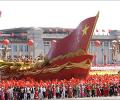
Premier Li Keqiang highlighted his government's performance in the last one year and the challenges ahead in various fields. Compared to other reports by his predecessors, Li spoke more frankly about the mounting challenges faced by the country. Srikanth Kondapalli on the two recent Chinese parliament sessions.

'This is the first time the US has formally recognised the threat India faces from terrorist organisations based in Pakistan.'

In an interview with Nayanima Basu, the DG lauds the efforts of Indian negotiators in bringing the deal on the table.

'Modi and Obama both had agendas that went beyond the nuclear deal. The threat from the chilly Himalayas had to be tackled in the warm waters of the Indian Ocean.'

'Happily,' says Ambassador B S Prakash, 'BRICS displayed new-found energy and built something real, a bank. Between needless nihilism and as yet unjustified euphoria, there are many stations for the BRICS train and we can watch its progress with renewed interest.'

Do Modi's foreign visits actually serve India or they nothing more than expensive tools for domestic positioning and image-building, asks Shehzad Poonawalla.
