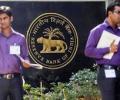
Richard Illey, chief economist, (Asia, ex-Japan) at BNP Paribas, talks to Business Standard on inflation and related issues ahead of the Reserve Bank's annual review of monetary policy.

Overall the inflation in vegetable segment was 8.57 per cent as compared to about 4 per cent in February.

Street expects RBI to keep CRR unchanged, opt for open-market operations to ease liquidity

The market believes there will soon be another offer to buy the bonds.

While the farmers are not getting remunerative prices for their produce, at the same time they are forced to pay high prices for items they consume.

Inflation measured by the Wholesale Price Index had declined to 6.62 per cent in January. It was 7.18 per cent in December and 7.24 per cent in November.
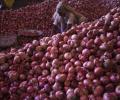
Retail inflation, based on Consumer Price Index, hit a 15-month high of 4.88 per cent in November
As per official data released on Wednesday, WPI inflation in the food articles category rose to double digits at 11.91 per cent, driven mainly by price rise in onion, cereals and rice.

The RBI's idiosyncratic focus on wholesale price inflation at the expense of retail inflation is a serious policy error.

If the pattern over the last three months is going to continue, the likelihood is that both indices will register inflation rates close to current levels over the next few months.

Infosys was the top gainer in the Sensex pack, closing 7.20 per cent higher as investors cheered its financial results. The IT major posted better-than-expected 5.3 per cent rise in its June quarter net profit, and raised revenue growth forecast for the current fiscal.

Inflation in food articles during June stood at 2.04 per cent, as against 1.13 per cent in May.

Wholesale Price Index for the month ended March moderated to 3-year low of 5.96 per cent against Reserve Bank's projection of 6.8 per cent.

The bank is due to review the monetary policy on July 30.

Tech Mahindra was the top laggard in the Sensex pack, cracking over 5 per cent, followed by Infosys, HDFC, IndusInd Bank, Reliance Industries and NTPC. On the other hand, Hero MotoCorp, L&T, Maruti, UltraTech Cement and Sun Pharma led the gainers' chart.
Use a mix of instruments that will beat both the wholesale and consumer price indices

It can be closer to RBI's perceived comfort level.

The average wholesale price inflation for FY14 will come at 5.3 per cent, while the consumer price inflation will average under 9 per cent, which would be a five-year low, the brokerage said.
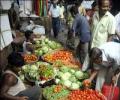
The rise in May Wholesale Price Index based inflation has been mainly on account of 31.44 per cent increase in prices of potato, 19.40 per cent in fruits and 12.75 per cent in rice.
His comments poured cold water on hopes that the central bank may have a rethink on rates after the wholesale price index, the main inflation gauge, rose a lower-than-expected annual 7.25 per cent in June, its slowest rise since January, helped by moderation in fuel prices.

The forecast has an error margin of four days, which is considered normal
However, risks to the outlook stems from possible sub-normal monsoon and higher crude oil prices (on account of the crisis in Iraq)," the Economic Survey 2013-14 tabled in Parliament by Finance Minister Arun Jaitley said.

Benchmark shares indices ended marginally higher on Tuesday, amid a volatile trading session, led by oil exploration major ONGC.
Declining inflation may present a case for further monetary policy easing.
RBI faces contradictory signals.
Food inflation, as measured by Wholesale Price Index, stood at 10.60 per cent in the previous week.
Wholesale prices, India's main inflation measure, had risen 6.1 per cent in August.

High inflation print is the price that the Reserve Bank of India (RBI) will have to pay to nurse a fragile growth back, say economists. Wholesale Price Index-based inflation rose to a record high of 12.94 per cent in May, aided by low base effect, but also because of higher fuel and commodity prices. Retail inflation, too, surprised by rising to 6.30 per cent, while the core inflation, which is the non-food and non-fuel component, rose to an 83-month high of 6.55 per cent. These numbers are much above RBI's upper limit of 6 per cent inflation target, but there is very little that the RBI can do at this moment.

The wholesale price-based inflation hovered over seven per cent through 2012, down from 10 per cent inflation seen in the previous year, reflecting the impact of tight money policy of the Reserve Bank of India.
The central bank is struggling to do so, after unleashing a panicky expansionary policy after the Lehman crisis.

Production in Karnataka and Madhya Pradesh are likely to be higher this year.
.jpg)
Food prices for consumers also eased to an annual 11.06 percent in August from 11.24 per cent in July.
Experts said onion prices, which are seeing deflation, are also headed to high-inflation territory in the coming months.

Falling core inflation on the back of slowing economic growth is likely to create space for the Reserve Bank to ease monetary policy in the early part of the next year, rating agency Crisil said.

Inflation in food articles, which have a 14.3 per cent share in the WPI basket, however witnessed an increase as onion prices shot up during the month.
The Sensex ended higher by 138 points at 19,367 and the 50-share Nifty advanced 43 points to close at 5,742.
Tata Motors was the top gainer among the Sensex stocks.

The WPI inflation for September rose to 7.81 per cent, from 7.55 per cent in August.

In its monetary and macroeconomic development report, RBI has raised hopes of a rate cut but also flagged some challenges.
 © 2026 Rediff.com - Advertise with us - Disclaimer - Privacy Policy - Sitemap - Feedback - About us - Terms of use - Grievances