
In its monetary and macroeconomic development report, RBI has raised hopes of a rate cut but also flagged some challenges.

Fitch Ratings said with GDP growth of 6.5% and WPI-based inflation of 8.8%, India may have entered into a stagflation period in 2011-12.

Inflation rose to 4.86 per cent in June, driven mainly by rising prices of food articles, especially vegetables including onion.
Some see CRR cut as tight liquidity continues.
A Reuters poll forecast the wholesale price index , India's main inflation measure, rose an annual 7.6 per cent in November, up from 7.45 per cent in October.
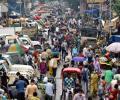
'We have lived through 10% plus inflation in India and we are aware of the economic pitfall.' 'With the RBI now having formally adopted an inflation target range, they cannot turn a blind eye to the impending risks.'

Inflation declined marginally to 7.45 per cent in October even though prices of food items like rice, wheat pulses and potato showed a rising trend.

CRISIL also expects the average Wholesale Price Index inflation to be higher at around 8 per cent as against of 7 per cent estimated earlier.

The gross NPAs of some public sector banks had crossed 4 per cent of their total assets at the end of September.

Though it eased slightly, prices of food items like rice, wheat pulses and potato showed a rise.

The Producer Price Index will be better able to measure the average change over time in the sale prices of domestic goods and services, the Reserve Bank Governor said.

After 24 months of slowdown beginning in January 2018 before the pandemic and then 18 months of collapse since January 2020, we have become the world's worst performing economy, observes Aakar Patel.
Inflation rose to 7.81 per cent in September, from 7.55 per cent in August.

Noting that India's inflation record was 'much, much better' against emerging economies, Basu said inflation should go down from September and as per expectations and calculations of the Finance Ministry, it will go below seven per cent from September.

Inflation based on the Wholesale Price Index (WPI) stood at 6.84 per cent in February. In March, 2012, it was 7.69 per cent.

The Nikkei India Manufacturing PMI dipped from 50.3 in November to 49.1 in December.
Inflation, as measured by the Wholesale Price Index, was 6.87 per cent in July.

Investors turned cautious after India's trade deficit widened to a more than three-and-a-half-year high of $16.6 billion due to costlier crude oil imports
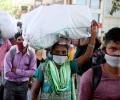
The government on Monday ruled out the possibility of free food-grains distribution to migrants saying there is no panic situation and no complete national lockdown unlike last year.

Several experts are of the view that inflationary pressure, including that in food items, may build from October with economic activity gathering steam. However, the price movement in three key items of tomato, onions and potatoes, commonly known as TOP, may give some solace in the months to come. Traders and market watchers said the price movement in all the three will remain within the band sans any unusual spikes.

Industrial production was seen growing 1.8 per cent from a year earlier in July, slower than June's 3.4 per cent increase, according to the median consensus in a poll of 31 economists.
The rate of price rise of food items was over 15 per cent during the same week last year.
Food inflation, as measured by the Wholesale Price Index, stood at 6.6 per cent in the previous week.
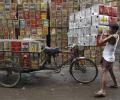
The Cabinet on Wednesday approved the National Mission on Edible Oils - Oil Palm (NMEO-OP) with a financial outlay of Rs 11,040 crore to promote domestic cultivation of oil palm in the next five years, and reduce the country's dependence on edible oil imports. The decision comes after Prime Minister Narendra Modi announced the new central scheme on August 15 during his Independence Day speech at Red Fort. Briefing the media, Union Information and Broadcasting Minister Anurag Thakur said the Cabinet approved the NMEO-OP with a focus on the northeast region and the Andaman and Nicobar Islands with a financial outlay of Rs 11,040 crore.

BSE Capital Goods and FMCG indices surged between 1-2%
For the first time since the new wholesale price index\nseries started in 1995, India's annual rate of inflation turned negative, falling to\nminus 1.61 per cent for the week ended on June 6.
Inflation moved up to 7.23 per cent in April on account of spurt in prices of vegetables, meat, milk and pulses, although onion and fruits showed a declining trend.
RBI may wait for a substantial downtrend and maintain repo at the current level in its third-quarter review.
After years of high food prices, India is now witnessing a deflation, according to the government's food inflation data.

The overall market breadth in BSE remained positive with 1,545 stocks advancing and 1,221 stocks declining.
With the average WPI-based inflation at 7.5% and CPI-based one above 10%, a bit of aggression is required to beat inflation. Four experts give their views.
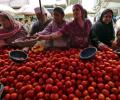
The rapid deceleration in prices has ignited a debate in New Delhi whether Asia's third-largest economy is heading towards deflation.
In February last year, it was 9.54 per cent.
Central bank should raise key policy rates again but avoid becoming a prisoner of its own making.

The rise in inflation based on wholesale prices in October from 9.72 per cent in September was mainly on account of higher prices of fruits and vegetables, manufactured goods and petrol.

The overall market breadth remained firm as 1,618 stocks are advancing while 1,270 are declining.
The latest numbers are the lowest since December 2009 when headline inflation was at 7.15 per cent.
Food inflation is back in double digits after a gap of a month-and-a-half and stood at 10.60 per cent for the week ending October 8 on the back of costlier vegetables, fruits, milk and protein-based items.
Headline inflation, as measured by the wholesale price index, was 9.7 per cent in March, 8.7 per cent in April and 9.1 per cent in the following month.
 © 2026 Rediff.com - Advertise with us - Disclaimer - Privacy Policy - Sitemap - Feedback - About us - Terms of use - Grievances