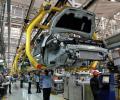
Auto parts exports from India may see a slight slowdown as US President Donald Trump's 25 per cent tariff could increase car prices for buyers by 8-25 per cent, thereby affecting demand, experts believe.
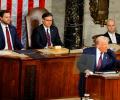
I'...additional concessions, such as opening government procurement, reducing agricultural subsidies, weakening patent protections, and allowing unrestricted data flows -- demands India has resisted for decades.'

Amid the ongoing global tariff war, Commerce and Industry Minister Piyush Goyal on Wednesday asked exporters not to panic and assured them that India is working on the "right mix and right balance" in its proposed trade agreement with the US.

'We currently have new proposals worth Rs 1.48 trillion in the pipeline.'

Chinese Foreign Minister Wang Yi said that it is imperative for the two sides to view each other as partners and opportunities rather than rivals or threats, and invest their valuable resources in development and revitalisation.

US President Donald Trump accused China and India of being the "primary funders" of the Ukraine war by continuing to purchase Russian oil during his address to the UN General Assembly. He also criticized NATO countries for not cutting off Russian energy.
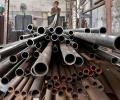
The Indian steel industry is faced with a paradox: Rising demand and falling prices. Demand continues to surge as user industries gather pace, with the World Steel Association projecting around 9 per cent annual growth for India over 2025 and 2026, the year domestic demand is projected to be almost 75 million tonnes (mt) higher than in 2020.

Union Minister Nitin Gadkari states that countries engaging in bullying do so because of their economic strength and technological advancement. He emphasized the need for India to increase exports and reduce imports to achieve global leadership.

State Bank of India, Tech Mahindra, Larsen & Toubro, Tata Steel, Sun Pharma, Infosys, HCL Tech, Axis Bank, Tata Consultancy Services and NTPC were among the biggest laggards among Sensex shares. Nestle, Hindustan Unilever, Titan, Power Grid, UltraTech Cement and ITC were among the gainers.
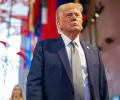
"India and everybody would think of them as an ally. I can say the same for others. But this is a group of wonderful nations that is countering other countries that look to hurt us on trade," he added.

American sourcing firms and exporters in China are approaching Indian companies to supply goods to the US as high tariffs imposed by Washington are making it difficult for them to ship directly to America, apex exporters' body FIEO said on Monday. The US has imposed 145 per cent tariffs on Chinese goods entering the American market. For India, the duty is just 10 per cent.

With US President Donald Trump "temporarily suspending" country-specific reciprocal tariffs until July 9, India sees the three-month window as an opportunity to renew its push for a proposed bilateral trade agreement (BTA) with the US and expedite finalisation of the first tranche of the trade deal.

US President Donald Trump on Friday again sought to pressurise Apple on its decision to increase production of its iPhone in India. Trump said that Apple will have to pay a 25 per cent import tariffs if its mobile handsets sold in US are not produced in the boundaries of the country.

India has implemented a number of free trade agreements with developed nations and is in active dialogue for such pacts with nations including the US, Oman, and the EU, Commerce and Industry Minister Piyush Goyal said. India has implemented trade pacts with Australia, the UAE and EFTA bloc. It has also signed an agreement with the UK.

Lutnick said that these countries have to understand that if "you want to sell to the US consumers, you've got to play ball with the President of the United States."
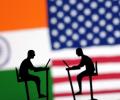
The US is expected to push for sweeping changes in India's policies, ranging from tariff reductions to regulatory overhauls, that could benefit American firms and exporters, under the proposed bilateral trade agreement with India, think tank GTRI said on Sunday.

'The steel industry has a multiplier effect on direct and indirect employment, national security on the supply chain, technology access etc.'

The strong domestic flow offset selling by foreign portfolio investors who pulled out $23.3 billion (Rs 2.03 trillion) from domestic equity markets in CY25.
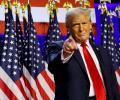
American President Donald Trump has announced imposing reciprocal tariffs on its major trading partners including China that levy higher import duties on goods shipped from the United States. He has already announced a 25 per cent duty on steel and aluminium imports, which will come into effect from March 12.

Foreign portfolio investors (FPIs) remained net sellers of Indian equities in September, withdrawing Rs 23,885 crore (around $2.7 billion) and taking year-to-date outflow to Rs 1.58 lakh crore ($17.6 billion).
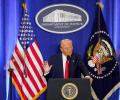
Unless something changes, Mr Trump is a huge threat right now, which is perhaps not being recognised fully, cautions Debashis Basu.

Private sector banks slipped in market capitalisation (mcap) during the July-September quarter, underperforming their government-owned peers as trade uncertainties dragged market sentiment, said S&P Global Market Intelligence. According to its analysis, HDFC Bank shed 4.8 per cent in mcap during the third quarter, while ICICI Bank's dropped 6.7 per cent.
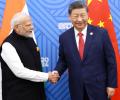
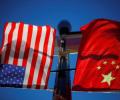
Chinese President Xi Jinping on Wednesday pledged to strengthen the strategic relationships with neighbouring countries by 'appropriately' managing differences and enhancing supply chain ties as China's tariff war with the United States escalated.
'Trump does have a master plan in mind to put pressure on India with the additional tariff of 25 per cent to get Modi to persuade Russian President Vladimir Putin to freeze the Ukraine war.' 'It has not worked so far. By end-September only we'll know for sure the future trajectory of India's oil purchases from Russia,' observes Ambassador M K Bhadrakumar.
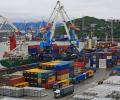
'There is definitely tepid demand because of the (reciprocal tariff) uncertainty.'
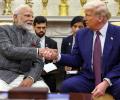
'President Trump believes in reciprocity and it is about time that we have a president who actually looks out for the interests of American businesses and workers'
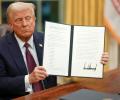
President Donald Trump delayed tariffs on Mexico and Canada for a short-term period for certain products before the 'big one' from April 2.

From the Sensex firms, Tata Motors jumped the most by 5.54 per cent, followed by Kotak Mahindra Bank, Trent, Sun Pharma, Axis Bank, and ICICI Bank. However, Bajaj Finance, State Bank of India, UltraTech Cement and Tata Steel were among the laggards.

The White House has claimed that India has begun 'scaling back' its oil purchases from Russia at the 'request' of President Donald Trump.

Saudi Arabia's steep cut in LPG benchmark prices has pushed India's household LPG underrecoveries to their lowest level in over two years, slashing oil companies' losses from Rs 200-250 per cylinder last year to about Rs 20-40 now.

US Vice President JD Vance and his wife Usha, the first Indian-American Second Lady, are set to visit India early next week. Vance will hold talks with Prime Minister Narendra Modi during his visit. The visit comes amid global concerns over President Donald Trump's policy on tariffs. Vance's visit is likely to be more of a private trip though it will have official components.

'Indian markets may underperform global peers for the next two quarters.' 'But beyond that, India should catch up and resume its long-term growth path.'

Smartphone exports for the first six months (April to September) of 2025-26 (FY26) surged to $13.4 billion, based on industry estimates. Driven by the production-linked incentive (PLI) scheme, this marks a 59 per cent jump over the $8.5 billion exported during the same period of the previous financial year (2024-25/FY25).

A Chinese firm this week began trial production of flying cars stated to be the next-generation in the world of transportation, ahead of US firm Tesla and others plans to launch the same shortly.
Trump administration's chief negotiator Brendan Lynch is arriving in India to hold talks on the India-US bilateral trade deal, which were impacted after the US imposed 50 per cent import tariffs on Indian goods.

Export-led Indian IT sector is not directly hit by Trump's tariff order on goods, but there could be worrisome indirect bearings on it arising out of possible slowdown in decision-making and GDP growth in America over higher tariffs, which may then cloud demand from specific verticals, according to some analysts.

While both sides have announced the decision to restart talks for a trade deal, government officials said discussions are continuing virtually.

Indian information-technology (IT) service providers are likely to report another quarter (July-September) of low, single-digit growth owing to macro uncertainties, chiefly emanating from America, with no respite in sight even in the second half of the year.

Passive funds appeal to investors seeking to avoid the risk of underperformance by the fund manager and minimise the need for frequent chopping and changing of funds.

The 15-year agreement will see Infosys develop a next-generation, data-driven workforce management platform to replace the existing electronic staff record (ESR) system, which annually manages a 55 billion payroll for 1.9 million NHS employees.
 © 2026 Rediff.com - Advertise with us - Disclaimer - Privacy Policy - Sitemap - Feedback - About us - Terms of use - Grievances