
From the Sensex firms, HCL Tech, Infosys, Power Grid, Tata Consultancy Services, HDFC Bank, Hindustan Unilever, Bharti Airtel and ICICI Bank were among the major laggards. However, Titan, Larsen & Toubro, Maruti and Axis Bank were among the gainers.

Reliance Industries cracked 4.42 per cent, while ITC, Kotak Mahindra Bank, InterGlobe Aviation, and HDFC Bank were also among the laggards. However, ICICI Bank, Sun Pharma, Hindustan Unilever, and State Bank of India were among the gainers.

The Gems and Jewellery Export Promotion Council (GJEPC) has urged the Centre to provide immediate relief measures as the tariffs imposed by the United States have started hitting the industry. US tariffs of 50 per cent on Indian goods came into effect on August 27.

'Given that India underperformed emerging markets by 28 per cent in 2025, the worst performance in over 30 years, the timing of the sharp STT hike could have been better.'
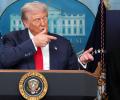
In trade negotiations, as in chess, sometimes you need to accept a temporary disadvantage to secure a better long-term position, points out Sonal Varma, chief economist (India and Asia ex-Japan) at Nomura.
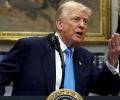
Industry leaders urge India to pursue diplomatic talks with the US, strengthen manufacturing, and consider China ties to gain leverage against tariff pressures.
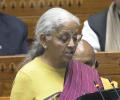
This Budget positions India's taxation ideology as not merely a revenue source but as a strategic catalyst for growth, inclusion and long-term confidence.

India and the US have signed a framework agreement for defence cooperation for the next 10 years, enhancing their partnership and aiming for regional stability.
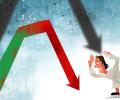
Indian equities declined on Friday, with the benchmark Nifty posting its worst weekly fall since September, as foreign investor sentiment remained weak amid tepid earnings growth and little progress on the India-US trade front.
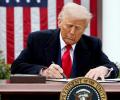
No experts, clearly, were involved in the design of these new tariffs, which have been the subject of bemused wonderment across the world in how completely they ignore logic, rationality, fairness, and economic theory, observes Mihir S Sharma.

Zelenskyy also stated that documents being drafted with Washington, DC to end the war were close to completion.

The Indian rupee, swaying through multiple headwinds, tiding over global trade disruptions and massive foreign fund outlfows, is unlikely to arrest its descent until tariff impact overhangs, notwithstanding robust domestic macroeconomic tailwinds. The Reserve Bank of India (RBI), which sees the rupee's depreciation as a silver bullet to offset the tariff shock, expects the currency to find its stable course once India reaches a trade deal with its largest trading partner, the US.
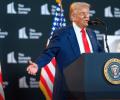
On August 7, the US president announced doubling tariffs on Indian goods to 50 percent for India's purchases of Russian crude oil, but gave a 21-day window to negotiate an agreement.

PDP leader Iltija Mufti defends a cricketer who displayed the Palestine flag on his helmet, criticizing restrictions on freedom of expression in Jammu and Kashmir and accusing the BJP of imposing Hindutva ideology.
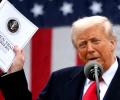
Chief Economic Advisor V Anantha Nageswaran on Thursday said he expects that a solution to the tariff issues with the US is likely to be arrived in the next eight to ten weeks.

The Indian economy is likely to grow at 7.4 per cent in 2025-26, up from 6.5 per cent in the previous fiscal, mainly on account of better performance of manufacturing and services sectors, as per the government data released on Wednesday.
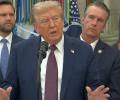
"India was charging us tremendous tariffs, about the highest in the world," Trump said adding that the US was therefore not doing much business with India.

New Zealand Prime Minister Christopher Luxon on Monday said the negotiations for a free trade agreement with India have been concluded.

'Incidentally, Prime Minister (Modi) and President Trump have also spoken on the phone on eight occasions during 2025, covering different aspects of our wide-ranging partnership'
Former White House official John Bolton suggests that tariffs imposed on India by the US for purchasing Russian oil may have unintended consequences, potentially driving New Delhi closer to Beijing and Moscow.
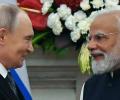
United States representative Sydney Kamlager-Dove while talking about the famous car selfie of Prime Minister Narendra Modi with Russian President Vladimir Putin said that it spoke a thousand words.

The BSE Smallcap index hit an over eight-month low of 47,627.96, falling 3 per cent in Tuesday's intraday trade amid selling pressure due to ongoing tariff-related concerns and rising geopolitical tensions.
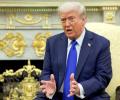
The US Representative criticised the administration's new USD 100,000 fee on H-1B visas, observing that Indians hold 70 per cent of these visas and saying the change directly harms workers who have long supported US innovation across technology, science and medicine.
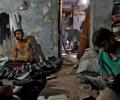
Uttar Pradesh's leading export hubs are reeling under the impact of a steep 50 per cent tariff imposed by the US on Indian imports, with exporters warning of job losses, stalled orders and shrinking market access. Industry leaders from Noida, Kanpur and Varanasi said the tariff has put years of painstaking market-building at risk, even as protests and demonstrations erupted in several districts last week.

'For those in for the long haul, this is a God-given opportunity.' 'Your market is falling despite strong fundamentals, and such a clear roadmap has been announced.'

Meeks, a ranking member of the House Foreign Affairs Committee Democrats, on Wednesday (local time) underscored "Congress' support for the US-India partnership," following his meeting with Indian Ambassador to the US Vinay Mohan Kwatra.

US President Donald Trump has again credited himself for ending the conflict between India and Pakistan, asserting Norway controls the Nobel Peace Prize. He claims he deserves the honor for ending eight wars and saving millions of lives.
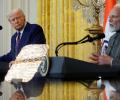
US Commerce Secretary Howard Lutnick claims a trade deal with India failed because Prime Minister Narendra Modi did not call then-President Donald Trump, despite requests.

Ukrainian President Volodymyr Zelenskyy has backed the imposition of tariffs on countries maintaining economic ties with Russia, saying it is the 'right idea' in the face of continued aggression by Moscow.

The textile and apparel sector is India's second-largest employment provider, after agriculture, and it is now caught in a wave of uncertainty following the Donald Trump administration's tariff policy.

As the potential threat of a steep 200 per cent tariff on pharmaceutical imports hangs in the air, analysts and industry insiders feel that focus on exports to non-US regions as well as domestic market will increase as a long-term trend. US President Donald Trump told CNBC's Squawk Box in the first week of August that planned tariffs on import of pharmaceutical products to the US could eventually reach up to 250 per cent.

Captured in powerful images and unforgettable moments, 2025 emerged as a turning point in global affairs. These images tell the defining stories that shaped the world across continents.
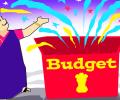
Sustaining 8 per cent-plus growth rates is necessary if we are to reach high-income status by 2047, points out Amitabh Kant.

'...but I would not like to put a timeline to it'
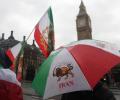
Trump's remarks came amid heightened US messaging about the Iran situation and a series of White House statements indicating that multiple options remain under review.

India and Canada are negotiating a long-term uranium supply agreement worth $2.8 billion. They are also exploring expanded civil nuclear cooperation after the passage of the SHANTI Bill.

This is the first Budget in my memory of Budgets over the last half a century which has embraced upfront, enthusiastically and emphatically, technology, modernity and fiscal sobriety, notes Shreekant Sambrani.
India, the world's fourth largest economy, is set to maintain the 'goldilocks' phase with tailwinds of good growth, low inflation and robust banking performance as well as reform initiatives poised to sustain the economic pace witnessed during 2025.
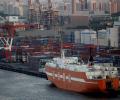
The government on Wednesday launched Rs 4,531 crore market access support (MAS) intervention scheme for a six-year period (FY26-31) to improve global reach, visibility and competitiveness of Indian exporters through 'structured and outcome-oriented' interventions.
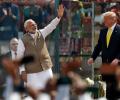
'It's important for India to think about areas where it wants the US to move.' 'We can be far more innovative in what we ask the US.' 'Given that there's a package deal, why not do it?'
 © 2026 Rediff.com - Advertise with us - Disclaimer - Privacy Policy - Sitemap - Feedback - About us - Terms of use - Grievances