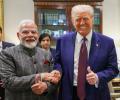
Modi lived up to his declaration that his visit was purely meant to strengthen India's relationship with the US, but there may be situations in which our silence on some issues will haunt us in the future, cautions Ambassador T P Sreenivasan.

'A less tense US-China relationship would make Beijing less likely to provoke India -- including on the border -- in retaliation for its close defence ties with the US.'

Now that David Headley has pleaded guilty, it is settled that he will not be extradited to India and that India will not be allowed to interrogate him.

In the volatile international situation where 'nativism' is on the rise and immigrant communities are being targeted, the Leader of the Opposition's statement is like adding fuel to fire. If the Indian diaspora numbering 4 crores is threatened it will constitute a grave threat to national security, warns Colonel Anil A Athale (retd).

In more than a decade since 2002, 60 fugitives were extradited or deported by foreign governments to India, which received a major victory in its fight to bring the perpetrators of the 26/11 Mumbai attacks to justice when a US federal court agreed to the extradition of Pakistani-origin Canadian businessman Tahawwur Rana to the country.

A United States court has denied the writ of habeas corpus filed by Pakistani-origin Canadian businessman Tahawwur Rana, paving the way for US Secretary of State Antony Blinken to issue a certification for him to be extradited to India where he is sought for his involvement in the 2008 Mumbai terror attacks.
Pakistani-origin terror convict Tahawwur Rana, whose extradition to India has received a green signal, was 'very relaxed' in the days after the 26/11 attacks and wanted Pakistan's highest military honour to be bestowed on the Lashkar-e-Taiba (LeT) terrorists who carried out the carnage in Mumbai.

Rana was arrested in 2009 on the charges of plotting the 26/11 terror attack. Some 166 people, including US nationals, were killed in the attack carried out by 10 Pakistan-based Lashkar-e-Tayiba terrorists. Nine of the attackers were killed by police while lone survivor Ajmal Kasab was captured and hanged after handed down death sentence by an Indian court.

A federal United States court has allowed Pakistani-origin Canadian businessman Tahawwur Rana time till November 9 to file a motion against his extradition to India to face a trial in the 2008 Mumbai terror attack.
Backed by a court order, India is expected seek extradition of Lashkar-e-Tayyiba operative David Coleman Headley and his accomplice Tawwahur Rana. But this is going to be an uphill task for investigators, reports Vicky Nanjappa.
In this report for ProPublica, Sebastian Rotella describes what the world learnt, and did not, about Pakistan's terror connection from Rana's Chicago trial.
Two days after reports of Tahawwur Rana admitting to providing support to 26/11 terrorists at the behest of Pakistani government and the Inter-Services Intelligence, his attorneys on Thursday denied any "knowing involvement" of the Pakistani-Canadian in the attacks.

Here's what Headley told the court on Thursday:
Gujarat Chief Minister Narendra Modi on Friday said that the clean chit given to Tahawwur Rana in Mumbai terror attack-related charges by a United States court was a "foreign policy setback", and demanded that India reconsider its policy towards the United States. "Just to please Pakistan, US has unlocked the ways for all the 26/11 Mumbai attack terrorists to be free of guilt. It is time the central government rethink its policy towards US," Modi said.
The trial of Pakistani-Canadian Lashkar-e-Tayiba operative Tahawwur Rana, co-accused with David Headley in the 26/11 case, is set to begin in Chicago on May 16. If insiders are to be believed, Rana is likely to implicate Pakistan's Inter-Services Intelligence in the Mumbai terror attacks, reports Vicky Nanjappa.

India has sought access from the United States to the 26/11 Mumbai terror attack convict David Headley and his accomplice Tahawwur Rana -- both of whom were sentenced by a Chicago court after being found guilty of terrorism charges.
India on Thursday said it will seek access to Tahawwur Rana, an accomplice of convicted terrorist David Headley from the United States and maintained that its demand for their extradition "continues to stand" to take forward its legal processes in Mumbai terror strike cases.
The "serious" prison sentence for Pakistani-Canadian Tahawwur Rana should send a tough message to all individuals planning to indulge in any direct or indirect terrorist activities that they cannot escape detection and punishment, US prosecutors said on Friday.
David Headley, who was involved in the Mumbai terror attack, was a liar and ditched his school time pal Tahawwur Rana, the Pakistani-Canadian's attorney told a Chicago court on Tuesday, claiming that their friendship was over and they would never meet again.
The United States prosecutors on Tuesday sought 30 years' imprisonment for Pakistani-Canadian Tahawwur Rana, an accomplice of convicted terrorist David Headley, for providing material support to Laskar-e-Tayiba and conspiring for a terror attack on a Danish newspaper.

The sentencing of American-born Lashkar-e-Tayiba terrorist David Headley, accused of involvement in 26/11 Mumbai attacks, has been fixed for January 17 next year while that of his accomplice Tahawwur Rana has been rescheduled for January 15 from December four.
The government has given its sanction to charge sheet nine people including Pakistani-American terrorist David Headley, Lashkar-e-Tayiba founder Hafiz Saeed and two Inter Services Intelligence officers for plotting terror attacks in India including the 26/11 strikes.
The United States on Friday said it would continue its hunt for dreaded terrorist Illyas Kashmiri, Lashkar-e-Tayiba handler Sajid Mir and four others involved in the Mumbai attacks that killed 166 people, including six Americans. The six are named in the indictment in the case in a Chicago court, which is hearing charges against Tahawwur Rana and David Headley. Rana was on Thursday sentenced to 14 years in jail.
A Delhi court on Saturday took cognisance of the National Investigation Agency chargesheet against Pakistani-American David Headley Coleman and eight others for allegedly carrying out several terror attacks in India.
A United States court on Wednesday rescheduled the sentencing of Pakistani American LeT terrorist David Headley, accused of involvement in 26/11 Mumbai attacks, from January 17 to January 24, while that of his accomplice Tahawwur Rana has been rescheduled for a second time to January 17.
Two years after his role in terror activities surfaced, the National Investigation Agency on Saturday chargesheeted Lashkar-e-Tayiba operative David Headley, Lashkar founder Hafiz Saeed and two Inter-Services Intelligence officers for plotting terror attacks in India including the 26/11 strikes.
There has been a huge cover-up of the LeT iceberg in India that helped David Headley and Tahawwur Rana plan the 26/11 terror strike, says B Raman
Mumbai attacks accused David Headley had repeatedly told his Federal Bureau of Investigation interrogators that his friend and co-accused Tahawwur Rana was unaware of his terror activities and had not provided any support to him knowingly, details that were omitted from an affidavit filed before a court, recently unsealed documents reveal.
Ajmal Kasab was hanged, but there are four other trials that need to be expedited to bring the real masterminds of the 26/11 attacks to justice. Vicky Nanjappa reports
On the instructions of Inter-Services Intelligence, David Headley masqueraded as a tourist interested in angling, taking fishing boats into the waters off Mumbai to identify a suitable landing site for Lashkar-e-Tayiba terrorists, who months later created mayhem in India's financial capital.
Judge Harry Leinenweber at the US district court for the northern district of Illinois, eastern division, in a ruling denied Rana's motions for a new trial and for a judgment of acquittal. In two different orders on June 7 and 8, Leinenweber also scheduled his sentencing for December 4. However, no sentencing has been scheduled for his co-defendant David Headley
The verdict of a United States court holding Pakistani-Canadian Tahawwur Rana not guilty of the Mumbai terror attacks would not affect the legal proceedings against terrorist Ajmal Kasab and the charge against Lashkar-e-Tayiba of masterminded the strikes, special public prosecutor Ujjwal Nikam said on Friday.
Pointing at Inter Services Intelligence's direct involvement in providing arms to militants in Kashmir, Tahawwur Rana, one of the key accused in the Mumbai terror attacks, has told the Federal Bureau of Investigation that Pakistan's spy agency gives weapons to terrorists when they are about to enter the Indian territory.
When Tahawwur Rana's defence attorneys cross-examine David Headley this week, it's possible that they will severely damage him, or that he will self-destruct on the stand. Investigative journalist Steven Rotella reports for ProPublica.org on the Lashkar operative's credibility problems
Three years have passed since India witnessed one of its worst terror attacks. While the National Investigating Agency tries stack up evidence against David Headley and Tahawwur Rana, security agencies across the country find themselves being foxed by a new wave of terror: unroganised hell.
The Indo-US extradition treaty may pose a major hindrance to India's efforts to produce David Headley and Tahawwur Rana before a Delhi court over the Mumbai attacks, as it does not allow handover of a person already convicted or acquitted for the offence he has been sought for.
A few days back the home ministry announced that it had completed its probe against 26/11 terror accused David Headley. However, there continues to be a slight delay where the filing of the chargesheet is concerned.
Tahawwur Rana, who was found guilty of providing support to Pakistan-based terror group Lashkar-e-Tayiba, had cited omission of crucial exculpatory evidence in his case to seek a fresh hearing, recently unsealed court documents have revealed.
The rejection by a Chicago court to conduct a retrial plea of Tahawwur Rana, the Pakistani-Canadian accused in the 26/11 Mumbai terror attacks is a shot in the arm for the Indian agencies who have been looking to question him, says Vicky Nanjappa.
Indian Foreign Secretary Nirupama Rao will travel to Islamabad later this month to hold talks with her Pakistani counterpart during which India will raise the issue of nexus between Pakistan's Inter-Services Intelligence and the perpetrators of 26/11 attacks, as brought out by the trial of Pakistani-Canadian terrorist Tahawwur Rana in the United States.
 © 2026 Rediff.com - Advertise with us - Disclaimer - Privacy Policy - Sitemap - Feedback - About us - Terms of use - Grievances