The turnover of FMCG major Nestle India's has grown 2.5 folds to Rs 20,100 crore in last one decade, post the Maggi crisis in 2015, according to the company's latest annual report. At the time of crisis, Nestle India's turnover was at Rs 8,100 crore.

Quick commerce (Qcom) platforms are bringing upon a rapid change in the behaviours of online shoppers, with 31 per cent of buyers relying on the fast delivery option for grocery needs, according to a new study.

Suresh Narayanan, chairman and managing director of Nestl India, is set to retire on July 31 next year, marking the end of an era that began 26 years ago with the Nestl group, a multinational giant in the food and beverage space. His tenure is perhaps most famously defined by his role in reviving the Maggi noodles brand. When Narayanan stepped into leadership at Nestl India in 2015, the company was facing criticism: the Food Safety and Standards Authority of India (FSSAI) had ordered a nationwide recall of the popular Maggi noodles due to high levels of lead found in the product.
Leading FMCG companies reported a decline in margins in the September quarter on account of higher input costs and food inflation, which ultimately slowed down the pace of urban consumption. Rising prices of commodity inputs such as palm oil, coffee and cocoa were also accentuated and some FMCG firms have hinted at a price hike. HUL, Godrej Consumer Products Ltd (GCPL), Marico, ITC, and Tata Consumer Products Ltd (TCPL) have expressed concerns over squeezing urban consumption, which according to industry experts forms 65-68 per cent of FMCG total sales.

India has been a tea sipping society. But the aromatic wave of coffee culture is wafting across it.

With rising incomes, education, and health awareness in India, especially in the big cities, droves of people are saying no to sugar.

Presently, around 23 per cent of Nestle India's workforce are women, its chairman and managing director Suresh Narayanan said on Monday. "We moved a fair degree on this. When I came to Nestle India in 2015, at that time we were at about 15-16 per cent.
Maggi was banned by Food Safety and Standards Authority of India in June 2015 for five months for allegedly containing lead beyond permissible limits

Sheshadri, who now runs a dance academy in Dallas, Texas, has penned the lyrics, composed music and sung the numbers in the yet unnamed album.

Nestle India said in a statement on Friday that its managing director for India, Etienne Benet, would move to the group's head office in Switzerland.
According to Nielsen, rural growth has plunged to a low 5 per cent in the third quarter of quarter from a high 20 per cent a year ago. This has for the first time in seven years rural growth has fallen below urban levels.

Nestle's Maggi 'shock therapy' worked. Nestle probably required such shock treatment as the June 2015 ban on Maggi noodles to jerk it out of its ennui, suggests Suresh Narayanan, now chairman and managing director of Nestle's India business.
While sales momentum from rural areas may last another three to six months, sales growth in urban areas could stage a comeback by next year's June quarter as people learn to live with the coronavirus and economic activity gradually improves in the cities.
Clearly, the domestic market has taken sharp knocks in April, which is likely to be visible in May as well, said analysts tracking the market, as FMCG companies are grappling with improving capacity utilisation and dealing with labour shortage.

Top companies reported that despite most of them making staples and essential products, movement of raw material, goods and labour remained restricted, impacting sales.

Nestle India Ltd will focus on growing its dairy, coffee and confectionary businesses, its new boss said
Companies from Nestle and ITC to Hindustan Unilever and Patanjali have pledged to reduce use of unhealthy ingredients by five to 50 per cent

Names such as Danone, Dabur, Mondelez and Abbott Healthcare have also figured on the list of suitors.

While companies have not launched too many products in rural areas of late, easy financing has helped push up demand.

From fast food and athleisure to ACs, the demand for several non-discretionary items has spiked since May 17, when Lockdown 4.0 was extended till May 31.
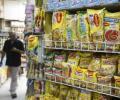
In 2019, the growth in sales of the Maggi brand of products surpassed the pre-ban level of 2014, in terms of both volume and value. While, Nestle raised prices of Maggi products by an average 3.1 per cent, its volume rose by 9.6 per cent year-on-year.

Nestle aims to shed the 'food and beverages company' tag; enters rapidly-growing petcare market in India

The court had provided a conditional relief to Nestle India.

Nestle India said it will continue with the existing formula of the product and not change the ingredients

While green shoots are beginning to emerge, with June sales rebounding to pre-Covid levels thanks to a rural revival, most FMCG chief executives have voiced concerns about localised lockdowns that began in July and have extended into August in some states.
Suresh Narayanan, chairman & managing director, Nestl India, shares tips on crisis management.
They are evaluating realignment of warehouses and supply chains, besides exploring locations to set up hubs and shutting down some distribution centres
Milk products and nutrition, the largest category that contributes nearly 47.6% to the company's top line, grew 1.6%

Almost 40 per cent of a durable company's sales are achieved during the festival season
From farm to kitchen: Nestle reveals Maggi's secret recipe.

The Indian operation of the Swiss food group employs more than 5,000.
Corporate leaders said a stable government at the Centre will help boost infrastructure spend, address agricultural distress, and encouraging employment.

Iron-rich noodles and vitamin-rich beverages are some products launched by segment majors

Maggi's reach is now close to some three million outlets.

Recent data from market analytics firm Nielsen shows that the rural market in the country's 630,000-odd villages is pulling down the overall FMCG business.
Although large companies like Nestle, Dabur or HUL have been impacted by this slowdown in demand, it was the small, local players that have been hit harder.
Lack of clarity on whether manufacturing bans in Punjab, Uttarakhand, Himachal, Goa and Karnataka still in place
As wholesalers largely failed to meet GST norms, companies were in a fix. According to industry veterans like Sunil Duggal, chief executive of Dabur, the hazard led many to look beyond third-party distribution and take the leap to cover unattended markets directly.

It is not easy for an FMCG brand to make a comeback if it has been out of consumer's reckoning for some time. Moreover, a protracted battle between the owners and then closure of a large number of outlets at one go might have sent some very negative signals to many, says Sneha Bhattacharjee.
 © 2026 Rediff.com - Investor Information - Advertise with us - Disclaimer - Privacy Policy - Sitemap - Feedback - About us - Terms of use - Grievances