
India's top 9 cities are likely to witness a 4 per cent decline in housing sales in the quarter ending September to over 1 lakh units on lower demand in Mumbai region and Pune, according to PropEquity. Real estate data analytics firm PropEquity on Sunday released data of primary residential market for July-September, which is generally considered as a weak quarter because of monsoon season and inauspicious Shraadh period.

India's leading real estate developers are accelerating their push into plotted development, a segment once dominated by unorganised players but now reshaped by branded offerings, faster cash flows and evolving buyer preferences. This strategic shift is visible across markets such as Bengaluru, Chennai, Hyderabad, Gurugram, peripheries of the Mumbai Metropolitan Region (MMR) and even Tier-II cities.

Part-I of this three-part series dives into Delhi-NCR's SPR, Sohna, Dwarka Expressway, and Jewar Airport leading the charge.

'The momentum is driven by rising affluence, strong demand from HNIs (high net worth individuals) and NRIs (non-resident Indians), an increased appetite for larger, well-located homes by branded developers, and support from the economy.'
Real-estate firms have welcomed the Goods and Services Tax Council's reforms, expecting better affordability for buyers, spurring demand. The council has reduced the rate on cement from 28 per cent to 18 per cent, while the rate on sand lime bricks or stone inlay work and granite blocks has been cut to 5 per cent from 12 per cent.

Housing sales are estimated to decline 23 per cent annually to nearly 1.06 lakh units during January-March across nine major cities on subdued demand due to high prices and concern over economic growth, according to PropEquity.

While demand for sub Rs 50-lakh affordable housing prevails, market players cite increased land rates, escalated construction costs and low margins as key prohibiting factors.

Mumbai -- home to industry titans and Bollywood stars -- is witnessing a slow offtake of houses priced between Rs 10 crore and Rs 50 crore. Industry insiders and real estate watchers explain why.

Union Finance Minister Nirmala Sitharaman on Saturday announced a fresh Rs 15,000 crore 'SWAMIH Fund' for completion of 1 lakh units in stalled housing projects across various cities, a move aimed at providing relief to distressed homebuyers whose investments are stuck. In November 2019, the Centre announced a stress fund named 'Special Window for Affordable and Mid-Income Housing' (SWAMIH), to complete stalled housing projects across India.

'In the past six months, capital markets have seen a dip, and realty is struggling. The stock-market investor will be cautious of putting that investment in real estate when there may be a slowdown coming.'

The national real estate market presents an intriguing picture. Lower volumes and flat pricing serve as dampeners. Sales bookings across the top ten markets have seen 6 per cent growth year-on-year (Y-o-Y) between April and August 2024, but sales volume is down 8 per cent Y-o-Y. Unsold inventory is up.

The government on Tuesday proposed reducing the long-term capital gains tax on immovable properties to 12.5 per cent from 20 per cent, but removed the indexation benefits to adjust for inflation, a move experts termed as "negative" for sellers.

Credit outstanding to the housing sector rose by nearly Rs 10 lakh crore in the last two fiscals to reach a record Rs 27.23 lakh crore in March this year, according to RBI's data on 'Sectoral Deployment of Bank Credit'. Experts from banking and real estate sectors attributed this growth in housing credit outstanding to a strong revival in the residential property market post-COVID pandemic on pent-up demand. According to the data of the Reserve Bank of India (RBI) on sectoral deployment of bank credit for March 2024, the credit outstanding to the housing (including priority sector housing') stood at Rs 27,22,720 crore in March 2024, up from Rs 19,88,532 crore in March 2023, and Rs 17,26,697 crore in March 2022.
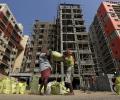
Housing sales across seven major cities in the country fell 35 per cent year-on-year to 50,983 units during the July-September period even as the demand recovered post lockdown, according to data analytics firm PropEquity. Sales stood at 78,472 units in the year-ago period in seven cities -- Delhi-NCR, Mumbai Metropolitan Region (MMR), Chennai, Kolkata, Bengaluru, Hyderabad and Pune.
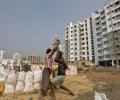
With the arrival of the second Covid wave in April, the numbers fell by almost 50 per cent.
The maximum fall on total market valuation will be in Mumbai (Rs 2,00,330 crore) followed by Bangalore (Rs 99,983 crore) and Gurgaon (Rs 79,059 crore).

'If they are taking marquee locations and, say, are paying 50 per cent higher rent, those locations will see a spurt in rates as well.'
PropEquity, the real estate data analytics and research firm, attributed the fall in absorption in these markets to lack of demand from investors.
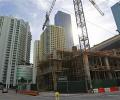
While Gurugram sees biggest drop in house prices, housing sales in Bengaluru dropped by 45 per cent followed by Kolkata, a 44 per cent decrease, and Ahmedabad, a 42 per cent decline.

Oberoi Realty has hit the top slot in Mumbai's ranking of the top-20 developers in terms of sales in 2021, evicting the Runwal group which was number one last year. The Lodha group which had occupied the top slot three out of five times since 2017 slipped to second place in 2020 and continues to be in the same position in 2021. The Oberoi group was in fifth place in 2019 and fourth place in 2020. This is the first time that it has occupied the number one position. The Runwal group which took the top slot in 2020 is down to third place in 2021.

Sales in newly launched residential products have gone up slightly owing to discounted prices. But will this trend sustain?
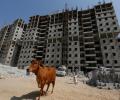
Experts say that the lockdown and its aftermath will further quicken the consolidation in the real estate sector, which has been taking place since 2012, with more small players going out of the business and bigger, branded players dominating the market.

The industry describes projects priced beyond Rs 5 crore (Rs 50 million) in Delhi and the National Capital Region region as luxury, but the benchmark is Rs 10 crore (Rs 100 million) for Mumbai.

Housing sales are estimated to rise 93 per cent year-on-year during April-June across seven major cities, but may fall 58 per cent compared to the previous quarter due to the adverse impact of the second wave of COVID-19, according to property consultant Anarock. Sales are likely to be around 24,570 units across seven major cities -- Delhi-NCR, Mumbai Metropolitan Region (MMR), Chennai, Kolkata, Bengaluru, Hyderabad and Pune, Anarock said. Sales of residential properties stood at 12,740 units in April-June 2020 and 58,290 units in March quarter 2021.

Housing sales dipped by more than half in the first quarter of 2012 in Mumbai and national capital region due to high prices and uncertain economic conditions, and a continued downtrend could force builders to sell homes at up to 20 per cent cheaper rates, says a report.

One can look at property only if they have excess cash and the property value is only a minor part of the investment portfolio, say investment experts.
In markets such as Mumbai, prices have gone beyond Rs 1.5 cr to Rs 2 cr which is beyond reach of most of the salaried class

Home seekers demand has exceeded supply and hence there is a possibility of rentals going up by atleast 10 percent.
CREDAI-MCHI, a body of developers in Mumbai, has pegged the drop in sales booking at around 80 per cent in the February-March period this year. This is the second highest fall in residential sales in the past five years, after Q1, 2017, when the decline, due to the note ban, was 37 per cent.
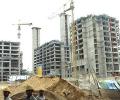
Bengaluru saw a 23% decline in home sales and a 3% fall in prices.

Financial planners advise against putting capital to work by anticipating what might go up or down.

Booked between 2007 and 2011, out of the total 32,700 residential units under various Jaypee Infratech (JIL) projects, at least 20,000 homes are yet to be delivered. Supreme Court documents show that, till last March, Jaypee had issued 7,997 offers of possession to homebuyers while executing only 6,530 sub-lease deeds. These deeds offer homebuyers possession rights but, unlike registration, does not guarantee absolute ownership.
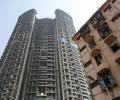
Listed realty developers saddled with unsold properties worth Rs 1 trillion
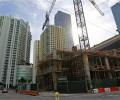
Most of these projects were launched between 2008 and 2010

HFCs and banks expect a drop in demand for housing loans in the short-term.

If your children live abroad, rely more on financial assets as they are easier to liquidate and move across borders.
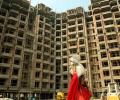
Markets such as Bengaluru and Chennai, which had managed to escape the impact of real estate slowdown so far, appear to be giving in now.
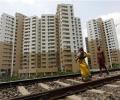
Slump in realty market to add to woes, debt of top players likely to rise 15-20% this financial year
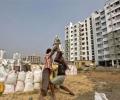
Consolidation is happening because of a prolonged slowdown in residential sales which has also brought down the business of brokerages.
