Evidently, households see a brighter future after the Budget, reveals Mahesh Vyas.

Congress' senior spokesperson Anand Sharma Sharma said Prime Minister Narendra Modi must 'walk the talk' and announce the measures required by giving money in the hands of the poor and small and medium enterprises to help reboot the economy.

In the short run, the government should loosen the purse strings but trying to invent new instruments is a bad idea, Banerjee said. Trust, he said, in the system is important at this point and keeping that in mind.

'It may take two years for the economy to return to normal.' 'We should ensure that the vulnerable do not dig into their savings or give up their assets because that will set them back by several years.'

The survey showed that women workers fared worse than men when it came to employment recovery (53 per cent versus 57 per cent) and urban areas have been much worse hit despite a quicker bounce back.
Experts say the party is undoing what it achieved through MNREGA by targeting beneficiaries
The immediate need is to put more money in the hands of agriculture-based and rural households to improve their purchasing power, says S Mahendra Dev.
'The stimulus packages, sector reliefs, loans etc are coming to industry, but state governments have not got any money from GST, no money from excise, no money from any income source.'

Former CAG Rajiv Mehrishi says Centre has held back a report he submitted to the President, to end what he called "a nightmare of accounts that militates against good governance".
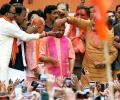
'What worked for the BJP were three things: Hindu nationalism, religion and a silent but strong anti-Muslim sentiment.'
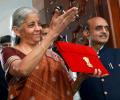
'The term 'pro-growth' must be qualified somewhat because, while a rising tide will lift all boats, it will not necessarily do so equally.'

RSS-aligned Bharatiya Mazdoor Sangh (BMS) on Monday expressed disappointment over the government's budget proposals with regard to divestment and foreign direct investment, especially in the insurance sector. The BMS, however, lauded the government for its current efforts on the massive vaccination programme, a special scheme for tea workers in West Bengal and Assam, labour oriented push on infrastructure projects in construction sector and development of five major fishing harbours viz. Kochi, Chennai, Visakhapatnam, Paradip, and Petuaghat as hubs for economic activities etc. On other Budget proposals, it said in a statement that "mixing the beautiful concept of Aatmanirbhar Bharat with FDI and disinvestment in the Union Budget is disappointing for the employees".

'Jobs will exist at very high levels or low levels of skill sets.' 'People, who are in middle level jobs, are the ones who are facing the problem as such jobs are fast disappearing because of technological advancement.'
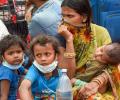
For states like West Bengal, Bihar, Odisha, Jharkhand and Uttar Pradesh, where migration is high, the return of workers could be as much an opportunity as a liability. All states have launched portals to register migrant workers; additional fields like nature of employment and remuneration in the past 2-3 years are being added to help in skill mapping.

'Waiting for a market correction and optimising entry time in the markets will be akin to missing the woods for the trees.'
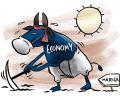
Almost 63 per cent of the increased allocation of around Rs 1.01 trillion has been spent in the first five months of 2020-21.
Excise duty hike for cigarettes could be lower.

"The PMJDY has been the foundation stone for the Modi government's people-centric economic initiatives. "Whether it is direct benefit transfers, Covid-19 financial assistance, PM-KISAN, increased wages under MGNREGA, life and health insurance cover, the first step was to provide every adult with a bank account, which PMJDY has nearly completed," Nirmala Sitharaman said on the sixth anniversary of the scheme.

The Supreme Court on Monday came down heavily on certain states for not implementing welfare legislation National Food Security Act, saying that why a state like Gujarat was not implementing the law passed by Parliament.
'MGNREGA Sameeksha' is an anthology of all major research studies on performance of the programme that were published in academic journals or the stand-alone reports, but excluding the newspaper and magazine articles and opinion pieces, says Rural Development Minister Jairam Ramesh in his forward to the volume.
The focus is likely to be on consolidation and improvement of existing rural-centric programmes to ensure their completion ahead of the next general elections in 2019, rather than announcement of new schemes. Sanjeeb Mukherjee and Arup Roychoudhury report.
This will cost the government Rs 3.1 trillion, about 10 per cent of its annual expenditure, and higher than any other spending item in its Budget.

The unemployment rate among women came down to 12.4 per cent in urban areas

FM has taken up basic issues that concerns the population in India's heartland.
An Empowered Group of Ministers on drought headed by Sharad Pawar on Friday sanctioned Rs 480 crore as immediate relief to Gujarat for rural drinking water and also announced increase of man days under MGNREGA from 100 to 150 per person.

Strict lockdown-like restrictions are already in place in the southern stateand the Pinarayi Vijayan government decided to clamp the complete shutdown in the wake of severe spike in the positive cases.

Congress leader Rahul Gandhi on Friday assured that the Citizenship Amendment Act (CAA) will not be implemented in Assam if the party is voted to power in the state in the coming assembly poll.
The National Level Monitors have pointed out grave irregularities in the NREGA scheme in Uttar Pradesh.

To make possible discretionary spending including capex and that on welfare, the government decided to borrow more than planned in FY21 -- Rs 12.7 trillion.

About 78 per cent respondents said they were also satisfied with the steps taken by their own state government, according to the findings of the survey.

Loss of confirmed orders, increase in wages and labour shortage were blamed on the scheme in a survey of 100 companies from diverse sectors.

Although demonetisation and improper implementation of GST along with falling prices are being blamed for much of the distress in rural India for some time, experts believe those may not be the only reason.
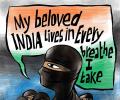
'We are patriots who love India and the secular ideals it has always upheld.'

The Union Budget stepped up plan allocation for the health sector by 20 per cent with a focus on health insurance, which Finance Minister Pranab Mukherjee announced would be extended now to unorganised sector workers in hazardous mining and associated industries.
China has sought information on India's poverty reduction programmes, including the Mahatma Gandhi National Rural Employment Guarantee Scheme, to beef up its own strategy.
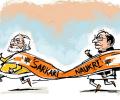
The situation could become more acute as millions of migrants who had returned to their villages during the lockdown come back to the towns for higher wages and better livelihoods.

Universal basic income or social security? Economist Nitin Desai feels we need a blueprint for universal health care and pensions to help the vulnerable section.

There will be uncertainty about outcomes,but one must hope for the best, observes T N Ninan.
Nearing the four crore (40 million) mark in providing jobs under MGNREGA, re-launching the Provision of Urban Amenities in Rural Areas scheme and reinforcing social audit in programmes on complaints of irregularities were the foremost tasks of the rural development ministry in 2010.
FMCG: Cut in excise duty on baby, clinical diapers, adult diapers and sanitary napkins.
