
With general elections on the horizon, the government's privatisation bandwagon has almost but stalled as a government wary of being accused of selling family silver opts for minority stake sales on stock exchanges over outright privatisation. The result -- the divestment target for current fiscal year is again likely to be missed. Big ticket privatisation plans such as that of Bharat Petroleum Corporation Ltd (BPCL), Shipping Corporation of India (SCI) and CONCOR are already on the backburner and analysts feel meaningful privatisation can happen only after April/May general elections.

Ispat Industries Limited is planning to market its newly developed 1.2 mm and 1.6 mm hot rolled coil to the carmakers of the US after completing second phase of their HR capacity expansion programme by April-May this year.
Steel producer Ispat Industries is hoping to sell its property at Mumbai's Pedder Road at a rate of about Rs 50,000 per sq.ft. The company may sell the property as duplex flats, implying an area of 8,000 sq ft, costing approximately Rs 40 crore (Rs 400 million), or as single flats of 4,000 sq ft, valued at Rs 20 crore (Rs 200 million).
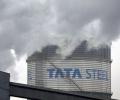
Tata Steel has built an iron ore chest of nearly 600 million tonnes (mt) and will look for more as it prepares for life beyond 2030 when its legacy captive mines come up for auction. The lease for four of its existing iron ore mines -- Joda East, Noamundi, Katamati, and Khondbond -- that feed the domestic operation with low-cost iron ore is going to expire in 2030, following changes in mining regulations. The year will also coincide with Tata Steel's ambitious target of doubling steelmaking capacity in India to 40 mt, increasing the need for iron ore. The company is pushing the pedal to ensure that it has enough resources to meet enhanced needs.

While presenting the Budget for 2022-23, the finance minister also said the strategic transfer of Air India ownership has been completed and strategic buyer for (Neelachal Ispat Nigam Ltd) NINL has been selected. National Asset Reconstruction Co Ltd (NARCL) has commenced its activity, Sitharaman added.

The government has tweaked the income tax laws to make it easier for the new owners of loss-making public sector undertakings (PSUs) to carry forward the accumulated losses and set them off against future profits. This will result in significant tax savings for the new owners if they are able to turnaround operations of the ailing PSU within a few years. This will, in turn, boost the post-tax earnings and returns for the new owners.
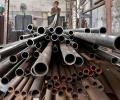
On June 30, mining and metals giant Vedanta, announced that it had decided to initiate a strategic review of its steel and steel-making raw material businesses. The review would begin immediately and evaluate a broad range of options, including but not limited to a potential strategic sale of some or all of the steel businesses, the company said in its stock exchange filing. The signs have been there - approaches had been made to steel players over the past year. Last December, Anil Agarwal, chairman Vedanta group, told Business Standard that the steel plant capacity was about 3 million tonnes (mt).

Many CEOs said they plan to give special leave to women employees so as to encourage their participation in the workforce.

It was touted as a game changer but big-ticket privatisation has been a mixed bag as the government faces unanticipated challenges of lukewarm investor response, employee union agitation and legal hurdles. Prime Minister Narendra Modi's often-repeated statement 'the government has no business to be in business' guided the drawing up of an ambitious privatisation pipeline. While Air India sale succeeded, Bharat Petroleum Corporation Ltd (BPCL) divestment failed.

Agitators squatted on railway tracks at various places, leading to cancellation, short-termination and diversion of several trains.

Coming Wednesday, Finance Minister (FM) Nirmala Sitharaman will present the 2023 Union Budget - the last full Budget ahead of the 2024 Lok Sabha elections. While India exited 2022 as a relatively bright spot in the global economy, the FM will endeavour to present a Budget that insulates India's economy against global headwinds and recession in advanced economies, while sticking to the path of fiscal consolidation. In this, she is being helped by her core team of trusted advisors.

India Ratings expects long products demand growth to be sharp, supported by a demand push from the government-led infrastructure investments in affordable housing, railways, rural electrification and road networks.

Most of the members, including Prime Minister Narendra Modi, were seen wearing face masks. However, members had crowded the Lok Sabha chamber, while hardly a handful of others, including union ministers Dharmendra Pradhan and Piyush Goyal, were seen seated in the Rajya Sabha chamber.

There is money to buy the central public sector enterprises, but buyers will need a firm assurance that the disvestment programme will keep environment issues front and centre of their corporate plans.
The target of mopping up Rs 1.75 lakh crore from divestments of some of the public sector companies, including LIC and BPCL during the current fiscal, is on track and groundwork is being prepared for the goal, Chief Economic Advisor Krishnamurthy Subramanian said on Monday. On the COVID-19 pandemic, Subramanian said the impact of the second wave is lesser than that of the first one. In an interactive session, organised by Federation of Telangana Chambers of Commerce and Industry, the CEA said robust GST collections, over Rs one lakh crore per month for eight months in a row shows that consumption is picking up indicating positive signal for growth.

With the government looking to divest loss-making steel assets, significant interest from secondary players is most likely this time apart from the anticipated list of large integrated primary steel producers, said industry experts. Rashtriya Ispat Nigam Limited (RINL), Neelachal Ispat Nigam Ltd (NINL), NMDC Integrated Steel Plant (NISP)-Nagarnar, Ferro Scrap Nigam Ltd and three units of Steel Authority of India (SAIL) - Alloy Steels Plant, Durgapur; Visvesvaraya Iron and Steel Plant, Bhadravati; and Salem Steel Plant, Salem - constitute the divestment list. All the three units of SAIL have been loss-making for more than five years.

Top companies have grabbed a bigger pie of their sectors in the pandemic period, leading to a further rise in market concentration in many industries as measured by the Herfindahl-Hirschman Index (HHI). The HHI score, which indicates competitive intensity in an industry (or a lack of it), reached a new high in FY21 as bigger firms raised their revenue market shares either organically or through mergers and acquisitions. A higher HHI score indicates a rise in market concentration in favour of a few firms while a lower score means that the industry's revenue is more evenly divided among many companies

The IPO lane will continue to be busy in December as 10 companies have lined up initial share-sale plans worth more than Rs 10,000 crore, merchant banking sources said on Wednesday. Moreover, the initial public offerings of Star Health and Allied Insurance and Tega Industries are currently open for public subscription. This comes after 10 firms successfully concluded their initial public offerings (IPOs) in November. Among the companies that scheduled their IPOs in this month include RateGain Travel Technologies, travel and hospitality technology services provider, and Anand Rathi Wealth Ltd, part of Mumbai-based financial services group Anand Rathi.

Kindo, a full back in his playing days, was a member of the team that won the lone World Cup for India in 1975 in Kuala Lumpur

Analysts caution against volatility and recommend buying stocks of companies that are on strong fundamental footing that have been beaten down badly in the recent carnage.
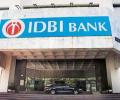
The department of investment and public asset management is racing against time to launch the LIC IPO, which could become the largest-ever listing on the Indian bourses. This would lead to some delay in the strategic divestment of IDBI Bank.
After a hiatus of nearly two decades, the government's programme to privatise state-owned firms restarted with the handing over of debt-laden national carrier Air India to the Tata Group. With the new owner shelling out Rs 18,000 crore for the buyout of the 'Maharaja', this would be the highest-ever amount garnered through privatisation, and is even more than the cumulative sum mopped up through strategic sales from 1999-00 to 2003-04. The government had in October last year inked the share purchase agreement with the Tata Group for sale of national carrier Air India for Rs 18,000 crore. Tatas would pay Rs 2,700 crore cash and take over Rs 15,300 crore of the airline's debt.

Re-rating of Bharat Petroleum Corporation, Container Corporation, Shipping Corporation, SAIL, and Hindustan Copper, for which the government has already shown intent to divest its stake, possible now, say analysts.

With the new owner shelling out Rs 18,000 crore for the buyout of 'Maharaja' this would be the highest ever amount garnered through privatisation or even the cumulative sum garnered through strategic sale in 1999-00 to 2003-04. The government had garnered roughly over Rs 5,000 crore during that five-year period by privatising 10 CPSEs.
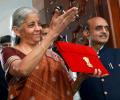
At the customary post-Budget media interactions, Finance Minister Nirmala Sitharaman and her topmost bureaucrats touched upon a number of issues. The minister said the government taxing income from digital virtual assets did not give them legitimacy and that issue was being dealt separately in the planned cryptocurrency Bill. She also expressed confidence that the Budget targets were achievable.

Power seems to have become the new dotcom," a market observer said, referring to the surge in the number of companies of all shapes and sizes wanting to get into the power business.
At least five companies looking to raise a cumulative Rs 6,595 crore could launch their initial public offerings (IPOs) next month after a busy August that saw eight IPOs. On Thursday, south-based diagnostic chain Vijaya Diagnostics announced its plans for a Rs 1,895-crore IPO. Ami Organics will announce its plans for a Rs 600-crore issue on Friday.
The share of public sector undertakings (PSUs) in the total market capitalisation of listed companies--at an all-time low of 10 per cent currently --- may get a leg-up from the government's divestment push. Recently the government announced the successful sale of national carrier Air India to Tata Sons, India's first privatisation of a PSU since 2002-03. The transaction is expected to be completed by December.
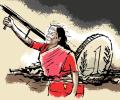
Finance Minister Nirmala Sitharaman will present the much-awaited 2022-23 Union Budget on February 1. While there has been strong recovery in some sectors, touch services like hospitality, tourism and leisure continue to suffer after two Covid-19 waves. Household savings have been hit due to increased spending on health care. Consumption has still not reached pre-pandemic levels.
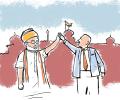
The Centre is likely to privatise profit-making enterprises, reversing its previous position of first closing or merging loss-making state-run units. The NITI Aayog, which is in the process of selecting public sector units for privatisation, is likely to put out its first list, focusing on companies in non-strategic sectors, along with those that have got Cabinet approval for stake sale, or are in final stage of due diligence. "The shortlisted firms will be put out in three-four tranches, with the first list comprising non-strategic ones, followed by strategic sectors with a focus on privatisation and not divestment," said a senior government official privy to the plan. He said the first report was expected in early April. The think tank approach is in sync with the government's new strategies on privatisation and asset monetisation.
The Inter-Ministerial Group on coal blocks on Saturday decided to recommend cancellation of two mines awarded to Bhushan Steel and SKS Ispat & Power, and forfeiture of bank guarantees for two other blocks.

If the fear of ED could drive the powerful people of today to be honest or at least be minimally corrupt, will it not be a great thing for our nation?, asks Sudhir Bisht.
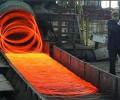
Despite NMDC raising iron ore prices by 10%, major steel firms say they will follow suit if demand increases

The government has merged the Department of Public Enterprises (DPE) with the finance ministry to give it a better control over state-owned firms and facilitate its ambitious privatisation programme. Finance ministry will now have six departments while DPE's hereto parent ministry, the ministry of heavy industries and public enterprises will now be called the ministry of heavy industries. Previously, the disinvestment ministry - created under the Atal Bihari Vajpayee government - was merged with the finance ministry and is now a department under it. Also, Foreign Investment Promotion Board (FIPB) was abolished and administration of foreign investments was given to the finance ministry (FinMin).

The companies are crying foul over the cancellation of 25 blocks held by 68 firms over the past two days.

As many as 20 central public sector enterprises and their units are at various stages of strategic disinvestment, while six are being considered for closure or are under litigation, Minister of State for Finance Anurag Singh Thakur said on Monday.

A little over a year before, when the Hajigak iron ore deposit was put up for grabs, at least five companies - Essar Minerals, JSW Steel, Rashtriya Ispat Nigam, Sesa Goa and Ispat Industries - had evinced interest.

Prime Minister Narendra Modi, who won a landslide election victory in May largely on a promise of economic growth, is expected to speed up divestments to bolster revenue generation.
 © 2026 Rediff.com - Investor Information - Advertise with us - Disclaimer - Privacy Policy - Sitemap - Feedback - About us - Terms of use - Grievances