
Yuriy Sedykh, a two-time Olympic champion in the hammer throw whose world record from 1986 still stands, has died. He was 66. The Russian track and field federation said Sedykh died early Tuesday following a heart attack.

Allegations by a former head of Russia's drug testing laboratory that dozens of Russian athletes used doping when they competed at the 2014 Sochi Olympics are "slander by a turncoat" and are absolutely groundless, the Kremlin said on Friday.

Evidence of widespread state-sponsored doping by Russian athletes at the Sochi Olympics was confirmed on Monday in a report by an independent commission of the World Anti-Doping Agency.

The Russian Sports Ministry said on Tuesday it was open for closer cooperation with the World Anti-Doping Agency (WADA) in order to eliminate any irregularities committed by the Russian anti-doping watchdog and its accredited laboratory.

Russian Sports Minister Vitaly Mutko said on Thursday his country's doping scandal was payback from those unhappy Russia had won the rights to host the 2018 FIFA World Cup.
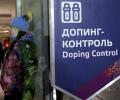
Russian federal investigators said on Saturday they had opened a criminal case against the country's former anti-doping chief on charges of abuse of office.

WADA is at the heart of the biggest doping scandal in years after three Russian whistleblowers went to the media and exposed a massive systematic doping scheme in the country across many sports and involving more than 1,000 athletes.

The World Anti-Doping Agency (WADA) on Monday recommended that the IOC and International Paralympic Committee should consider banning all athletes entered by the Russian Olympic Committee for next month's Rio Olympics.

The International Olympic Committee told the United States on Thursday it should get its own house in order in the fight against doping before putting athletes from other countries under threat of punishment for breaking US law.

The sports field saw two special mentions at the 90th Oscar Awards on Sunday night.

Thirty one athletes from six sports could be banned from this year's Rio de Janeiro Olympics after 454 doping samples were re-tested from the 2008 Beijing Olympics, the International Olympic Committee said on Tuesday.

The decision by the World Anti-Doping Agency (WADA), imposed a four-year ban on Russia participating in a range of top-flight sporting tournaments, a period covering the 2020 Tokyo Summer Olympics, the 2022 Beijing Winter Olympics and the 2022 soccer World Cup.

Although the change will have no immediate effect on current bans on the Russian federations for athletics, weightlifting and paralympics, it opens the door for their return, following the reinstatement of the Russian Olympic Committee after the country was banned from this year's Winter Games in South Korea.

WADA identified Doctor Sergei Portugalov, former deputy director of the Russian Federal Research Centre of Physical Culture and Sports (VNIIFK), as the mastermind of the scheme, advising athletes on doping, administering injections and helping cover up positive drugs tests.

Reaction to WADA's decision to reinstate RUSADA
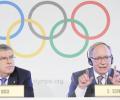
Russia has been banned from the 2018 Pyeongchang Winter Olympics after the IOC found evidence of an "unprecedented systematic manipulation" of the anti-doping system that has led to a series of bans for the country's athletes in recent months.

Dozens of Russian athletes who competed at the 2014 Sochi Winter Olympics, including at least 15 medal winners, were part of a state-run doping program.

A summary of sports events and sports persons, who made news on Thursday
With the Rio Olympics less than three weeks away, the IOC on Monday promised "the toughest sanctions available" after a report found Moscow had concealed hundreds of positive doping tests in many sports ahead of the Sochi winter Games.

A summary of sports events and sports persons, who made news on Thursday
 © 2026 Rediff.com - Advertise with us - Disclaimer - Privacy Policy - Sitemap - Feedback - About us - Terms of use - Grievances