
The Indian Army bravely prevented the Chinese PLA's attempts to unilaterally change the status in the Yangtse area of Arunachal Pradesh's Tawang sector on December 9 and confronted it with firmness, Defence Minister Rajnath Singh said on Tuesday.

The "eyeball to eyeball" deployment and the dynamic internal security situation in the JK make Northern Command the most unique theatre.

The resolution was introduced by Senator John Cornyn, Republican Senate Majority Whip, and Senator Mark Warner, ranking member of the Senate Select Committee on Intelligence.

'It is unfortunate that aspersions are being cast on how our brave Armed Forces are treated. The armed forces give the best possible treatment to their personnel'
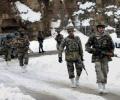
Within the army, there is growing concern that New Delhi will allow the Chinese to retain the territory they have occupied in the last month.
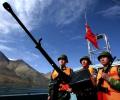
Both the Indian and Chinese armies have brought in more troops in sensitive locations like Demchok, Daulat Beg Oldie and areas around Galwan river as well as Pangong Tso lake in Ladakh, the sources said. The area around Galwan has been a point of friction between the two sides for over six decades.

Tan said that China has always stressed that military cooperation of relevant countries, especially on exercises and training activities, should not be targeted at any third party, but rather serve to help maintain regional peace and stability.

China remains in firm control of an estimated 600-800 square kilometres of Indian territory.

The meeting comes against the backdrop of demands by the opposition seeking details of the violent face-off between Indian and Chinese troops in the Galwan Valley in Ladakh which left 20 Indian Army personnel dead.
Experts have said the economic cost of China's misadventure in the last couple of months in eastern Ladakh and South China will be "massive" as it has "exposed" Beijing's "real face" when the entire world is fighting coronavirus.
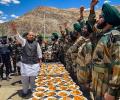
Defence Minister Rajnath Singh on Monday said India is a peace-loving nation that never resorts to any kind of aggression but is always prepared to give a befitting reply if provoked or threatened.
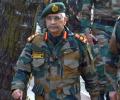
Gen Naravane reviewed the overall security situation in the region with Northern Army Commander Lt Gen Yogesh Kumar Joshi, commander of the 14 Corps Lt Gen Harinder Singh and other senior Army officials.

"After the Major General-level talks on Wednesday, the talks are expected to be held over the next few days in Chushul at multiple levels to find solutions to the dispute in specific areas," sources said.

The former Congress president has been questioning the government over the martyrdom of Indian soldiers and has demanded answers from the prime minister.
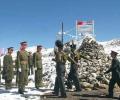
The two armies had mutually decided not to resort to use firearms during face-offs in sync with provisions of two agreements on border management.
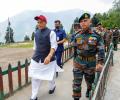
There seems to be a desire for opacity when it comes to confronting China, points out Aakar Patel.
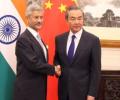
Wang said the two sides should follow the important consensus reached by the leaders of the two countries and strengthen the communication and coordination on the proper handling of the border situation through the existing channels so as to jointly maintain peace and tranquility in the border area, the Chinese foreign ministry said in a statement.

The marathon fourth round of Lt Gen-level talks also focussed on steps for pulling back large number of troops and weapons from rear bases along the Line of Actual Control in eastern Ladakh.
Chinese foreign ministry spokesman Geng Shuang told a media briefing in Beijing that "at the moment the situation in the boundary region between China and India is overall stable and controllable".
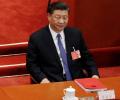
Observers say China should re-address its policies towards India or else it will continue to face flare-ups increasing the tensions between the two countries at a time China's increasing tension with the US over Taiwan and the South China Sea besides the downturn in the Chinese economy which is hit hard by the zero-covid policy.

Military affairs experts said his key challenge will be to build consensus among the three services for the theaterisation plan as the Indian Air Force has some apprehensions about its roll-out.
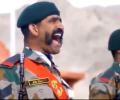
The video comes just days after 20 Indian soldiers lost their in a "violent face-off" with Chinese troops in the LAC across Galwan Valley of Ladakh.
At the talks, the Indian side insisted on complete disengagement of Chinese troops at the earliest and immediate restoration of status quo ante in all areas of eastern Ladakh prior to May 5 when the standoff began following a clash between the two armies in Pangong Tso, they said.

'The Galwan crisis involves the security of the nation, can't we spend eight hours on that?' 'Why are you scared? Why are you running away from that?

The navy has significantly expanded its deployment in the Indian Ocean Region deploying a plethora of warships and submarines to create pressure points on China as the maritime space around the Malacca Strait is very critical for its supply chain through sea routes.

Many people believe that India's first prime minister Jawaharlal Nehru made a blunder when he recognised China's sovereignty over Tibet but he did what he thought was best for his country, said the president of the Tibetan government in exile.

Bihar's choppy political waters were on Tuesday astir over the prospects of a meeting between Chief Minister Nitish Kumar and K Chandrasekhar Rao, his Telangana counterpart, both of whom share a passion for building a united front against the Bharatiya Janata Party's hegemony.

The Congress alleged that whenever an issue of national security comes up, the "prime minister hides behind his ministers".
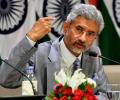
Chinese Foreign Minister Wang Yi and his Russian counterpart Sergei Lavrov will be the other two participants at the conference. Uncertainty had loomed over the meeting following the cross border clash between Indian and Chinese troops in Galwan Valley on Monday evening.

The next phase of the de-escalation process will kick off only after the fourth round of talks between corps commanders of the two sides.
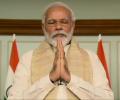
In a statement, the Prime Minister's Office (PMO) said the focus of Modi's remarks at the meeting on Friday was the events of June 15 at Galwan that led to the loss of lives of 20 Indian military personnel.
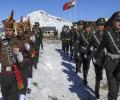
The two militaries are set to hold extensive talks on finalising modalities for restoring normalcy and bringing back peace and tranquillity in the region after the verification of the disengagement exercise is completed.

'The Chinese staying put in Pangong Tso, and creating a buffer zone on Indian territory in other areas,' a senior serving general tells Ajai Shukla.

'The Chinese are retaining geostrategic pressure on India by keeping troops there and building infrastructure continually.'
Sources said the process of disengagement along the Line of Actual Control is "complex", and in such a context, speculative and unsubstantiated reports need to be avoided.
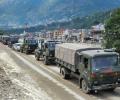
Indian Army planners find themselves contemplating the possibility of more Chinese intrusions along the contested 3,488-km border. That could lead to the army having to man a 'hardened LAC' round the year, like the LoC with Pakistan, reports Ajai Shukla.
It is learnt that the India's top military brass is constantly monitoring the evolving situation even as the United States said the aggressive behaviour by Chinese troops was a reminder of the threat posed by China.

'Don't be too much after legacy that it should be solved in my lifetime.' 'It is not going to be solved, because you are not dealing with just any other country, you are dealing with a civilisation, a cultural nation.'

The two sides held diplomatic talks through video conference on the border standoff in midst of fresh details emerging that China has strengthened its position in several areas in eastern Ladakh including Galwan Valley where a violent clash on June 15 left 20 Indian soldiers dead.
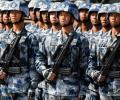
Chinese military has also deployed a sizeable number of its troops in Galwan Valley, the site of the violent clashes on June 15 that left 20 Indian soldiers dead.
 © 2026 Rediff.com - Investor Information - Advertise with us - Disclaimer - Privacy Policy - Sitemap - Feedback - About us - Terms of use - Grievances