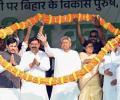
If he cannot do it this term by using his bureaucracy and experts from different fields, it will be a tragedy, asserts Ramesh Menon.

'The statistical confidence bands of the fan charts of the forecasts will provide a better sense of the potential variability of outcomes.'

In President Donald Trump's big priority bill, there is a proposal for a 5 percent excise tax on remittance transfers that would cover more than 40 million people, including those holding green cards and H1B visas.
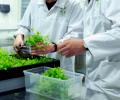
Several leading scientists, academicians, and agriculturalists have called for raising government support for research and development to make Indian agriculture future-ready.

An increase in the farmer income support scheme PM Kisan Nidhi, the introduction of a 'robot tax' to fund reskilling of people who lose their jobs to artificial intelligence (AI), and a reduced income-tax (I-T) to bring relief to the middle classes - these are some of the items in the Budget wish list submitted by Sangh Parivar affiliates to Finance Minister (FM) Nirmala Sitharaman. Representatives of the affiliates of the Rashtriya Swayamsevak Sangh (RSS), such as the farmer organisation Bharatiya Kisan Sangh (BKS); trade union Bharatiya Mazdoor Sangh (BMS); Laghu Udyog Bharati, which works for micro and small industries; and Swadeshi Jagran Manch (SJM), which works on economic and policy issues, met the FM and other officials over the last couple of weeks as part of the pre-Budget consultations.

The target was for banks to sell Rs 2 trillion worth of non-performing assets to NARCL, the so-called 'bad bank, by 2021-2022. Only 10 per cent of this has been executed.

The money sent home by Indians from West Asian countries took a beating in 2020-21 due to the pandemic. On the other hand, overseas Indians in advanced nations - the United States, United Kingdom and Singapore - emerged as important sources of remittance, according to a Reserve Bank of India (RBI) survey. Indians working in informal sectors in West Asia seem to have been impacted the most due to the lockdowns and subdued crude oil prices as well as slower pace of migration in recent years.
Claims of a spike in poverty and inequality in India during the Covid-19 pandemic are patently false as such claims are based on uncomparable different surveys, according to a paper co-authored by eminent economist Arvind Panagariya. The paper also noted that inequality fell in the country during Covid years, both in rural and urban areas as well as nationally. Panagariya, Columbia University Professor and former vice chairman of NITI Aayog and Vishal More of Intelink Advisors, New Delhi have co-authored a detailed paper 'Poverty and Inequality in India: Before and After Covid-19'.

India, he said, has already taken a host of reforms in banking and other sectors and is now focussing on stepping up public investment. "Compared to other nations, even among advanced countries, I think India is relatively better placed for the simple reason that India paid a certain price last decade... we had a banking system stress which was then compounded by stress in the non-banking financial sector towards 2018," he said at Amazon Smbhav Summit.

The total amount of money various entities have raised through the private placement route is at its lowest since 2014. They raised a total of Rs 1.96 trillion in the first five months of 2022, revealed the numbers from PRIME Database. It is down 23.4 per cent from the Rs 2.56 trillion raised in the corresponding period in 2021.

Indian issuers are borrowing lesser through bonds compared to their global peers. The total value of bond issuances was down 10.1 per cent on a rolling 4-quarter basis in March 2022, compared to a similar period in March 2019, shows an analysis of data from tracker Refinitiv, a London Stock Exchange Group (LSEG) business. The four quarters ended March 2019 marked the last full financial year before the pandemic took hold.

The study, published in the journal Science on Wednesday, assessed the disease transmission patterns in 5,75,071 individuals exposed to 84,965 confirmed cases of COVID-19 in the two states based on data collected by tens of thousands of contact tracers.

'Until the case load starts dropping, we will have to keep up the current level of prevention activities.'

While those who attended 'Livelihoods in Lockdown' learnt a lot, was anyone from the government listening?

Where do the four members of the Supreme Court appointed panel to interface with farmers stand on the Modi government's farm laws?

Rajiv Kumar will continue as vice-chairman of the body, along with other full-time members V K Saraswat, Ramesh Chand and V K Paul.

'The trajectory of the disease will keep increasing because of the population density being very high.'

The answer cannot be that we will beat the disease at the end of the 21 days. And the answer cannot be that it is to halt the spread because the spread is going to happen anyway, notes Aakar Patel.

The experts agreed that the lockdown has helped in slowing down spread of the virus but insisted that the situation has not reached a plateau and that there was an urgent need to upgrade healthcare facilities to deal with the crisis.

'Scientists around the world are focused on very quickly doing work to help us better understand what we are facing.' 'I am inspired by what scientists have found in such a short amount of time since the virus emerged.'

Overseas education consultant NNS Chandra shares advice on how to pick the right international education.

The Twelfth Finance Commission is ready with its report and has sought time from the President to submit the recommendations, its chairman C Rangarajan said on Saturday.

'In the long run, the boost to farmers' incomes must come from technological breakthroughs,' says Pratap S Birthal and Digvijay S Negi.
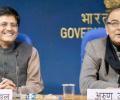
While Arun Jaitley remains part of the decision making process, Piyush Goyal, who was given additional charge on May 14, attends cabinet meetings and takes the day-to-day decisions.

Average global growth prospects for the next 12 months and the next three years are 35 per cent and 49 per cent, respectively.

The finance ministry has ruled out the proposal for the appointment of a chief operating officer (COO) of the rank of deputy governor in the Reserve Bank of India (RBI), as the government feels no interim arrangements should be made for such high-profile appointments.
The panel will also recommend a fiscal consolidation road map for the central and state governments, study the impact of GST on the divisible pool, and propose performance-based incentives for states.
'To bring about a paradigm shift in farmers's income, we need to change our approach to agriculture, and transit from the narrow prism of cultivation to a full-fledged enterprise, by building all associated supply chain linkages.' 'This alone will make the farmer an entrepreneur in his own right.'

The panel suggests family head must be valued at skilled wage rates.

Indian CEOS are very innovative, says a PwC report.

In a pre-budget meeting with Finance Minister Arun Jaitley, the experts suggested timely implementation of the BJP's election manifesto promises to fix higher support prices. They also favoured a Kissan TV channel, an efficient procurement policy, priority for farm mechanisation and the linking of rivers.

Cabinet note being readied, on basis of study, to ensure against foodgrain shortage; might require buffer of up to 50% more.

On the final day of Prime Minister Narendra Modi's visit to the US, that country on Tuesday extended its Defence Cooperation Agreement with India by another 10 years. The pact, which was to expire in June next year, will now be in force till 2025.

The resentment against the government has increased.

'I am not optimistic about the global economy for the next couple of years.'
Taking away free healthcare facilities, as recommended by the Aayog, would place a huge burden on the people, especially in rural areas, says Devanik Saha.

Experts say it will make GDP growth target of 5.7-5.8% difficult to achieve, while ministries feel late resurgence will help in sowing of rabi crops.
 © 2026 Rediff.com - Advertise with us - Disclaimer - Privacy Policy - Sitemap - Feedback - About us - Terms of use - Grievances