
Non-banking financial companies (NBFCs) such as Bajaj Finance, Shriram Finance, Muthoot Finance, and IIFL Finance have regained their growth momentum after losing market share to banks in the post-Covid period. The growth surge is being led by diversified lenders and gold-loan companies while development-finance institutions such as Power Finance Corporation (PFC), REC, and Housing & Urban Development Corporation (Hudco) continue to grow at a slower pace.

In a double-dose bid to boost growth and employment prospects, the Union Cabinet on Tuesday approved a Rs 2.07 trillion outlay for a research development and innovation (RDI) Scheme to fund private sector innovations, and an employment-linked incentive (ELI) to create over 35 million new jobs over the next two years.

The United Kingdom extracted USD 64.82 trillion from India over a century of colonialism between 1765 and 1900 and USD 33.8 trillion of this went to the richest 10 per cent -- enough money to carpet London in notes of 50 British pound almost four times over.

Commercial banks have turned cautious in lending to smaller microfinance institutions (MFIs), which has compelled the latter to borrow from non-banking financial companies (NBFCs) at much higher rates. Recently Reserve Bank of India (RBI) Deputy Governor M Rajeshwar Rao slammed micro lenders for increasing their margins "disproportionately" and said these lenders were quick to pass on the increased cost to the borrowers but reluctant to pass on the benefits under the new regime, where margins are not capped.

DFC is the US government's development finance institution. Adani Ports and Special Economic Zone Limited (APSEZ) in a statement said that the US fund will support the development of deepwater shipping container terminal in the Port of Colombo.

There was no smooth surge in middle class prosperity for foreign businesses to tap into because of the Indian economy was mismanaged, argues Debashis Basu.

'I don't think we have ever seen such alignment of everything that we need in the banking sector.'

We have millions of newbie investors who are clueless about how to handle sudden and severe adverse market reactions, which arrive from time to time, observes Debashis Basu.

The government on Wednesday announced the appointment of veteran banker K V Kamath as chairperson of the newly set up Rs 20,000 crore development finance institution NaBFID to catalyse investment in the funds-starved infrastructure sector. Parliament had in March cleared the National Bank for Financing Infrastructure and Development (NaBFID) Bill 2021 to support the development of long-term non-recourse infrastructure financing in India, including the development of the bonds and derivatives markets necessary for infrastructure financing.

This month, advertisements for managing directors and the senior management team for the National Bank for Financing Infrastructure and Development or NaBFID, should be out, signalling the start of a financial institution (FI) like no other the country has ever had. For this and other reasons government managers associated with the NaBFID project are convinced it should remain a 100 per cent government-owned entity. This is somewhat different from what former economic affairs secretary Tarun Bajaj said when the NaBFID Bill was being tabled in Parliament earlier this year: "To begin with, it will be 100 per cent government owned.

Mahindra & Mahindra (M&M) and the British International Investment (BII) have inked a pact to invest Rs 1,925 crore each in a wholly-owned subsidiary of the home-grown auto major to focus on four-wheel passenger electric vehicles. The Mumbai-based automaker and BII have executed a binding agreement to invest in the new entity -- "EV Co". According to the pact, BII will invest up to Rs 1,925 crore in the form of compulsory convertible instruments at a valuation of up to Rs 70,070 crore, resulting in 2.75 per cent to 4.76 per cent ownership in the EV Co, M&M said in a regulatory filing. EV Co will focus on four-wheel (4W) passenger electric vehicles, it added.

7 key areas that the Budget must address to re-energise the infrastructure sector, suggests Vinayak Chatterjee.

The turmoil, if you read the headlines, is about the so-called funding winter. Deep down, though, the question is one of the common direction in which founders and investors need to pull, points out Suveen Sinha.

Finance Minister Nirmala Sitharaman presented her third Budget on February 1.

One thing is for sure: It smacks of the regulator's lack of confidence in the bank's board, points out Tamal Bandyopadhyay.

After his wide-ranging talks with Modi on the second and final day of his India visit, Johnson said the new defence and security partnership will enable India to strengthen its domestic defence industry as well as help the two countries protect vital shared interests in the Indo-Pacific.

The Budget kept away from mood dampeners such as an increase in taxes (capital gain taxes) and even the much-feared introduction of Covid cess and wealth taxes, says Nimesh Kampani, chairman, JM Financial.
For development finance institution to succeed now, the government must stand like a rock behind it and be patient.

The Cabinet has cleared a Bill to set up a government-owned development finance institution (DFI) with initial paid-up capital of Rs 20,000 crore so that it can leverage around Rs 3 trillion from the markets in a few years to provide long-term funds to infrastructure projects as well as for development needs of the country. To put it in perspective, Rs 3 trillion constitutes slightly less than 3 per cent of the Rs 111 trillion to be spent on over 7,000 projects in the National Infrastructure Pipeline from 2019-20 to 2024-25. Besides, the government will give Rs 5,000 crore as grant to the institution, Finance Minister Nirmala Sitharaman on Tuesday told the media after the Cabinet meeting.

As spending on infrastructure has three times the desired impact, the government's Rs 111 trillion National Infrastructure Pipeline should be accelerated: Assocham president, Vineet Aggarwal

The department of investment and public asset management (Dipam) can also seek in-principle approval from the Cabinet Committee on Economic Affairs (CCEA) for strategic divestment of PSUs on a case-to-case basis considering investor appetite and sectoral trends.

All banks are eligible for privatisation. A committee of secretaries will decide which banks will be privatised, says Financial Services Secretary Debasish Panda.
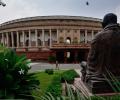
The session started on January 29 and was originally slated to end on April 8 but several members had urged Speaker Om Birla to end the session earlier as they focus on electioneering for the five assemblies.
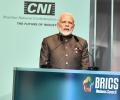
Modi also urged the BRICS Business Council to create a roadmap to achieve the $500 billion intra-BRICS trade target by the next summit.

While a DFI will help banks derisk their loan portfolios, creation of a bad bank will clean up their balance sheets.

The Manila-based development finance institution has decided not to guarantee loans directed to Andhra Pradesh, where the microfinance activity has fallen sharply due to strict rules introduced by the state government in October last year.

Corporate India is not bothered about the subprime crisis. I have not seen any large business house walk away from a deal on account of lack of funding.
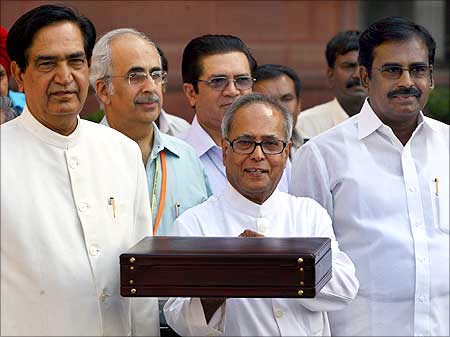
The sad truth is that the debt-to-GDP ratio will shoot up close to 90 per cent in the coming year, and the fiscal deficit glide path does not promise to reduce it substantially any time soon, predicts Mihir S Sharma.

Bigbasket's founder V S Sudhakar said his company was reengineering its supply chain to allow for faster delivery to its resellers and to reduce the time from farm to customer.

The country's largest lender SBI on Thursday reported a 4.20 per cent decline in consolidated December quarter net at Rs 6,257.55 crore, largely because of a higher base in the year-ago period where it had benefitted from a Rs 4,500 crore one-off income. On a standalone basis, the city-headquartered lender's net profit came in at Rs 5,196.22 crore as against Rs 5,583.36 crore in the year-ago period and Rs 4,574.16 crore in the preceding September quarter. SBI chairman Dinesh Kumar Khara told reporters that the year-ago period had seen the resolution of the Essar Steel loans, resulting in an over Rs 4,000 crore interest income and Rs 500 crore other income benefit.

The central bank held 72.5 per cent equity in Nabard worth Rs 1,450 crore, of which 71.5 per cent amounting to Rs 1,430 crore were divested way back in October 2010 and the residual shareholding was divested on February 26, 2019.
International Finance Corporation, the private equity venture of the World Bank Group, DEG, one of the largest European development finance institutions, are eyeing a stake in State Industrial Corporation of Maharashtra.
State-run Power Finance Corporation plans to diversify into merchant banking and insurance sectors to mobilise cheaper resources as part of its initiatives to enhance lending to power projects.
Why do we need a bad bank, owned by the banks themselves when there are at least 28 ARCs around, asks Tamal Bandyopadhyay.
Highlighting India Inc's drive for fresh investments, FICCI on Thursday called for the revival of development finance institutions by allowing agencies like IFC and ADB to play strategic roles in DFIs.

Speaking at CNBC TV 18's business leadership awards event, Sitharaman made it clear that she was not expecting a jump in the number either.

Banks are allowed to invest up to 10 per cent of the paid-up or unit capital in Category-I or Category-II Alternative Investment Funds

Can the newly-minted Jal Shakti ministry bring water to some 19 crore Indian households that have never had taps or heard the sound of flowing water, wonders Vinayak Chatterjee.
 © 2026 Rediff.com - Investor Information - Advertise with us - Disclaimer - Privacy Policy - Sitemap - Feedback - About us - Terms of use - Grievances