
The Chinese military has already completed moving back its troops from the face-off sites in Galwan Valley, Gogra and Hot Springs in line with the first phase of the disengagement process from the friction points on the LAC in eastern Ladakh, sources said. The main focus now shifts to Pangong Tso. India has been insisting that China must withdraw its forces from areas between Finger Four and Eight.
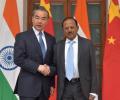
'Both sides had candid and in-depth discussions over easing the current border situation and reached positive common understandings,' it said. 'Both sides welcomed the progress achieved in the recent military and diplomatic meetings, agreed to stay in dialogue and consultation, and stressed the importance to promptly act on the consensus reached in the commander-level talks between Chinese and Indian border troops, and complete disengagement of the front-line troops as soon as possible,' it said.
There was no comment from the Indian side on the statement made by the Chinese defence ministry spokesperson Colonel Wu Qian, and carried by China's official media.

A meeting between India and China was held at Multipurpose Complex of Chinese Army at Nathula in Sikkim on Wednesday, with delegations of both countries reiterating the importance of such interaction in maintaining peace and tranquility along the international boundary.

Prime Minister Narendra Modi is serving 'dhokla' to Chinese President Xi Jinping when incursions from that country continue, Congress leaders said on Thursday taking a dig at the Bharatiya Janata Party and Modi.

A day after rejecting any incursion by its troops in India's Ladakh region, China said both countries should work together to resolve the boundary dispute to "create good conditions for the sound development of bilateral relations".
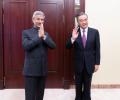
'It is advisable for Indian interlocutors to follow the Chinese tactic of repeating the Indian position, both for the record and to test the Chinese negotiator's resolve and intentions.' A riveting excerpt from former foreign secretary Vijay Gokhale's The Long Game: How the Chinese Negotiate With India.
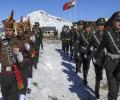
The focus of the deliberations was on finalising modalities for disengagement of troops in eastern Ladakh.
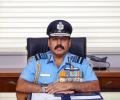
Air Chief Marshal Bhadauria was at the Leh IAF base on Wednesday where he reviewed operational preparedness of the force in effectively guarding the sensitive border areas in eastern Ladakh where Indian and Chinese armies have been on a nearly six-week standoff.

India has told China that disengagement at all friction points is necessary to contemplate de-escalation of troops in eastern Ladakh even as the foreign ministers of the two countries agreed to establish a hotline for "timely" communication and exchange of views.
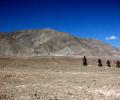
While the de-escalation process was underway, a violent face-off took place on Monday night between Indian and Chinese troops leading to the death of 20 Indian soldiers.
India by withdrawing its troops from Depsang Plains of Ladakh de-facto has conceded this territory to China. It needs certain special talents to interpret an ignominious defeat as a diplomatic victory, says Ravindra Narayan Ravi
Defence Minister A K Antony on Tuesday discussed ways of resolving the Chinese incursion issue with the top security brass of the country and emphasised that India will take every step to safeguard its interests there.

Shah attacked Banerjee over the alleged culture of political violence in the state, saying the only industry that was flourishing in Bengal was that of "crude bombs and illegal weapons".

Indian Army Chief General Bikram Singh, who arrived on a two-day visit to Jammu and Kashmir on Tuesday, briefed Governor N N Vohra and Chief Minister Omar Abdullah about the recent reports of Chinese army incursions in Ladakh.

The government has adopted a multi-pronged approach involving the Army, the Indian Air Force and the Navy as well as diplomacy and economic measures to send out a firm and clear message to China that its misadventure in eastern Ladakh was not acceptable at all.
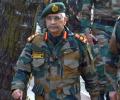
The commanders will also deliberate on the overall situation in Jammu and Kashmir besides delving into issues having national security implications, they said. However, the main focus will be on the situation in eastern Ladakh where Indian and Chinese troops are locked in an eyeball-to-eyeball face-off in Pangong Tso, Galwan Valley, Demchok and Daulat Beg Oldie, the sources said.

The Indian Army has been matching up to the Chinese build up in both Pangong Tso lake and Galwan Valley, the two locations in Ladakh which have witnessed major reinforcement of troops in the last two weeks, sources said. There was very little chance of easing of tension anytime soon as both sides are aggressively holding onto their respective positions, they said.

The marathon fourth round of Lt Gen-level talks also focussed on steps for pulling back large number of troops and weapons from rear bases along the Line of Actual Control in eastern Ladakh.

Chinese Consul General Ma Zhanwu also asserted that by working together cooperation and exchanges can be further enhanced.
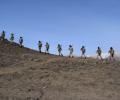
On May 5, around 250 Indian and Chinese army personnel clashed with iron rods, sticks, and even resorted to stone-pelting in Pangong Tso lake area in Eastern Ladakh.

Answering questions on the clashes near Naku La Pass in the Sikkim sector which resulted in injuries to both sides, Chinese Foreign Ministry spokesman Zhao Lijian said that the most pressing issue for the world at present is the fight against the coronavirus.
Amid a raging dispute with Japan over islands in East China Sea, the Chinese army has scaled up its military exercises on all fronts including aerial drills by its air force in Tibet as well as by special forces.

The agenda of the talks will be to firm up a roadmap for disengagement of troops from all the friction points in eastern Ladakh, the sources said.

Sources said that even though India and China have been talking at the diplomatic and the military level for over six weeks now, there has been no thinning down in troop numbers or equipment by the Chinese side on this front.
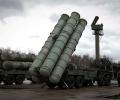
RInstead of disengagement, the Indian and Chinese armies have deployed an estimated 35,000 to 40,000 soldiers each along the LAC. The PLA has deployed S-400 air defence missiles to neutralise the IAF's advantage in air power

Addressing the Congress Working Committee, the president of the party said, ""Misfortunes do not come singly. India has been hit by a terrible economic crisis, a pandemic of huge proportions and, now, by a full-blown crisis on the borders with China. Much of each crisis is attributable to the mismanagement of the BJP-led National Democratic Alliance government and the wrong policies pursued by it."

'It's a very tough situation. We're talking to India. We're talking to China. They've got a big problem there'
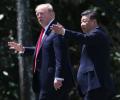
'General Secretary Xi Jinping has greenlighted a brutal campaign of repression against Chinese Muslims, a human rights violation on a scale we haven't seen since World War II. Now, the PLA has escalated border tensions with India'
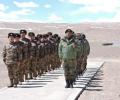
The US hopes that the differences will be resolved peacefully, officials said in Washington.

In his monthly 'Mann ki Baat' radio address, the prime minister also said that the threat of coronavirus is not over yet and we need to remain vigilant against the deadly virus.
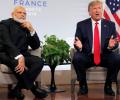
Trump on Wednesday said in a tweet that he was "ready, willing and able to mediate" between the two countries.
It is learnt that Defence Minister Rajnath Singh has conveyed to top military brass that there was no need for reviewing the implementation of any of the key projects along the Line of Actual Control (LAC) in Ladakh, Sikkim, Uttarakhand or in Arunachal Pradesh in view of the aggressive behaviour by Chinese troops in several sensitive areas.
People familiar with the situation in the region said the two sides were engaged in trying to resolve the dispute, but there was no indication of a positive outcome yet as both the armies continued to bolster their positions in disputed areas of Pangong Tso and Galwan Valley and Demchok.
Minister of State for Home Mullappally Ramachandran said there were 228 cases of transgression of the Indo-China border by the People's Liberation Army in 2010, 213 cases in 2011, and 64 cases till April 2012

The Indian and Chinese armies have been locked in a bitter standoff at multiple locations in eastern Ladakh for over eight weeks since May 5.

The envoy said Japan has been watching the situation "very closely" as it "can affect the stability of the entire region."

Thirty-one army personnel too have been awarded the Sena (gallantry) medal.

Future, even present, wars -- at least those involving such tech giants as China -- include hi-tech battlefields, which a Pakistan-obsessed India has not sufficiently prioritised. Today's generals plan on how to disrupt an enemy city's power supplies, rail networks, airports, ports, and government departments, not just by bombing or torpedoing them; they also examine the option of tripping up the computer networks that run these, notes David Devadas.
The decision to disengage the forces, locked in a bitter standoff for the last six weeks in eastern Ladakh, was taken at a nearly 11-hour-long meeting between senior Indian and Chinese commanders in Moldo on the Chinese side of the Line of Actual Control (LAC) on Monday.
 © 2026 Rediff.com - Investor Information - Advertise with us - Disclaimer - Privacy Policy - Sitemap - Feedback - About us - Terms of use - Grievances