
Nepal witnessed political turbulence in 2022 that dramatically turned rivals into allies and throned former guerrilla leader Pushpa Kamal Dahal 'Prachanda' as the prime minister for a third time, as Kathmandu made efforts to balance ties with immediate neighbours India and China with high-profile talks and visits.

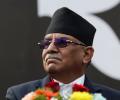
In a dramatic turn of events, Communist Party of Nepal-Maoist Centre chairman Pushpa Kamal Dahal 'Prachanda' was appointed as the new prime minister of Nepal by President Bidya Devi Bhandari on Sunday.
Police arrested former prime minister Sher Bahadur Deuba from his residence Wednesday morning around 2:00 am.
'Indiscriminate killing, abduction, extortion and torture can't be acceptable ways to bring about political change,' Deuba told the second World Summit on Buddhism at Lumbini.
India also offered to help Nepal deal with the Maoist problem.
Nepalese Prime Minister Sher Bahadur Deuba, however, did not give a timeframe for the completition of the investigations.

Prachanda took the oath of office and secrecy from President Bhandari at an official ceremony at Shital Niwas.

Much to the surprise of Beijing, Nepal's Parliament on Sunday ratified the contentious US-funded $500 million Millennium Challenge Corporation compact along with an interpretive declaration a day ahead of the February 28 deadline set by Washington.
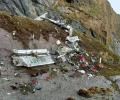
Rescuers on Monday recovered 20 bodies from the wreckage site of the Tara Air plane that crashed in Nepal's mountainous Mustang district on Sunday with 22 people on board, including four Indians, minutes after taking off from the tourist city of Pokhara, officials said.

The pact was to run the government on a rotational basis until elections to the parliament are held.

The turning point in his career was undoubtedly Nepal where he was sent as ambassador and acted with a cool head.

Wishing him, President Droupadi Murmu said the work for nation-building under his incomparable hardwork, dedication and creativity continue to advance.

Whether it is Sri Lanka, Maldives, or Nepal, quietly but steadily, India has been reclaiming some of the ground it had lost to China, observes Aditi Phadnis.

Here are the highlights of Modi's second day in Nepal.

President Bidya Devi Bhandari administered the oath of office and secrecy to Oli, 69, at a ceremony at Shital Niwas, after he was reappointed to the post on Thursday night as the Opposition parties failed to secure majority seats in Parliament to form a new government.

Three Madhesi leaders have supported Prachanda's candidacy.

A day after premier K P Oli resigned, Nepal President called on all the political parties to elect a new prime minister within a week

While there is no change in the strength of the Modi-led CCPA over its two tenures, what has changed is its profile.

Blinken and Indian leaders on Wednesday will discuss a plethora of pressing issues such as the fluid situation in Afghanistan, regional security concerns, COVID-19 response and ways to boost Indo-Pacific engagement, people familiar with the agenda of talks said.

India last month reacted angrily to Nepal showing the three areas as Nepalese territory in the new map and cautioned the country that saying such "artificial enlargement" of territorial claims will not be acceptable to it. India has been maintaining that these three areas belong to it.

Nepal Prime Minister Sushil Koirala on Saturday resigned even as Parliament prepares to elect a new premier tomorrow after parties failed to forge a consensus amid continued protests and blockade of a key border trade point with India over the country's new Constitution.
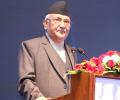
Prime Minister Oli secured 93 votes in the lower house of parliament during a special session convened on the directives of President Bidya Devi Bhandari.
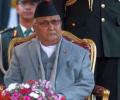
Deuba was elected as the 40th prime minister on June 6 with the support from Communist Party of Nepal-Maoist Centre, which is now a part of Left alliance and opting for merger with Communist Party of Nepal-Unified Marxist-Leninist.

External Affairs Minister Salman Khurshid's daylong "goodwill" visit to Nepal on July 9 will give him an opportunity to meet top functionaries of its interim election government as well as the leaders of the main political parties.
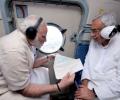
Modi also announced Rs 2 lakh aid to the kin of those who died in the deluge.

'By treating Nepali politicians as shabby buffoons to be pampered one day and collared another day, India badly exposed itself.' 'A belief got entrenched in the Nepalese mind that we are a dangerous neighbour,' observes Ambassador M K Bhadrakumar.

The age-old Indian practice has brought people from different cultures and countries together.

'Neither State should take the matter into a terrain that involves tension -- and certainly not war.'

The main contest is likely to be between the Maoists and the Nepali Congress, but neither of the parties have retained the support they had in 2008. Shubha Singh reports
 © 2026 Rediff.com - Advertise with us - Disclaimer - Privacy Policy - Sitemap - Feedback - About us - Terms of use - Grievances