
Barely eleven days to go, lacklustre campaigning for the coming January 28 Manipur assembly polls is at a very low ebb with candidates confining to hoisting flags at their houses and their supporters.
Warning that partial revocation of the Armed Forces Special Powers Act from Jammu and Kashmir will create "terrorist sanctuaries", Army chief General V K Singh has said dilution of the controversial Act will be 'detrimental' to national interest. the Army chief said, "Just one summer of peace does not mean normalcy. Diluting of AFSPA in any form will be detrimental to national interest."
"The presence of troops in residential areas is a grave threat... the sooner the rulers understand this, the better," Mirwaiz said addressing a religious function at Reshi Mohalla locality of Habbakadal in downtown city, shortly after authorities lifted restrictions on his movement.

Human rights activist Irom Chanu Sharmila, who has been charged with the offence of attempt to commit suicide by fasting, was on Monday released from judicial custody.
Even as the two-day conclave of the director of generals of police of northeastern states held in Guwahati has raised the alarm over the attempts by Maoist elements to strike roots in the region, especially in Assam and Manipur, the government of India has once again extended the enforcement of the Armed Forces (Special Powers) Act, 1958 in Assam by another one year notwithstanding the marked improvement of security scenario in the state of late.
Sticking to his demand for revocation of the Armed Forces Special Powers Act from those areas where normalcy has returned, Jammu and Kashmir Chief Minister Omar Abdullah on Wednesday said the move will ensure that benefits of peace in the state percolate to all sections of the society.

The present happenings in Manipur are the wages of continued neglect, and not so benign at that, of a vital region and its people. Had we lavished on the North East even a fraction of the care and resources we do on Kashmir, things would not have come to this pass, asserts Shreekant Sambrani.
Home Minister P Chidambaram on Wednesday said the efforts of Jammu and Kashmir Chief Minister Omar Abdullah are to denotify the Disturbed Areas from some places in the state, a move which will pave way for removal of Armed Forces Special Powers Act.
Backing Chief Minister Omar Abdullah, Jammu and Kashmir interlocutor M M Ansari on Tuesday said the Centre must give "full support" to the plan for partial revocation of the Armed Forces Special Powers Act in the border state at the earliest to reduce any "trust deficit".
Everybody has developed a vested interest in maintaining the status quo in Kashmir in spite of the fact that the ground situation has improved, feels former home secretary G K Pillai.
The meeting with the Prime Minister comes a day after Omar had discussions with Defence Minister A K Antony and Army Chief V K Singh to press for early removal of the Act from certain parts of the state.
Kashmiri separatists on Monday rejected the suggestion made by the Jamiat Ulema-i-Hind, the powerful body of Deobandi clerics, at its Kashmir conference at Deoband that 'the issue should be resolved within the parameters of the Constitution of India.'
The crucial unified headquarters meeting that had been convened in J&K winter capital Jammu on Wednesday evening to discuss partial removal of the Armed Forces Special Powers Act (AFSPA) ended without any consensus.
Hundreds of supporters of 'Iron Lady' Irom Sharmila, whose indefinite hunger-strike for repeal of the Armed Forces Special Powers Act entered 11 years on Saturday, fasted in Imphal and across the country.
Debates and discussions on the issue of revocation of the Armed Forces Special Powers Act in Jammu and Kashmir are welcome, but it has to be ensured that no such action is taken which sets back the clock on what has been achieved after making tremendous sacrifices, writes Jaibans Singh
Opposing the withdrawal of the Armed Forces Special Powers Act from Jammu and Kashmir, Bharatiya Janata Party leader L K Advani on Saturday said nothing should be done that weakens the armed forces' position. He, however, said there is a case for withdrawal of the Act in Manipur, which could be examined.
The Bharatiya Janata Party on Friday opposed withdrawal of the Armed Forces Special Powers Act (AFSPA) in Jammu and Kashmir, saying such a step could help extremists who are "caught in crossfire" in Pakistan.
Jammu and Kashmir Chief Minister Omar Abdullah on Wednesday said withdrawal of the Armed Forces Special Power Act (AFSPA) from certain areas of the state was in no way an effort to undermine the role of the Army.
The Armed Forces Special Powers Act and the Disturbed Areas Act will be revoked from some areas of Jammu and Kashmir within the next few days, Chief Minster Omar Abdullah said on Friday. While assuring the people that revocation of these laws will not have any adverse affects, he said the measure will put an added responsibility on the shoulders of state police and paramilitary forces.
What everybody is losing sight of is the emergence of a new extremist segment in Kashmir which has taken advantage of the situation. This segment is now orchestrating events in a manner that suits their masters across the border.

Discussions and deliberations need to be held on the purpose of imposing AFSPA and how to revoke it, Rio said during the public funeral of the 14 daily wage earners of a coal mine, who were shot dead by security forces on Saturday at Oting village on their way home from work.
The Cabinet Committee on Security (CCS) will meet in New Delhi on Saturday amid indications that the controversial Armed Forces Special Powers Act (AFSPA) could be partially withdrawn from Kashmir and Jammu, an issue that was deliberated upon by the top Congress leadership on Friday.

Anti-corruption crusader Anna Hazare has been urged to support the demand for repeal of the controversial Armed Forces Special Powers Act, 1958 by Manipuri social activist Irom Sharmila, who has been on an indefinite fast on the issue for nearly 11 years now.
The Iron Lady of Manipur, who has been on hunger strike for 11 years against the Armed Forces Special Powers Act, is an ordinary woman fighting an extraordinary struggle, finds Sumit Bhattacharya.
Union Home Minister P Chidambaram said there would be 'zero tolerance' towards militancy and violence while addressing a public gathering at Khonsa, the headquarters of troubled Tirap district in Arunachal Pradesh on Saturday.
Union Home Minister P Chidambaram on Friday said recommendations of two panels on replacing the controversial Armed Forces (Special Powers) Act, in force in some northeastern states, with a more humane law would soon be placed before the Cabinet.
Irom Sharmila, has been fasting for 9 years against a controversial law.
Supporting Omar Abdullah's demand for withdrawal of Armed Forces Special Powers Act from some areas of Jammu and Kashmir, Union Minister Farooq Abdullah on Thursday said the chief minister is "the boss" in the state and the Centre should take his views on the controversial Act.
In the first part of this interview with Bula Singh, former home secretary G K Pillai had talked about why AFSPA need not be repealed immediately but the Disturbed Areas Act should be lifted in Kashmir. In the second and concluding part of the interview, he explains that no one wants to take a risk or bite the proverbial bullet in Kashmir, fearing that the situation might implode again.
Holding that the government has to have courage to take a decision on the issue of Armed Forces Special Powers Act, Jammu and Kashmir Chief Minister Omar Abdullah on Wednesday questioned the need for "protection" to the army in areas where they have not operated for years.
Amid reports that the army is opposed to withdrawal of controversial Armed Forces Special Powers Act from some areas of Jammu and Kashmir, Army Chief General V K Singh on Thursday said the issue is under the purview of the home ministry. He said the army has already given its inputs on the issue.
'Today's terrorist/insurgent/militant/Naxalite does not allow you the luxury of a magistrate's presence -- you are shot dead or blown-up in a jiffy, unless you are quicker and forestall him.'
Kashmiri Pandits have impressed upon the central government that there should be no dilution of the Armed Forces Special Powers Act and nothing should be done to weaken the state's integration with the country. A group of Kashmiri Pandits met Finance Minister Pranab Mukherjee in Delhi on Sunday night and apprised him of their views on the current volatile situation in the state.
With the government of India inclining towards Union Defence Minister A K Antony's adamant stand that the controversial and contentious Armed Forces Special Powers Act should neither be diluted nor withdrawn, the issue was not raised by either Prime Minister Dr Manmohan Singh, Home Minister P Chidambaram, or even Congress chief Sonia Gandhi during Wednesday's all-party meeting on the Kashmir crisis.
The Centre has convened an all-party meeting on Kashmir on Wednesday. This was decided after a meeting of the Cabinet Committee on Security chaired by Prime Minister Manmohan Singh in New Delhi on Monday.
Jammu and Kashmir Chief Minister Omar Abdullah on Monday met Home Minister P Chidambaram, ahead of a crucial meeting of the Cabinet Committee on Security which will deliberate on the issue of partial withdrawal of the controversial Armed Forces (Special Powers) Act in the state. Prime Minister Manmohan Singh and Congress president Sonia Gandhi had a threadbare discussion with Cabinet colleagues and senior party leaders in the Congress Core Group on Friday on the issue.
The home minister said the northeast and the Left-wing extremism-affected areas in the country are tribal-dominated regions and security is a precursor to development there.
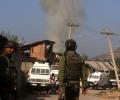
The Army has initiated general court martial proceedings against a captain for the killing of three men in a staged encounter in Amshipura in south Kashmir in July 2020 after a Court of Inquiry found that troops had 'exceeded' powers vested under the Armed Forces (Special Powers) Act, officials said in Srinagar on Sunday.
The Jammu and Kashmir government has sought sanction from the Centre for the prosecution of armymen under the Armed Forces Special Powers Act in 41 cases of human rights violation in the state. "The Jammu and Kashmir home department has sought sanction from the central government for the prosecution of army personnel under AFSPA in 41 cases since 1990," a senior army officer of Northern Command told PTI. A total of 41 cases have been received by the central government.
The AFSPA was being "unnecessarily demonised" although it had "nothing to do with the present unrest (in Kashmir)", General Singh said while firmly sticking to his opposition to any withdrawal or even dilution of the Act which gives the Army vast powers to deal with insurgents.
 © 2026 Rediff.com - Advertise with us - Disclaimer - Privacy Policy - Sitemap - Feedback - About us - Terms of use - Grievances