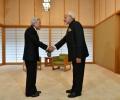
The call on came ahead of wide-ranging talks between Modi and his counterpart Abe

The long-reigning monarch is the first to abdicate his throne in nearly 200 years.

Emperor Akihito to become the country's first monarch in more than two centuries to abdicate.
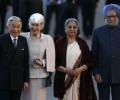
In his first visit to any South Asian country after taking over the throne in 1990, Japan's Emperor Akihito and his wife Empress Michiko arrived in Delhi on Saturday.
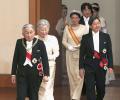
The emperor has no political power, yet he enjoys a unique place in Japanese society, notes Dr Rajaram Panda.
If plans do go ahead, the 82-year-old will be the country's first monarch to abdicate in 200 years.
.jpg)
In a rare and special gesture the Indian government has invited Japanese imperial couple Emperor Akihito and Empress Michiko to stay at Parliament House for a day during their India visit in the third week of November.

Prime Minister Narendra Modi on Tuesday took a dig at his "secular friends" over his gifting a copy of the holy Hindu text Bhagvad Gita to Japanese Emperor Akihito, saying they could kick up a storm and trigger TV debates back home.

Japanese Emperor Akihito and Empress Michiko took a morning stroll at the beautiful Lodhi Gardens and interacted with schoolchildren, diplomats and a section of lay people on their historic visit to New Delhi.
For the Japanese living in India it was like a dream come true when they took a walk in Delhi's Lodhi Gardens along with the Emperor Akihito and Empress Michiko. Rediff.com's Vipin Vijayan captures the euphoria
A magnitude 7.0 earthquake shook wide areas of eastern and north-eastern Japan on Sunday, shaking the ground in Tokyo, agencies have said. There were no immediate reports of damage or injuries. No tsunami warning has been issued yet.
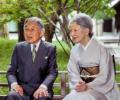
Japanese Emperor Akihito and his wife Empress Michiko'six-day on Saturday to India is expected to be defining moment in India-Japan relations.
Japan's nuclear nightmare worsened on Wednesday with radiation levels surging at a quake-crippled reactor at Fukushima plant, forcing authorities to briefly pull out emergency workers even as another fire erupted slowing desperate efforts to avert a meltdown.
Institutional investors and independent advisors are questioning the company's crisis-handling process in the wake of reports that several workers, including strike leaders Sonu Gujjar and Shiv Kumar, quietly resigned after pocketing hefty payouts.
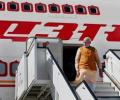
Prime Minister Narendra Modi will embark on a four-day trip to Japan from August 31 to bolster bilateral ties in key areas of civil nuclear cooperation, security, defence and trade.

Earlier, Trump also praised the US-Japan military alliance and thanked the US troops for keeping all safe and boosted the country's military ability.

Princess Mako's love story will make you believe in the power of love.
Japanese Prime Minister Shinzo Abe will be the chief guest at this year's Republic Day parade at Rajpath in New Delhi.

Here's a list of the most famous royals families from around the world.

Departing from the usual protocol, Prime Minister Manmohan Singh and his wife will receive Japanese Emperor Akihito and his spouse Empress Michiko who will arrive in New Delhi on Saturday on a six-day visit, their first to any South Asian country after being enthroned in 1990.

PM Modi and his Japanese counterpart are likely to sign several agreements, including on civil nuclear cooperation. Both leaders are also likely to discuss defence cooperation, including joint maritime exercises between Japan, India and the United States.

Taking a dig at the Bharatiya Janata Party government, Hindu religious leaders have said that they will construct the Ram temple at the "Lord's birthplace" in Ayodhya without any political assistance if the Supreme Court gives order in their favour.

Japan marks the fourth anniversary of a quake-tsunami disaster that swept away thousands of people.

The PM will pay a two-day visit to Japan from October 28-29 to hold the annual India-Japan summit with Abe. The focus of the visit will be to further expand cooperation in the Indo-Pacific region, carry out joint infrastructure projects in third countries and further boost ties key sectors like defence and trade.
In recent years India-Japan relations have acquired rich economic content and strategic intents. Although the bilateral trade at $18 billion between the two countries is not very impressive and leaves much to be desired, the economic engagement between the two countries is both qualitatively and quantitatively noteworthy. India-Japan defence cooperation, however, has generated a lot interest among the strategic community in the context of rise of China. There has been a lot of speculation about India-Japan strategic partnership to hedge China, says Rup Narayan Das.
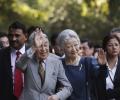
In the media frenzy over inconsequential issues, the visit of the Emperor of Japan to India has been pushed to the margins of public discourse. Colonel (retd) Anil Athale explains the great historical and political significance of the visit.

A list of monarchs who abdicated after 2000.

'The test of true secularism in India is when a girl in your family decides to marry someone from another religion. If you accept her decision happily, then you are truly secular. If you don't, it means your secularism is fake,' argues Syed Firdaus Ashraf.

Prime Minister Narendra Modi on Tuesday termed his Japan trip as "very successful" and hoped that India's infrastructure will improve and the country will become clean with the help of $35 billion promised by Japan over five years, the highest ever amount ever.
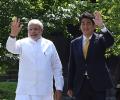
Although the India-Japan relationship has its own driving forces in terms of robust economic ties and shared values, China is the elephant in the room in the strategic parleys between the two countries, says Rup Narayan Das.

As Japan beefs up its defences against China, both New Delhi and Tokyo seem to have decided to re-energise their relationship to ensure a strategic balance in Asia. It is a clear signal that they may be ready to work together in containing if not confronting China, says Nitin Gokhale.

India and Japan have a shared interest in countervailing China's hegemonic ambitions in Asia. Although neither has an interest in forming an overt anti-China alliance, Tokyo and New Delhi feel increasingly obligated to work together to find ways to guard against a muscular Beijing's power sliding into arrogance, says Brahma Chellaney.
Japan has the capital and needs to pull out of China, which has been its major destination. India, on the other hand, desperately needs capital especially for infrastructure, argues Rajeev Srinivasan.
 © 2026 Rediff.com - Investor Information - Advertise with us - Disclaimer - Privacy Policy - Sitemap - Feedback - About us - Terms of use - Grievances