
The Agni-V can reach beyond Tibet to high-value targets in the Chinese heartland, even its northern-most provinces.

The test-firing of the missile from the Abdul Kalam Island off Odisha coast came amid India's lingering border row with China.

In our euphoria over the successful Agni V test, we should not lose sight of the continuing gaps in tactical capabilities and the need to close them, writes B Raman
The display of India's military strength, specially the intercontinental ballistic missle Agni-V, has been highlighted by the Chinese official media in Beijing on Saturday.

Reacting cautiously to India's second launch of ballistic missile Agni-V that has a strike range of over 5,000 km, China on Monday said both sides should make concerted efforts to enhance political trust and asked the media to play a more conducive role to improve bilateral ties.
India on Thursday conducted the maiden test of its indigenously developed nuclear capable Agni V ballistic missile with a strike range of over 5,000 km, from the Wheeler Island off Odisha coast.

The first canister-based trial of the 5,000 km-plus nuclear capable Agni-V long range ballistic missile is likely to take place on January 31.
Defence Research and Development Organisation Director General Vijay Kumar Saraswat on Friday said the Agni-V missile, which took 30 years to be developed, was the best such thing in the 21st century. Agni-V is an intercontinental ballistic missile developed by the DRDO. It is part of the Agni series of missiles, one of the missile systems under the original Integrated Guided Missile Development Programme.
Range preparation for the maiden test of India's indigenously developed nuclear capable 'Agni-V' ballistic missile with a strike range of over 5,000 km is "near complete" and the trial is likely to be held from Wheeler Island off Odisha coast this Wednesday.
India on Sunday conducted a second test flight of its indigenously developed nuclear-capable Agni-V long-range ballistic missile, which has a strike range of more than 5000 km, from the Wheeler Island off Odisha coast.
Nuclear-tipped missiles don't give security, says Praful Bidwai

The indigenously made Agni V missile was test-fired from off the Odisha coast.
Surface-to-surface Agni V missile is launched from the Wheeler Island off Odisha coast on Thursday
Chinese strategic experts have said that India's Agni-V missile has a potential to strike targets 8,000 km away and the launch of the long-range weapon shows that India is making concrete efforts to become a world power.
Missile's range to cover China, West Asia, South East Asia and large parts of Africa

The defence ministry said the test-flight was carried out on Wednesday evening and it met all the trial objectives, validating the reliable performance, as confirmed from the data captured by a number of range sensors deployed at different locations.

Prime Minister Narendra Modi on Monday congratulated Defence Research and Development Organisation (DRDO) scientists over the first flight test of indigenously developed Agni-5 missile, capable of deploying multiple warheads.

Although the credit for acquiring the technological skill must be given to India's outstanding nuclear scientists, the decision to go nuclear was a political one that entailed clarity of vision, courage and resolve, points out Rup Narayan Das.
Breaking the glass ceiling to enter a field dominated by men, Tessy Thomas has had to walk the tightrope as a defence scientist and homemaker to achieve what very few women have. Mohammed Siddique reports
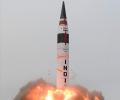
Maintaining that its strategic capabilities were not targeted against any particular country, India has said that it abides by all applicable international obligations and expects others do the same, while responding to Chinese reaction to its test-firing of Agni V missile.

A lot of new technologies developed indigenously were successfully tested in the trial.
China has well and truly cemented its position in the 'star wars' era. Gordon Arthur explains why.
Once Agni-3 and Agni-5 are inducted into the forces, all the cities in China and Pakistan will be in India's range, Defence Research and Development Organisation Chief V K Saraswat said.
Rediff.com takes a look at how India bolstered its defence preparedness this year.

The Indian troops guarding the nearly 3,500-km Line of Actual Control (LAC) maintained an assertive approach in sync with the broader national security doctrine and procured a variety of military platforms and weapons to enhance their combat capabilities.
Observers of India's struggle to design and build defence equipment might wonder why the indigenous missile programme has been so much more successful than many other projects that the Defence Research and Development Organisation has taken up.
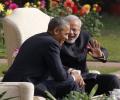
India on Thursday hit back at China for its statement that Nuclear Suppliers Group membership can't be a "farewell gift", saying it was not seeking the membership to the 48-nation grouping as gift but instead based on its non-proliferation record.
India on Friday said it is developing a long-range nuclear-capable Agni-VI ballistic missile that would carry multiple warheads, allowing one weapon system to take out several targets at a time. "Agni-V is major strategic defence weapon. Now we want to make Agni-VI which would be a force multiplier," said Defence Research and Development Organisation chief V K Saraswat.
After the success of Agni-V project, India is developing an Anti-Radiation Missile which can hugely multiply the strike capabilities by destroying the enemy's advance warning system.
The missile tested today was 'an improved version of Shaheen-1 with improvements in range and technical parameters'. The military did not specify the range of the missile though the original version of the Hatf-4 had a reach of 750 km. The missile, capable of carrying nuclear and conventional warheads, can reach targets deep within India
Continuing its tirade against the successful launch of Agni V, Chinese state media has again accused New Delhi of buckling under pressure from the North Atlantic Treaty organisation to cut down the missile's range from 9,000 km to 5,000 km.
China's "charm diplomacy" on India is bearing fruit in terms of mutual cooperation, but it may not be enough to eliminate all suspicions in the backdrop of New Delhi's plans to launch long rage Agni-V missile, an article in an official daily in Beijing said.
The missile has a strike range of 2000 km, the sources said soon after it blasted off from a mobile launcher at the Launch Complex-4 of the Integrated Test Range, the sources said.

Agni-V is a three stage missile, 17 metres tall, two metres wide and capable of carrying 1.5 tonne of nuclear warheads.

The missile has a strike range of more than 2,000 km.

The armed forces have been pushing for adequate allocation of funds so that they are well prepared to deal with the possibility of a "two-front" war on both northern and western borders.

In 2013, India had displayed the Inter Continental Ballistic Missile Agni V during the Republic Day Parade. The chief guest at that time was Bhutanese King Jigme Khesar Namgyel Wangchuck.
RK Gupta has complained to the defence ministry alleging victimisation.
From tackling cyber threat to having an an unmanned tank, there's so much DRDO wants to do

India on Sunday successfully test-fired its medium-range nuclear-capable Agni-II missile with a strike range of more than 2,000 km from the Wheeler Island off Odisha coast as part of a user trial by the army.
 © 2026 Rediff.com - Investor Information - Advertise with us - Disclaimer - Privacy Policy - Sitemap - Feedback - About us - Terms of use - Grievances