
"GDP at factor cost at constant (1999-2000) prices in the year 2007-08 is likely to attain a level of Rs 31,14,452 crore (Rs 31,144.52 billion) as against Rs 28,64,310 crore (Rs 28,643.1 billion) in 2006-07," according to the advance estimates of national income released by the government on Thursday.
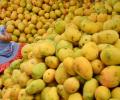
The plucking of dussehri, which will hit the shelves next week at 50% premium, started late this season, because of poor crop and adverse weather conditions, including hailstorms, in the orchards of Malihabad.
Finance Minister P Chidambaram's speech.

The RBI projection of 6.9 per cent GVA growth for the current fiscal comes on the back of the Economic Survey last week forecasting economic growth of 6.5 per cent.

Loans, cash credits, and overdrafts at the end of December 22, 2017, stood at Rs 81,287.32 billion, against Rs 73,340 billion in the year-ago period.
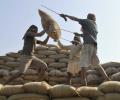
For many farmers, though, a bumper harvest isn't good news, as they have been forced to sell their produce, particularly pulses, dirt cheap.

The CSO estimate is, however, a bit lower than 7.4 per cent growth projected by the Reserve Bank for the current fiscal.
Lower agricultural performance in the current financial year is likely to pull the economic growth down to 6.9 per cent from 8.5 per cent in the last financial year.

Oilseed output to surpass its previous record of 32.75 mt in 2013-14 to 33.59 mt this year
The worst drought in a century and its cascading effect has led to a sharp fall in India's foodgrain output by 30 million tonne to a seven-year low of 182.57 million tonne in 2002-03.
With drought taking its toll, India's oilseeds production has fallen by a massive one-fourth to the lowest in more than 13 years at 157.5 lakh tonne from 208 lakh tonne, it was officially announced on Thursday.
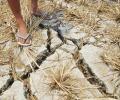
Though their intensity has been less so far and the exact impact on the crop is not yet known.
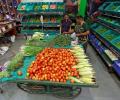
On one hand, Operation Greens should help to smoothen volatility in the prices of vegetables, whereas the proposal to enhance and extend minimum support prices to augment farmer incomes, may emerge as an inflation risk.

The BSE Sensex spurted 130.00 points to end at 35,980.93, while the broader NSE Nifty advanced 30.35 points to 10,802.15.
The production of major agricultural crops is likely to drop by 12 per cent for 2002-03, reflecting an adverse impact of poor monsoon, according to the Centre for Monitoring Indian Economy.\n\n\n\n

Flour millers want import duty exemption.
Confirming fears of a slowdown, the growth rate of the economy is estimated to plunge to 4.4. per cent during 2002-03 as against 5.6 per cent during the previous fiscal.
The Centre for Monitoring Indian Economy on Tuesday said industrial production growth is likely to decline in the second half of the current fiscal, while the first advanced estimate of kharif crop showed a 10 per cent drop in food production.\n\n\n\n

The manufacturing sector during the fourth quarter recorded a growth rate of 9.3 per cent while the farm sector grew at 2.3 per cent.
India's foodgrains production is pegged at a seven-year low of 184.07 million tonnes in 2002-03, a major decline of 13.2 per cent against record production of 212.02 million tonne last year, in the third official advance estimates released on Friday.
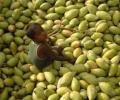
Intermittent storm in the first week of March hit the flowers and emerging buds.

To do so, the government will have to tackle a number of broad development challenges successfully, says Shankar Acharya

'India remains a bright spot amid the global slowdown.'
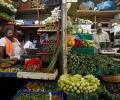
Supply rises as farmers harvest crops amid fear of spoilage on expectations of early showers

Indian economy's growth is expected to be "below trend" even as neighbouring China and most of the developed nations are expected to see better prospects, according to Paris-based think tank OECD.

'We will have to wait for one more year to cross the 7% mark, which should be possible in the absence of any disruptive reform,' points out CARE Ratings Chief Economist Madan Sabnavis.

This is mainly due to GST impact on manufacturing and subdued farm output.

Income velocity based on currency with the public went down from 0.93 in October to 0.84 in March says a report from SBI's economic research department

While the mango season started with the Alphonso variety trading at Rs 18 a kg (model price), it jumped to Rs 30 a kg at the wholesale Vashi mandi.
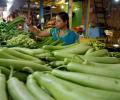
Not only primary vegetables, but also additives like garlic, ginger and chilly have recorded a sharp increase in prices

The term of the members of the Planning Commission is co-terminus with the Prime Minister and they would be submitting their resignations once the new government is formed after the ongoing general elections next month.

Agriculture implements that are currently taxed up to 18 per cent may come under the 12 per cent or the 5 per cent bracket.
This kind of growth will turn India into a $8 trillion economy.

'Onion supply to mandis has declined due to its lower availability.'

For 2015-16, IMF pegged India's growth rate at 7.5 per cent.

Impact of lack of significant investments in the last 4-5 years; inability of private sector to put in fresh capital with availing of loans becoming an issue due to rising NPAs of banks, along with demonetisation were mainly responsible for dampening growth, he said.

The services sector, which plays the biggest role in shaping the economy, is facing loads of issues currently. The largest segments, financial and real estate, are struggling to cope with bad debts and low demand for houses.

The sharp rise was also due to a statistical illusion -- low industrial numbers in November 2015, and sharp reversal of a 12-month declining trend in capital goods.
 © 2026 Rediff.com - Investor Information - Advertise with us - Disclaimer - Privacy Policy - Sitemap - Feedback - About us - Terms of use - Grievances