
Restore macro economic stability

Majority of respondents feel that the government in the forthcoming Budget will increase the standard deduction and give more incentives for housing loans.

The Survey presented by the Union Finance Minister, Shri Pranab Mukherjee in the Parliament on Friday states that the Indian economy remains the second fastest growing in the services growth with 8.9 per cent rate, behind China (10.5 per cent).
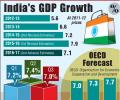
Projecting acceleration in India's GDP growth to 9% for FY 2011-012, Economic Advisory Council to Prime Minister seeks measure to address serious supply bottlenecks.
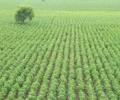
Agriculture and allied activities are likely to grow at 5.4 per cent in 2010-11, compared to just 0.4 per cent in 2009-10, according to Advance Estimates released by the Central Statistical Organisation on Monday.

The government response was key in overcoming the recent financial crisis, but the time is now ripe for credible fiscal consolidation.
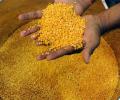
At an average national price of Rs 90 a kg in the retail market, it shows a jump by 20% in the last two months.

'In 2016, we had De-Mon and in 2017, we had GST.' 'The combined impact of these two started showing up in 2019 and 2020.' 'COVID-19 only added insult to injury.'

For 2010-11, the country hopes to achieve a gross domestic product growth of 8.5 per cent (plus or minus of 0.25 per cent), the finance minister said.

Advance estimates of national income growth released today by the Central Statistical Organisation (CSO) project it at 7.2 per cent in 2009-10, pegging it a notch below earlier forecasts of the Reserve Bank of India (7.5 per cent) and finance ministry (7.75 per cent). With economic growth back on track the government may initiate a phased withdrawal of the fiscal stimulus package.

The projected gross domestic product figure for the current fiscal, as put out by the advanced estimates of the Central Statistical Organisation, is lower than the Reserve Bank of India and the finance ministry's forecasts.
'I expect fourth quarter GDP growth to be sharply down.' 'I would imagine it would shave off at least one percentage point, if not more, as compared to the third quarter.'
India's growth slowed in three months through December from a revised 7.4% expansion in the previous quarter, but it was much stronger than expected.
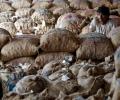
Large stocks were ruined in transit due to thunderstorm and rainfalls in the north and the north-east states, resulting in fewer kilos of potatoes at mandis.

According to the Central Statistical Organisation data, released earlier in the day, Index of Industrial Production grew by 16.7 per cent in January against just a per cent during the corresponding month in 2009.
India's per capita income grew by 10.5 per cent to Rs 44,345 in 2009-10 against Rs 40,141 in the year-ago period, according to government data.

However, the World Bank has projected India's GDP growth rate at 7.5 per cent for the next three financial years, including the current one.
The estimates are based on the feedback received from the states and validated with the information available from other sources. Production of both rice and wheat are estimated to have touched a new record. Rice output is estimated at 99.15 mt, up 2.54 per cent from previous year's output. Wheat output is estimated to be at an all-time high of 80.58 mt, up 2.55 per cent from previous year's 78.57 mt. Production of maize also rose 1.74 per cent to 19.29 mt.

India is expected to harvest bumper crop this year based on estimates of higher food grains production in Kharif (summer sown) and hopes of better Rabi (winter) crop with enough water in reservoirs, Finance Minister P Chidambaram said.
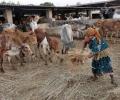
The Budget allocation for Ministry of Agriculture and allied activities has grown by 114% since 2010-11
Economist and former Reserve Bank Governor C Rangarajan on Monday said that the economy will recover in the second half of 2009 and there would be distinct improvement in growth in 2010-11.

Most analysts expect the note ban to sharply hit GVA growth in Q3 and Q4, and the central bank's stance is being called into question.

The US decline decelerates on the back of public spending.
Per capita income, according to advance estimates for national income released, is expected to grow by 14.4 per cent during the current fiscal, the highest growth rate recorded in a single year in the last decade. It is expected to soar by Rs 4,801 to Rs 38,084 during 2008-09, which means the per capita income has more than doubled in the last seven years.
The monthly income of an average Indian for the first time in the country's history has crossed Rs 3,000, thanks to economic reforms and a high growth rate of above 9 per cent achieved for three years since 2005-06.The per capita income, a measure of average income of a citizen, went up 12.2 per cent to Rs 37,490 per annum during 2008-09, said the advance estimate for national income released by the Central Statistical Organisation (CSO) on Friday.
Showing no immediate signs of recovery, the American economy shrank at staggering rate of 6.1 per cent in the first three months of 2009, one of the worst contractions in decades.
The Central Statistical Organisation, the government agency responsible for keeping track of how the economy is performing, goes through five phases of estimating how much India's GDP amounts to each year.
The kharif grain output is estimated to have declined 2.48 per cent to 117.96 million tonnes while the rabi grain output has remained flat at 109.92 million tonnes, according to a government release. Output has declined mainly in kharif pulses and coarse cereals while a marginal dip has been projected in the rabi wheat output.
India can now claim membership of the select list of economies that have an annual national income of over $1 trillion.
The Indian economy is projected to have grown at a slower pace in 2007-08, as data released today showed industrial production growth during the year moderated considerably over the previous year. The advance estimates for national income for 2007-08 had pegged the growth of gross domestic product at 8.7 per cent. Economists now expect it to be a notch lower.
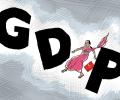
Moody's said the government will face challenges in achieving its deficit target for the fiscal year ending March 2021, amid persistent structural and cyclical headwinds to growth.
Karnataka has registered a lower rate of growth in its gross state domestic product (GSDP) compared to the national average in 2007-08. It logged a 7 per cent growth in its GSDP as against the national advance estimates of 8.7 per cent. Inflation was more or less the same as that of the country. The performance of secondary and tertiary sectors (comprising industry and services) has turned out to be a major disappointment unlike the agriculture sector, which has fared better.
With the Central Statistical Organisation estimates putting India's economic growth rate at 8.7 per cent for the current financial year, spotlight has turned on GDP forecasts by various other agencies.

Of the seven surveys presented under Modi govt, predictions of three were quite close to the actual GDP growth rate, one saw the base year change in between, but the last three were way off the mark.
According to the Third Advance Estimates for 2007-08, the total foodgrains production is slated to reach an all-time high at 227.3 million tonnes, recording an increase of 4.6 per cent over the previous year (217.3 million tonnes). The production during 2007-08 would exceed the target set earlier (221.5 million tonnes) by 5.8 million tonnes. Notwithstanding the moderation, the growth performance was in tune with the high average real GDP growth of 8.7 per cent.

'The government is of the view that distilleries around Hapur and Bijnor would pollute groundwater in the vicinity and its spill over into the sacred Ganga. Hence, we are looking to close these distilleries to prevent them from discharging water into the open area,' said a senior UP government official.

The Punjab government blames the slow growth on tax concessions in neighboring Himachal Pradesh and Haryana's proximity to Delhi.

Growth in the third quarter (October-December) is expected to be the weakest in years, with spending hit due to unavailability of enough replacement currency.

Crops including fruit, vegetables account for 60% of GDP in agriculture, forestry, fishing sector.
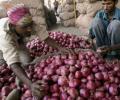
In the retail markets, fresh onion is sold between Rs 10 and Rs 12 a kg. Now, farmers have to sell onion at a loss of Rs 2-3 per kg if transport cost is included.
 © 2026 Rediff.com - Investor Information - Advertise with us - Disclaimer - Privacy Policy - Sitemap - Feedback - About us - Terms of use - Grievances