The US has temporarily permitted India to accept Russian oil already on ships to ensure energy supplies amid the conflict with Iran. This short-term measure is not expected to significantly benefit Russia financially.

United States President Donald Trump has brushed aside French President Emmanuel Macron's call for an emergency G7 meeting amid escalating tensions over Washington, DC's push to acquire Greenland, while Europe has warned of retaliatory trade action against US tariff threats.

The European Union (EU) has suspended export benefits to sectors such as textiles and plastics under a preferential scheme for India and two other countries from January 1, a move that will impact the country's shipment to the 27-nation bloc. The development is important as the two sides are likely to announce the closure of negotiations for a free tarde agreement (FTA) on January 27.
There were apprehensions that additional secondary tariffs would have hit India in case the US decided to enforce them.

The additional 25 per cent tariff imposed by US President Donald Trump on India is set to deliver a major blow to West Bengal's export-driven economy, with the state's labour-intensive leather, engineering and marine sectors expecting losses ahead of the festive season, stakeholders said. The increased levies on Indian products for the country's purchases of Russian oil came into effect on Wednesday, bringing the total amount of tariff imposed on New Delhi to 50 per cent.

As the potential threat of a steep 200 per cent tariff on pharmaceutical imports hangs in the air, analysts and industry insiders feel that focus on exports to non-US regions as well as domestic market will increase as a long-term trend. US President Donald Trump told CNBC's Squawk Box in the first week of August that planned tariffs on import of pharmaceutical products to the US could eventually reach up to 250 per cent.

India will maintain multiple sources for crude oil purchases and diversify them to ensure stability in the supply chain with national interests remaining the "guiding factor" for the procurement, Foreign Secretary Vikram Misri said.

'The US reciprocal tariff has added another element of uncertainty and the central bank may prefer to wait and get further clarity.'
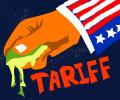
India needs to come together to deal with the 50 per cent punitive US tariffs on Indian products and stand up to any kind of bullying, Maruti Suzuki India chairman R C Bhargava said on Thursday. "It is our duty as Indians to do our very best to promote and maintain our dignity and respect and not give in to any kind of bullying in this matter... the nation has to stand united," Bhargava said at the company's 44th Annaul General Meeting in New Delhi.
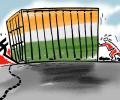
The USA's steep 50 per cent tariffs on Indian goods entering America will severely impact exports and job creation in labour-intensive export sectors such as shrimp, apparel, leather and gems and jewellery. Exporters said that the imposition of a 25 per cent penalty on India over and above the 25 per cent tariffs move will disrupt the flow of Indian goods to its largest export market.

Foreign portfolio investors (FPIs) withdrew a substantial amount from Indian equities in the first half of March, driven by geopolitical tensions, rupee depreciation, and concerns about crude oil prices.

A senior Russian diplomat has called the US pressure on India for its procurement of Russian crude oil "unjustified," expressing confidence in continued energy cooperation between India and Russia despite external pressures.

Stock market benchmark indices Sensex and Nifty surged in early trading session on Tuesday after India and the US agreed to a trade deal under which Washington will bring down the reciprocal tariff on Indian goods to 18 per cent from current 25 per cent.
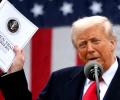
The additional 25 per cent duty will come into effect after 21 days or August 27.

The steep 50 per cent tariffs imposed by the United States on Indian goods are largely a result of President Donald Trump's 'personal pique' at not being allowed to mediate in the India-Pakistan conflict, according to a recent report by American multinational investment bank and financial services company Jefferies.

President Trump is celebrating the US-India trade deal as a landmark achievement, with a major focus on boosting American coal exports to India and other trade partners.

To shield against US President Donald Trump's tariff shock, analysts have been advising investors to focus on stocks of domestic-oriented companies, rather than export-centric ones, to minimise potential losses.

The Swiss government would not object to tennis legend Roger Federer or FIFA President Gianni Infantino intervening to reduce the country's tariff burden after the US slapped a 39 percent import duty on its goods, President Karin Keller-Sutter said.

Putin further described the Ukraine conflict as a mere "pretext" by Western powers to take these broader punitive measures against countries maintaining strong economic ties with Russia.

If pharmaceutical exports from India to the US come under a 25 per cent tariff bracket, the impact on earnings before interest, tax, depreciation and amortisation (Ebitda) could be around 5 per cent, felt analysts. This is after assuming that about 75 per cent of the tariff would be passed on.

India has been on an FTA-signing spree of late. Since 2021, it has signed eight trade agreements, three of which -- with the UK, Oman and New Zealand -- were finalised in 2025 alone.

US President Donald Trump greeted India on its 77th Republic Day, highlighting the historic bond between the two democracies amid ongoing trade tensions.

Sitharaman in her budget speech said that the customs proposal "aim to further simplify the tariff structure, support domestic manufacturing, promote export competitiveness, and correct inversion in duty".
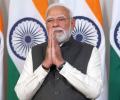
Modi's remarks came hours after the US and India agreed on a trade deal under which Washington will bring down reciprocal tariff on Indian goods to 18 per cent from current 25 per cent.

'India has the deciding vote in the 21st century...India is a significant player in the 21st century and is poised to become even more powerful.'

Exporters of gems and jewellery have said the free-trade agreement (FTA) has brought relief to their sector because this opens up the world's second-largest market and brings them on a par with China and Thailand, which face zero tariffs on shipments to Europe.

Customs regimes can lead to labyrinthine legal disputes. Budget 2026 must recognise that an excessively defensive Customs posture can itself become a trade barrier, point out Mukesh Butani and Shankey Agrawal.

US President Donald Trump's announcement of 25 per cent tariff on all goods coming from India starting August 1, plus an unspecified penalty, is expected to impact Apple's plans to expand iPhone manufacturing in India as well as export of other electronics to the US. The move comes at a time when Indian electronics production is reeling under pressure due to restrictions imposed by China on supply of several critical components, capital goods and even skilled technology professionals.
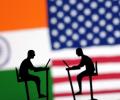
US President Donald Trump has announced a 25 per cent plus tariff on India from Aug 1. Trump, describing India as a "friend", said the US has done relatively "little business" with the country because of its high tariffs.
According to the Economic Survey 2026, the appropriate stance for 2026 is therefore one of strategic sobriety rather than defensive pessimism.

In the wake of the FTA between India and the European Union, the United States has described the Europeans as 'very disappointing', saying they were unwilling to join Washington, DC in putting tariffs on New Delhi for its purchases of Russian oil because of this trade deal.
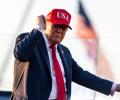
President Trump threatens to impose a 10% tariff on countries aligning with BRICS anti-American policies. This follows BRICS criticism of increased tariffs. Trump also announced tariff letters to various countries.

India's merchandise exports experienced a slight decrease in February, while imports surged due to increased gold and silver purchases, leading to a widened trade deficit. The West Asia crisis is expected to further impact trade in the coming months.

India's economy experienced a growth of 7.8 per cent during the October-December quarter of 2025-26, according to the new series of national accounts with 2022-23 as the base year.

India's micro, small and medium enterprises (MSMEs) - which contribute over 45 per cent to outbound shipments - are facing a major disruption following the United States (US) decision to impose 50 per cent additional tariffs on the country's exports. MSME industry bodies have raised an alarm over the deep impact, seeking immediate government intervention.

Lavrov said that the US has set itself the objective of 'achieving economic domination', adding further to it that Americans want to control the routes to leading countries to provide its energy sources to them.

The 50 per cent US tariff on Indian goods pose a downside risk to growth but the impact is expected to be short-lived for the economy, and consumption demand could see an uptick after the new goods and service tax (GST) rates are implemented which could even offset the external uncertainty, Chief Economic Advisor (CEA) V Anantha Nageswaran reckoned on Friday.

United States President Donald Trump has said Prime Minister Narendra Modi 'knew he was not happy' with India's purchases of Russian oil and that Washington, DC can raise tariffs on New Delhi 'very quickly'.

Macroeconomic data, global geopolitical developments and rising concerns over AI-related disruptions are likely to dictate sentiment in the stock market next week, even as investors may remain cautious amid ongoing volatility, according to analysts.
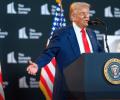
He added that India sells to the US, its biggest "client", "massive" amounts of goods, "but we sell them very little - Until now a totally one sided relationship, and it has been for many decades."
