
Bank shares were the top gainer in early trades with Bank of Baroda up over 4%.

Global equity research firm Standard & Poor's has projected a significant jump in the American Depository Receipts

'Markets are not expensive; they are fairly priced.'

Recently, TPEM's first born electric concept, Avinya broke cover. The model promises a minimum range of 500 kilometres and advanced technology features, aimed at buyers in India and outside. TPEM, the newly formed entity may also consider a separate dedicated sales channel for the EVs with a distinctive corporate identity once the volumes reach a critical mass and throughput is large enough for the dealers to be profitable, said Chandra. Elaborating further on the hiring strategy he said, "We will hire from everywhere-wherever the talent of the required competency is available."
ITC, Sun Pharma, Cipla and Tata Steel were top gainers on BSE Sensex
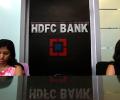
Growing concerns over slower-than-expected margin recovery, amid weak deposit growth have caught HDFC Bank's investors off guard. HDFC Bank's stock on Wednesday plunged nearly 9 per cent to hit an intraday low of Rs 1,527 on the BSE after reporting weaker-than-expected earnings in the third quarter (October - December) of the current financial year (Q3FY24). The shares of India's biggest private lender closed at Rs 1,536.9, down 8.46 per cent.

Nifty50's earnings growth, estimated at 20 per cent by global research and brokerage firm Jefferies for financial year 2023-24 (FY24), will be amongst the top three in the Asian region, and is likely to outperform peers. Asean 40 index with 29.1 per cent estimated earnings growth and Straits Times Index (STI) with 29.1 per cent estimated earnings growth are the only two other indices in the Asian region that are likely to outperform India, suggests the recent Jefferies report, coauthored by Mahesh Nandurkar, their managing director along with Abhinav Sinha and Nishant Poddar.

Investment banking star and Moelis India Chief Executive Officer Manisha Girotra remembers a colleague who wanted to resign because she needed to attend to her parents' health issues in a different state. Rather than quit a promising career, she was given the flexibility of working from home on Fridays, which was unusual in the pre-pandemic days. This allowed her to take care of her parents' visits to the doctor and other health-related needs without quitting her job. She would be back in the city office on Mondays.
The S&P BSE 500 index, which accounts for 94% market capitalisation of BSE listed companies, has gained 45% from its March 24 low. However, out of the BSE 500 index stocks, 225 have underperformed the index by gaining less than the broader index during this period.
The S&P BSE Midcap and the S&P BSE Smallcap indices gained 0.3% and 0.5%, respectively
Debt management is going to be a worry for the Vedanta group until FY25 at least. However, the restructuring of business divisions in Vedanta India could lead to an unlocking of values. The group structure is fairly complex. Anil Agarwal-led Vedanta Resources (VRL), which is London-listed, has a lot of debt on the balance sheet. It will have to repay $1 billion in secured bonds by January 2024 and at least another $300 million in calendar 2024.

The Reserve Bank of India's latest order prohibiting Bajaj Finance from sanctioning and disbursing loans under its 'eCOM' and 'Insta EMI Card' products may not have serious implications on the non-banking finance company's profitability, provided the ban is lifted within six to eight weeks, analysts said. "In a surprise move, the RBI has asked Bajaj Finance to stop sanction and disbursal under two of its digital lending products. "While the move is negative, the speed of correction will be key to reinstate products," global brokerage Jefferies said in a report.

The sharp rally in the broader markets has propelled India's market capitalisation (m-cap) to a new high. The combined m-cap of all BSE-listed firms rose to Rs 291.9 trillion in intraday trade on Thursday before settling lower at Rs 290.9 trillion. The previous record was on December 14, 2022, at Rs 291.3 trillion.

The decline of over 5 per cent in PB Fintech's shares (the parent company of PolicyBazaar) in the past two days presents an opportunity for long-term investors to consider buying the stock, suggest analysts. By comparison, the benchmark S&P BSE Sensex has remained flat during the same period with a negligible gain of 40 points, or 0.06 per cent. Analysts believe that the recent selling is "overdone", as the company behind the online insurance portal remains committed to achieving profitability, and the potential threat from the government's online insurance portal, Bima Sugam, might be embellished.

Investors indulged in buying beaten down blue chips at lower and attractive levels.

The S&P BSE Sensex plunged 128 points to end at 25,102.

At an aggregate level, the late ace investor's portfolio that was valued at Rs 32,445 crore as on March 31, 2023 is now worth Rs 35,979 crore.

Sentiments took a hit after broader Asian markets weakened, following a renewed sell-off on Wall Street on Tuesday as energy shares dropped after crude oil prices plunged to a 13-month low amid weak earnings and US-China trade disputes, fuelling worries about economic growth

The Indian indices also offer one of the lowest dividend yields.

Banks stocks continued to trade weak along with FMCG major ITC.

Financials were the top losers while oil shares also declined amid weak crude oil prices.

Traders are closely watching the progress of the monsoon.

Fresh buying by domestic institutional investors and better-than-expected June quarter results from some blue-chip companies boosted investor sentiment
HDFC Bank Q1FY24 results analysis: Shares of HDFC Bank, the world's seventh largest financial entity, have advanced 2 per cent in two days, as against 1 per cent rise in the benchmark S&P BSE Sensex, after the lender reported its April-June quarter (Q1) results for financial year 2023-24 (FY24) on July 17. The S&P BSE Bankex index, meanwhile, has gained 1.3 per cent. While the near-term stock performance may remain sideways due to merger-related hiccups, analysts remain bullish on the stock's long-term prospects.

Top 5 losers include Infosys, TCS, ITC, M&M and HUL.

Investors became poorer by over Rs 4.47 lakh crore on Friday as markets faced severe drubbing, mirroring weak trends in global equities. The 30-share BSE benchmark dived 866.65 points or 1.56 per cent to settle at 54,835.58. During the day, it tumbled 1,115.48 points or 2 per cent to 54,586.75.
However, investors have turned cautious over the likelihood of Britain leaving the European Union.

The S&P BSE Sensex ended up 28 points at 25,844 and the Nifty50 ended flat at 7,915.

FII stance, progress of monsoon, crude oil and rupee movement are likely to dictate the trend.

The BSE Midcap and Smallcap indices underperformed the largecaps and ended over 1% lower.

Indian investments in equity and debt account for the second-highest remittances outgo (about a quarter).
Investors engaged in profit booking in the recent gainers at attractive and higher valuations.
Broader market outperformed the frontline indices with the Smallcap and Midcap gaining up to 1%

Capital goods shares continued to trade firm in late noon despite weak market trend on the back of encouraging core sector growth in February.

Shares of telecom services providers - Reliance Industries (parent of Reliance Jio), Bharti Airtel, and Vodafone Idea - have shed up to 23 per cent so far in the current calendar year as growth in the wireless subscriber segment begins to plateau amid higher tariffs and rising costs of smartphones. By comparison, the benchmark S&P BSE Sensex, and sectoral index BSE Telecom have dipped 1.8 per cent, and 12.6 per cent, respectively, ACE Equity data shows. However, analysts expect the trend to reverse soon as telecom services providers focus on the next leg of growth -- fixed broadband (FBB) segment.
ICICI Bank was the top gainer after stable rating for its senior unsecured bonds by S&P Global Ratings.
Infosys was the top Sensex loser along with other index heavyweights ITC and HDFC.
HDFC Bank Q4 review: HDFC Bank's January-March quarter (Q4) results, for financial year 2022-23 (FY23), brought no cheer to investors as elevated costs, and merger-related uncertainties continue to dent the sentiment. Moreover, analysts fear that merger-related costs may put pressure on margins and cost to income ratio in the near-term, while the return on equity could moderate owing to low leverage of the parent. Analysts, therefore, opine that the stock's re-rating may be some time away. "While the risk of a de-rating on a standalone basis appears to be quite low given that the business performance is holding up well, we believe a re-rating in the stock would happen as and when more clarity emerges on the smooth transition (merger)," said a report by Sharekhan.

The S&P BSE Sensex surged 217 points to end at 25,736.

The S&P BSE Sensex dropped 207 points to end at 25,230.
 © 2026 Rediff.com - Investor Information - Advertise with us - Disclaimer - Privacy Policy - Sitemap - Feedback - About us - Terms of use - Grievances